PrologueA Petition 270 Metres Long
On 19 September 1893, Lord Glasgow, Governor of New Zealand, signed a new Electoral Act into law. From that day, this self-governing colony at the bottom of the Pacific became the first country in the world to guarantee women the right to vote in parliamentary elections by law.[1] Before the bill reached Parliament, thirteen petitions bearing 31,872 signatures were laid out on the floor of the debating chamber — the largest of them 270 metres long, signed by about a quarter of the country's adult women.[1] That same year, women went to the polls for the first time: in the general election of 28 November, 109,461 women enrolled to vote, about 80% of those eligible, and 90,290 of them cast a ballot — a turnout of 82%, higher than the 70% recorded among men.[2]
The petition carried no weapons and made no threats. It was only a list of names — absurdly long, too long to pretend not to see. Faced with 270 metres of names, a parliament finally admitted a simple fact: half of the people it governed had never been counted among "the people" at all. This is the story of how that half wrote their names, one by one, into the definition of democracy.
This is not a story about kindness. No parliament ever gave way because it suddenly became kind. It is a story about organisation, patience, shame, and timing — about people with no power making it more expensive for the powerful to keep refusing than to give in.
Chapter OneSeneca Falls: A Meeting People Laughed At
On 19 July 1848, about 300 people squeezed into a small Wesleyan chapel in Seneca Falls, New York, for a convention "to discuss the social, civil, and religious condition of woman."[4] It was the first women's rights convention in the United States organised by women. Over two days, 100 people — 68 women and 32 men — put their names to a document.[4]
The document was the Declaration of Sentiments, drafted chiefly by Elizabeth Cady Stanton. She rewrote the Declaration of Independence almost word for word: "We hold these truths to be self-evident: that all men and women are created equal." It listed eighteen grievances: married women owned no property, could not attend university, were barred from most professions, and were disadvantaged in divorce and child custody — and the most contentious of all was the vote.[4]
Even the people in the room were frightened of that one. Lucretia Mott urged Stanton to drop it, fearing it would drive everyone away; in the end it was the abolitionist Frederick Douglass who spoke up for it, and the resolution passed only narrowly.[4] The newspapers of the day treated the convention as a joke. It took a joke 72 years to become a constitution — from 1848 to 1920, American women waited 72 years.[8]
Seneca Falls matters not because it changed anything on the spot — it changed nothing. It demonstrated a new political technique: gather people who have each been suffering alone into one room, and let them discover that what they endure is not fate but a system. One person suffering is a private matter. Three hundred people saying it together is politics.
Chapter TwoFrom Petitions to Hunger Strikes
Petitions worked, but far too slowly. British women had petitioned Parliament every year since the 1860s, and every year the answer was the same: wait. On 10 October 1903, Emmeline Pankhurst founded the Women's Social and Political Union (WSPU) in her Manchester home, under the motto "Deeds, not words." They would no longer ask. They would compel.[5]
The WSPU escalated step by step: marches, window-smashing, arson, hunger strikes. Women arrested and imprisoned went on hunger strike; the government force-fed them. On 25 April 1913, Parliament passed the Prisoners (Temporary Discharge for Ill-Health) Act, known everywhere as the "Cat and Mouse Act": a hunger striker could be released when her health failed, then rearrested to finish her sentence once she had recovered.[6] One law turned the state into the cat and the women into mice.
On 4 June 1913, at the Epsom Derby, 40-year-old Emily Davison ducked under the rail and stepped towards Anmer, the horse of King George V, trying to seize its reins. The horse knocked her down and trampled her. She suffered a fractured skull and died in hospital four days later, on 8 June.[6][7] She left no note, and nobody knows what she meant to do — kill herself, stage a protest, or simply pin a flag to the King's horse. The coroner returned a verdict of accidental death.[6] At her funeral on 14 June, 5,000 women in white escorted the coffin while 50,000 people lined the streets of London.[7]
Davison's death won no votes overnight. But it won something else: attention. What a movement fears most is not opposition but indifference. The WSPU used their bodies to move "women have no vote" from a parliamentary memorandum to the front page of the newspapers. The price was that a 40-year-old woman had to die in full public view to earn a single headline.
Chapter ThreeWon by a Single Vote
What finally rewrites the law is rarely the most heroic moment. It is usually the most pragmatic calculation. When the First World War ended, the British Parliament faced a practical problem: millions of men had served overseas, the old electoral registers were obsolete, and they had to be rewritten. On 6 February 1918, the Representation of the People Act passed: all men over 21 gained the vote, and for the first time so did women over 30 who met a property qualification — about 8.4 million of them.[5] Ten years later, on 2 July 1928, the Equal Franchise Act lowered the voting age for women to 21, on the same terms as men, and the number of women voters rose to 15 million.[5]
Note that threshold of 30. It was not chosen at random. The war had left women greatly outnumbering men, and MPs had done the sums: give every adult woman the vote, and women would instantly become a majority of the electorate. The age bar of 30 was a precisely calculated concession — enough to quiet the protests, not enough to overturn the balance of power. Rights are rarely granted in full at once; they usually arrive in instalments, and the size of each instalment is worked out by those already in power.
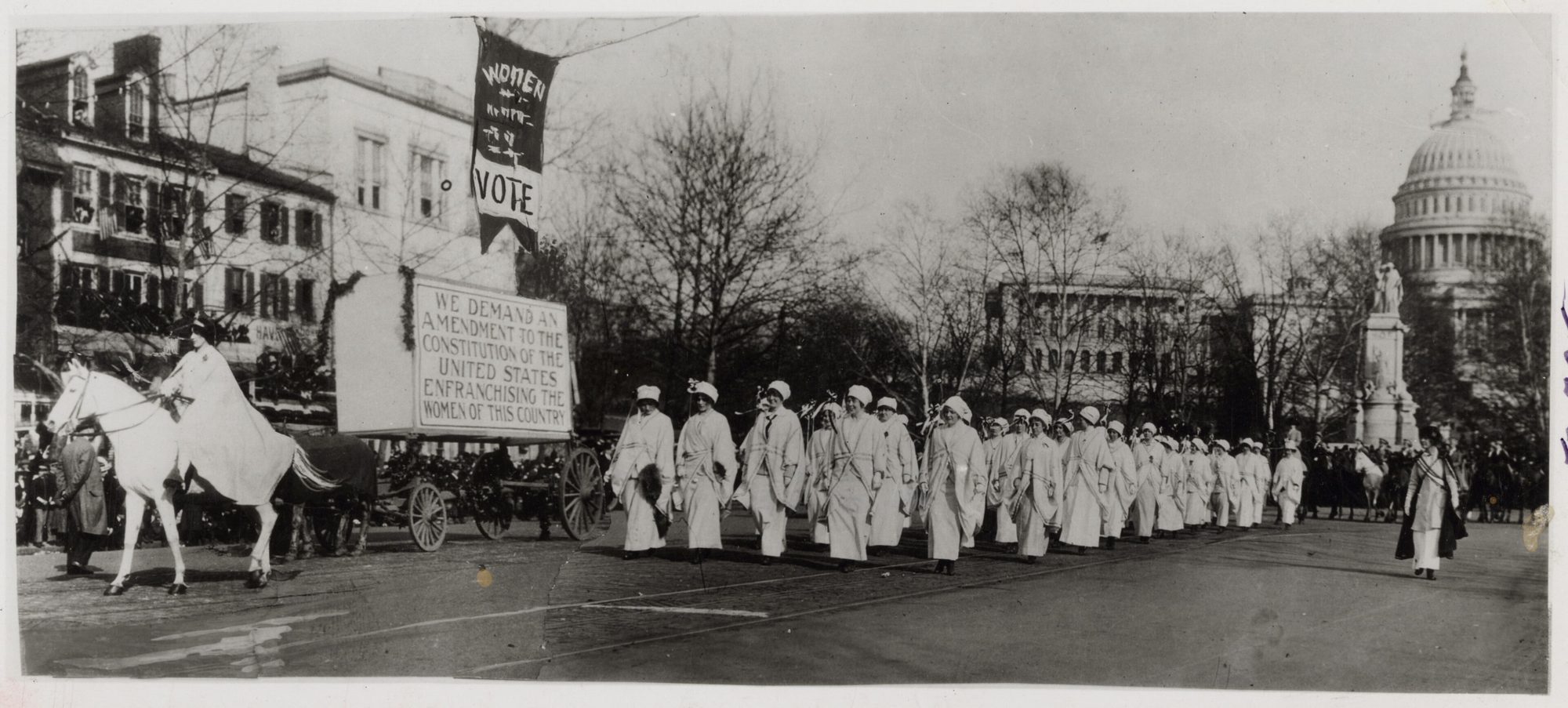
The American ending was more dramatic still. On 4 June 1919, Congress passed the Nineteenth Amendment, a single sentence: "The right of citizens of the United States to vote shall not be denied or abridged by the United States or by any State on account of sex."[9] It needed 36 states to ratify. By August 1920, 35 had done so, and only Tennessee remained. On 18 August, the Tennessee House voted, and 24-year-old Harry Burn changed his vote to aye when his name was called — he was carrying a letter from his mother in his pocket: "Be a good boy and vote for ratification." The final tally was 50 to 49, a single vote.[8] On 26 August the amendment took effect, and about 26 million American women gained the vote.[8][9]
Burn's vote is often told as a heartwarming story. What it really shows is something else: democratic change rarely happens where ideals are purest. It happens at the most fragile seams of the system — one state legislature, one roll call, one young man who has not yet decided which side he is on. The whole work of a movement is to push the country up against that seam.
Chapter FourAfter Victory, Who Still Had No Vote?
After 1920, the story is often told as "from then on, women had the vote." That is wrong. The Nineteenth Amendment said only that the vote could not be denied on account of sex. It said nothing about poll taxes, literacy tests, or white primaries. Black women in the American South waited another 45 years, until the Voting Rights Act of 1965, before they could actually vote.[8] Between a right written on paper and a ballot that goes into the box lies a whole generation.
Elsewhere it was slower still. France — home of the Declaration of the Rights of Man — did not grant women the vote until 1944, and they first voted in 1945. Switzerland opened the vote to women at the federal level only in 1971, and its last canton, Appenzell Innerrhoden, did not follow until 1991. Women in Saudi Arabia first voted and stood for office in municipal elections in December 2015 — and women cast only about 10% of the ballots in that election.[10] In Taiwan, women's suffrage was written into the 1947 Constitution of the Republic of China — but the years between a constitutional right and its real exercise were still turbulent ones.[10] The year a right is written down and the year it actually arrives are often two different years.
Finland was the exception that proves the rule: in 1906, still a Grand Duchy within the Russian Empire, it became the first country in the world to give women both the vote and the right to stand for office.[10] Exceptions are worth mentioning precisely because they are so rare. The usual script ran the same way everywhere: half first, then the other half; the cities first, then the countryside; white women first, then everyone. Behind every "at last" there was still another "not yet."
Chapter FiveWhat Is a Ballot, Really?
Why is a slip of paper worth 72 years? A ballot cannot be eaten, cannot cure illness, cannot raise a wage. Its value is not in what it can be exchanged for, but in what it represents: a person counted among "the people."
Democracy has a cruel logic: anyone who is not on the electoral roll does not exist in political arithmetic. Politicians need not court people who do not exist; budgets need not provide for people who do not exist; laws need not leave room for people who do not exist. What women were fighting for was never just a ballot. It was a ticket to be counted — so that from then on, anyone who wanted to win an election had first to ask: what do women voters think?
This also explains what the opponents were really afraid of. It was never women voting. It was what would happen after women voted: the pubs would close, the factories would be regulated, the schools would change. A ballot is a key, and behind the door lies a renegotiation of the whole society. Those who defended the door were not guarding a slip of paper. They were guarding the entire house behind it.
And the supporters learned the most important lesson of all: rights do not arrive because they "should." They arrive because a group of people keeps making refusal more expensive than consent — with the length of a petition, the overcrowding of prisons, the front pages of newspapers, the arithmetic of elections. Moral argument decides who is right. Cost decides when it happens.
EpilogueA Sentence Not Yet Finished
In New Zealand in 1893, women's turnout was 82%, higher than men's 70%.[2] Most of the women who walked into a polling station for the first time that day would not live to see a woman become prime minister. But the votes they cast had already rewritten the arithmetic of every election that followed.
Today, women can vote in almost every country in the world. That sounds like an ending, but it is only the first half. The vote settles who gets into the room; it does not settle who speaks once inside — and the share of women in parliaments around the world is still far below half. The 270-metre petition of 1893 finished the first sentence, not the last one.
Democracy was never a document written once and for all. It is a list of names that keeps being added to, and every name added changes what the document means. The 100 signatures at Seneca Falls, the 31,872 in New Zealand, the single vote in Tennessee — they are all the same gesture: one person standing up to say, I am here too. Count me in.