PrologueA Book Its Author Never Wrote
On 31 May 2018, the Silicon Valley investor Naval Ravikant posted a thread of about 40 tweets titled "How to Get Rich (without getting lucky)".[4] It spread through the tech world within days. Two years later, the writer Eric Jorgenson gathered those tweets, along with podcasts and interviews, into a book — The Almanack of Naval Ravikant.[2]
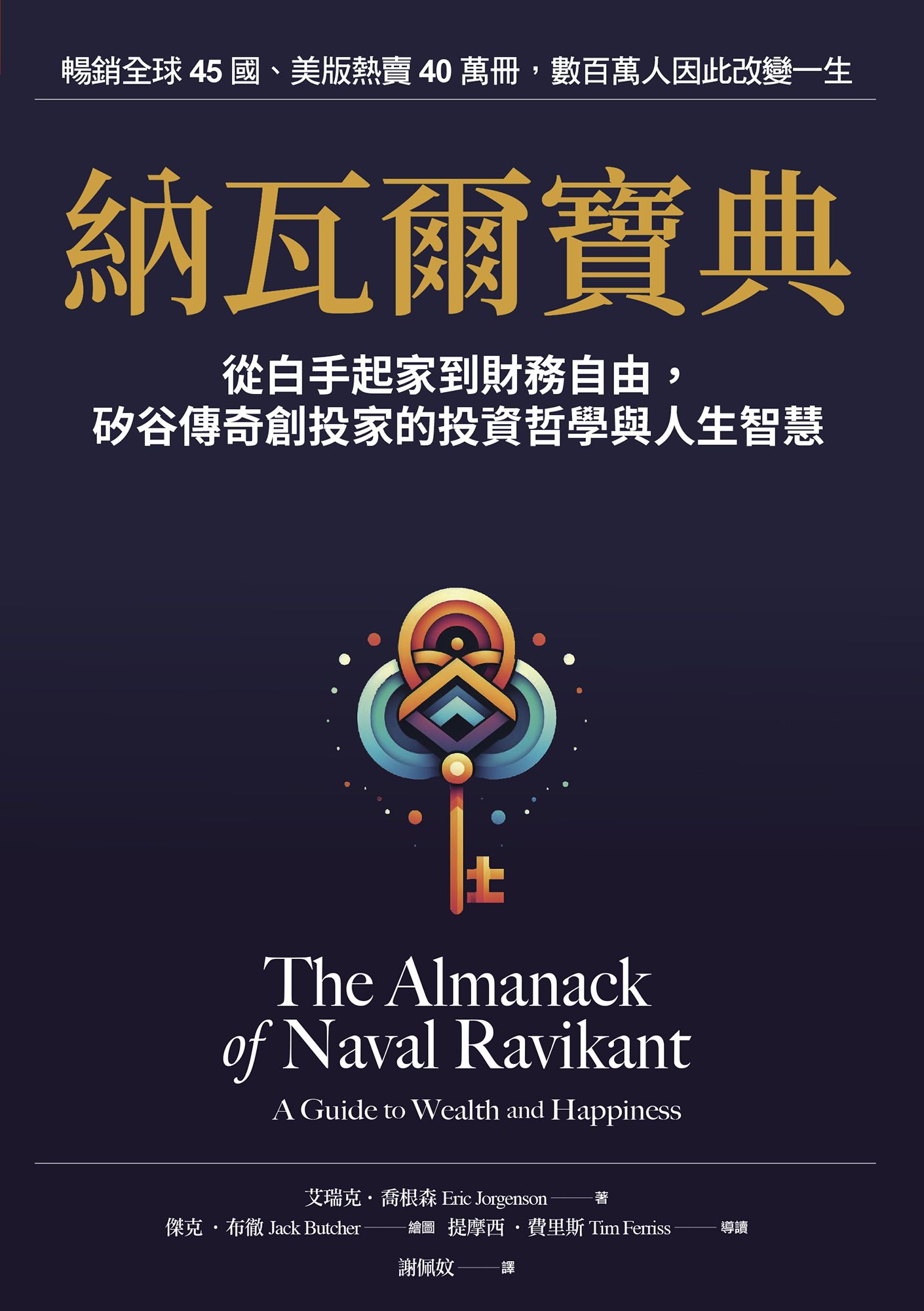
The book has a peculiar biography: its protagonist did not write it, and its editor is not him. Even the word "Almanack" in the title is borrowed. In America, a book that gathers one person's lifetime of wisdom is called an almanack — from Benjamin Franklin's Poor Richard's Almanack to Charlie Munger's Poor Charlie's Almanack, the tradition runs deep. The English edition came out in September 2020, its full text free on the internet for anyone to read; the Traditional Chinese edition followed in January 2024 from Commonwealth Publishing (天下雜誌), 288 pages, priced at NT$450.[1]
A free book should not, by rights, sell. In Taiwan it became a champion: No. 1 on Rakuten Kobo's 2025 list of the 100 bestselling e-books, No. 1 on Readmoo's 2025 annual list, and still at the top of Kobo's Taiwan chart in the first half of 2026.[8][9][11] The cover proclaims "a bestseller in 45 countries, 400,000 copies sold in the US" — that is the publisher's copy, but the Taiwanese charts are real.[6] Why would anyone pay for a book that is free? Half the answer is inside the book. The other half is outside it.
Chapter OneFirst, Tell Them Apart: Wealth, Money, or Status
Naval's first move is a distinction: "Seek wealth, not money or status. Wealth is having assets that earn while you sleep. Money is how we transfer time and wealth. Status is your place in the social hierarchy."[2] In everyday conversation the three words blur together; he insists on pulling them apart, because blurring them makes you chase the wrong thing.
Status is a zero-sum game: someone climbs only by pushing someone else down, and your position is always decided by others. Wealth is different — it is a positive-sum game. A company can make its founders, its employees, and its shareholders rich at the same time, with nobody standing on anybody else. That explains why people who chase status are always anxious: the ladder has no top, and those who climb it still have to watch for the people climbing behind them.
The difference between money and wealth is the difference between a job and an asset. A salaried job is renting out your time, and no hourly rate escapes the ceiling — there are only 24 hours in a day. Wealth is owning something that runs on its own: equity, code, media, intellectual property — things that work while you sleep. Naval himself is living proof of the distinction: he has invested in more than 200 companies, including Uber and Twitter, and he got there not on a salary but on equity he started owning early.[5]
Behind the distinction sits a question of priorities. The book says wealth, health, and happiness are the three great pursuits of life, and we rank wealth first and happiness last — when their true importance runs the other way around.[1] Another way of putting it became one of the most highlighted lines among Readmoo's readers: "Money can buy you freedom in the material world. But money won't make you happy, and it won't solve your health problems."[9] A book about getting rich that opens by reminding you wealth is not the most important thing — that is precisely what makes it unlike other books about getting rich.
Chapter TwoSpecific Knowledge, Accountability, Leverage — Three Parts of Getting Rich
If you compress Naval's wealth lesson into one formula, it reads like this: wealth equals specific knowledge, times accountability, times leverage. All three parts are necessary, and the order matters.
Specific knowledge is the hardest of the three to grasp. It is not a degree or a licence; it is knowledge that cannot be trained — something that grows only out of genuine curiosity and hands-on practice. Naval's test is cold: if society can train you, it can train someone else to replace you. The opposite of specific knowledge is replaceability.
Accountability means putting your own name on the outcome. In a world where everyone hides behind an organisation, a person willing to be named, to bear responsibility, to let their reputation ride on the result, is itself a scarce resource. Reputation here is not vanity; it is the collateral for leverage. People hand you money and opportunity because your name is worth something.
Leverage is the last part, and the most decisive. Naval divides it into four kinds: labour, capital, code, and media. The first two are the old levers, and they need someone else's permission — people willing to follow you, people willing to fund you. The last two are the new levers: they need nobody's permission, and their marginal cost is close to zero. Write a piece of code once, record one podcast, publish one essay, and it can serve countless people, working while you sleep.[4]

That this argument went viral after 2018 is no accident. In that decade, code and media — the two new levers — became available to ordinary people for the first time. Writing code, starting a channel, publishing a newsletter: the cost fell toward zero. The book went big because it named a structural change of its era: for the first time, an ordinary person could own leverage without an organisation and without capital, with nothing but a computer.
Naval took leverage to its extreme, even into law. In 2012, he helped push through changes to the US JOBS Act, letting startups raise money publicly from ordinary people — leverage turned from a personal tool into infrastructure for everyone.[7]
The same logic explains his most quoted line: "Escape competition through authenticity."[1] Competition is exhausting because everyone is racing on the same track at the same thing; the authentic self cannot be copied — nobody can compete with "you", because there is no second you. Rather than fight for a place in someone else's game, switch to a game only you can play, a long-term game: play long-term games with long-term people.
Chapter ThreeLuck Comes in Four Kinds
The title says "without getting lucky", yet the book spends a whole section on luck. That is not a contradiction; it is the book's most honest passage. Naval divides luck into four kinds: blind luck, luck that finds you because you hustle, luck that finds you because you are prepared to notice it, and luck that finds you because of your unique character. The last kind compounds, and after long enough it looks like destiny. The classification is borrowed from the physician James Austin's Chase, Chance, and Creativity (1978).[10]
The title says do not rely on luck; the text teaches you to cultivate it. Naval's answer is that the first kind is out of your hands, but the other three are yours to work on. Run around more, do more, let more people see what you are doing, and the odds of an opportunity colliding with you go up. Go deep enough in one thing, and you will see opportunities others cannot. Live as a distinctive brand, and opportunities will come looking for you.
But this is also where the book is most vulnerable. Naval himself is a beneficiary of the first kind of luck: born in New Delhi in 1974, moved to New York with his mother at nine, Stuyvesant High School, a double degree in computer science and economics from Dartmouth, co-founder of Epinions in Silicon Valley in 1999, co-founder of AngelList in 2010.[5] Every step involved choices, and every step also involved luck — which family you are born into, which era you live in, which city you walk into. He does not deny it; the book admits the first kind of luck is real. But when readers close the book remembering only the four words "without getting lucky", that admission is easy to forget.
Chapter FourHappiness Is a Craft
The second half of the book changes the subject: happiness. Naval's definition is unusual — happiness is not something you gain, but what remains after you take something away: "Happiness is what's there when you remove the sense that something is missing in your life."[2] In other words, happiness is subtraction, not addition.
"Desire is a contract that you sign
to be unhappy until you get what you want."
This is the most quoted line in the whole book. Naval does not ask you to eliminate desire — he thinks that is unrealistic — but to choose carefully: keep one desire at a time and set the rest down. Every extra desire is one more contract to be unhappy. The practice of happiness is not getting more, but signing fewer contracts.
His other formulation is this: peace is happiness at rest, and happiness is peace in motion. Meditation, in his words, is "intermittent fasting for the mind" — deliberately leaving blank space so the mind has time to repair and notice.[6]

The happiness half is harder to write than the wealth half, and more contested. Getting rich can be broken into steps — specific knowledge, accountability, leverage, one after another. Happiness can only be broken into attitudes: no steps, no data, no studies cited. The book contains not a single paper, not one experiment, only aphorisms. That is its strength — it reads effortlessly, and every line can be carried away — and also its limit: when you ask "does it actually work?", the book has no answer, only the author's own testimony.
Reading is Naval's cheapest lever, and the habit he mentions most. According to the author's biography in the book, he treated the library as an after-school care centre as a child, and his love of learning carried him into a top school.[7] Taiwanese readers have noted on Books.com.tw that this rendering reads a little stiff in places — a small reminder that the Chinese edition is not without flaws: however good the ideas, they still have to pass through translation.[6]
Chapter FiveWhat the Book Does Not Say
The most rewarding part of reading a bestseller is often not what it says, but what it leaves out. There are three things The Almanack of Naval Ravikant does not say, and knowing them first makes for a clearer read.
First, survivorship bias. Naval has invested in more than 200 companies; we remember Uber and Twitter and forget most of the other 200. This book is a successful sample dissecting itself, not a randomised trial. Its advice comes from one person's career, not from statistics.
Second, the starting point. Stuyvesant, Dartmouth, Silicon Valley in the late 1990s — his specific knowledge grew in a particular soil. For someone without those starting points, "follow your curiosity" sounds right and costs a lot to execute: curiosity needs room to fail, and room to fail is not something everyone has. The book does not deny this, but it does not seriously deal with it either.
Third, "specific knowledge" is a little circular. How do you know what your specific knowledge is? The book's answer is to follow your curiosity; but before curiosity grows into specific knowledge, how do you know it is worth following? Naval's answer is hidden in time: keep at it long enough to become irreplaceable, and looking back, that road was your specific knowledge. The answer is right — but it only becomes visible after the fact.
One more thing is worth saying: the book is its own best proof. Its full text is free, yet it became a bestseller — the cleanest demonstration of media leverage. Free is not charity; it is leverage. Give value first, and reputation and opportunity come looking for you. Jorgenson turned a tweet thread into a book, Naval turned a life into a tweet thread, and readers turned a book into a way of living. Leverage stacked on leverage, until it is no longer clear who is the lever and who is the fulcrum.
Questions Without Answers
For honesty, two things in this essay have no reliable answer, and we will not pretend otherwise:
- "400,000 copies sold in the US" is the cover and the publisher's claim; no independent third-party sales figure is available to check it against, and the publisher has not disclosed the Chinese edition's actual sales in Taiwan.
- Of Naval's portfolio, how many companies succeeded and how many failed has never been published in full; "more than 200" comes from him and from public reporting, and cannot be verified company by company.
EpilogueAfter the Book Goes Back on the Shelf
The most valuable thing about this book is not its quotable lines, but the question it swaps in. Do not ask "how do I make more money"; ask "what do I want to own, and who do I want to become". The first question is answered by overtime and speculation; the second by specific knowledge, accountability, and leverage — slower by far, and it travels much further.
If you could take only three things from this book, they would be these: own something that works while you sleep; sign only one desire contract at a time; play long-term games with long-term people. None of them is hard to understand. Each takes many years.
The book sells so well in Taiwan perhaps not because Taiwanese readers are especially eager to get rich, but because it answers two questions at once — how to be rich, and how to be happy. Most books answer only one, and life insists on both. Once the book is back on the shelf, the real work begins: not reading another book about getting rich, but finding one thing worth doing for ten years, and doing it.