PrologueDecember 10, 1513: A Letter Home
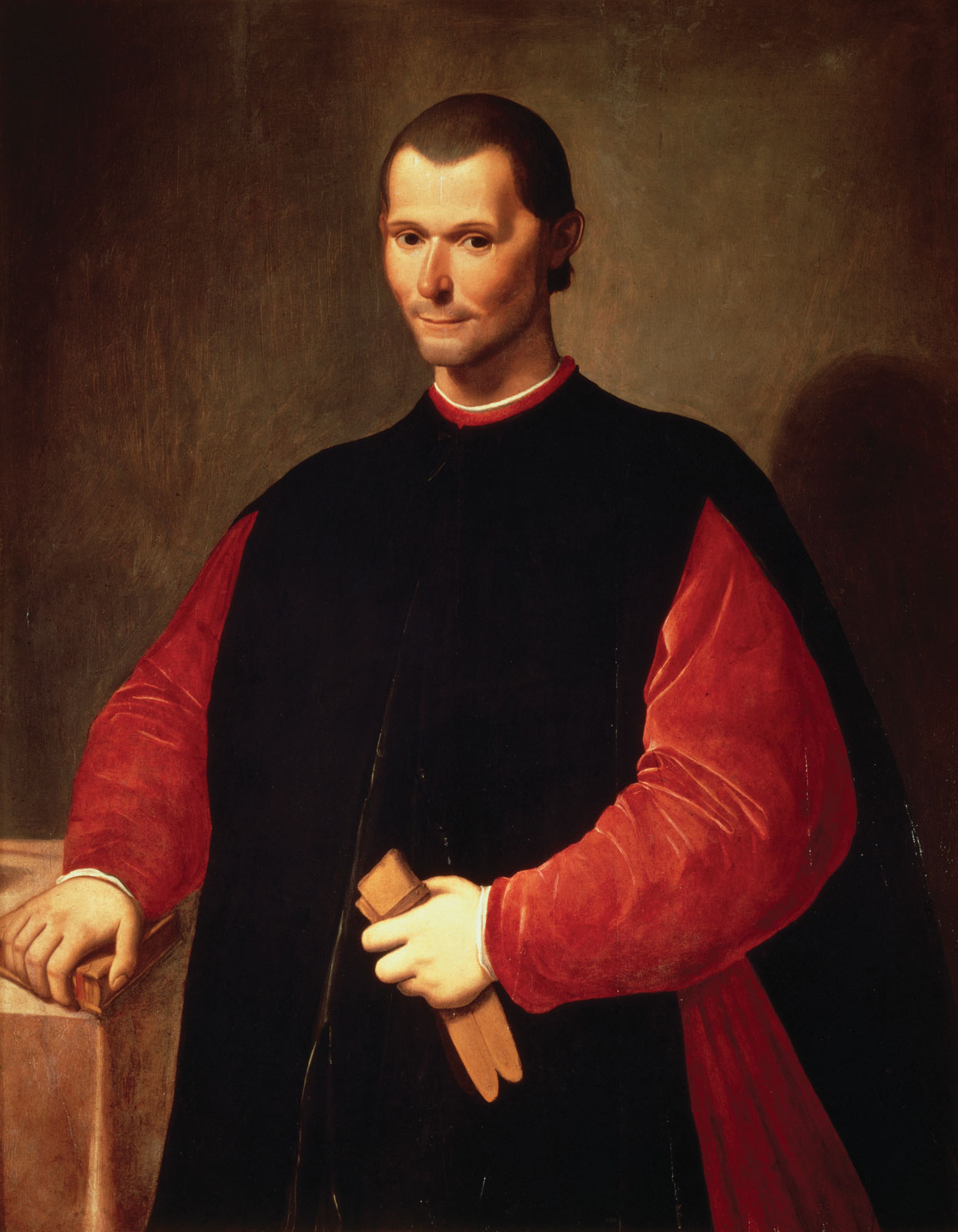
On December 10, 1513, in the little village of Sant'Andrea outside Florence, Niccolò Machiavelli sat in his farmhouse study and wrote to a friend in Rome. By day he still worked the fields: poetry in the morning, cards with the neighbours at the tavern in the afternoon, mud on his trousers. In the evening, he changed into "royal and courtly garments," went into his study, and talked with the ancients — that is how he put it. Then he told his friend he had just finished a little book, on principalities, asking: what is a principality, how many kinds are there, how are they gained, how are they kept, why are they lost.[3]
That letter later became the most famous private letter in Western literature. And the little book became the most famous book in the history of political thought — and the most notorious.
Machiavelli was 44 when he wrote it, fresh out of prison, fresh off the rack, stripped of everything. He was not writing theory. He was writing a job application. The recipient was a Medici. He wanted his job back. The application never got him the job. It turned his name into an adjective: Machiavellian — unscrupulous, stop at nothing.
Chapter OneFrom Second-Rate Clerk to Prisoner
Machiavelli was born in Florence on May 3, 1469, the son of a lawyer. In 1494 the Medici were driven out of Florence and the republic restored. Four years later, at 29, Machiavelli became secretary to the Second Chancery, and secretary to the Ten — the council in charge of diplomacy and war. He held the post for 14 years.[2]
Those 14 years were the best school of his life. He was sent on missions to France, Germany, and the papal court, and watched at close range how Pope Alexander VI used his son Cesare Borgia to conquer. In 1502 he was sent to the Romagna to meet Borgia, and watched the man turn a shambles into a state of his own. In February 1506, the Florentine citizen militia he had built marched in parade for the first time — 400 farmers in iron breastplates, carrying lances; in 1509 those same soldiers retook Pisa.[2]
Then everything collapsed in August 1512. Spanish troops stormed Prato, Florence's gateway, and sacked it, killing thousands. Florence surrendered and the Medici returned. On August 31 the Medici retook Florence; on November 7 Machiavelli was dismissed, barred from the Palazzo for life, confined to Florentine territory for a year, and made to post a surety of 1,000 florins.[2]
Worse followed. On February 18, 1513, suspected of a plot to overthrow the Medici, he was arrested and put to the strappado. His name had turned up on a seized list — that alone was enough to have him hoisted up and questioned for 3 weeks. In the end a new pope's amnesty saved him: on March 11, 1513, the Florentine Giovanni de' Medici was elected Pope Leo X and ordered all political prisoners released. Machiavelli walked out of prison and back to his farmhouse. His political career was over. He was 44, and he had nothing.[2][3]
Chapter TwoA Job Application
It was in that farmhouse that he wrote The Prince. Scholars generally date it to the second half of 1513, some to early 1514. In his letter to Vettori he called it a "little work"; its Latin title was De Principatibus, On Principalities. The whole book runs to 26 chapters, about 30,000 words — an afternoon's read that has taken 500 years to finish.[1]
From the start the book was written for someone, and for someone specific. Machiavelli first meant to dedicate it to Giuliano de' Medici; after Giuliano died in 1516, the dedication went to his nephew Lorenzo de' Medici, Duke of Urbino. The dedication says it plainly: here is everything he learned in 15 years of public service, offered to His Magnificence in the hope of employment.[1][3]
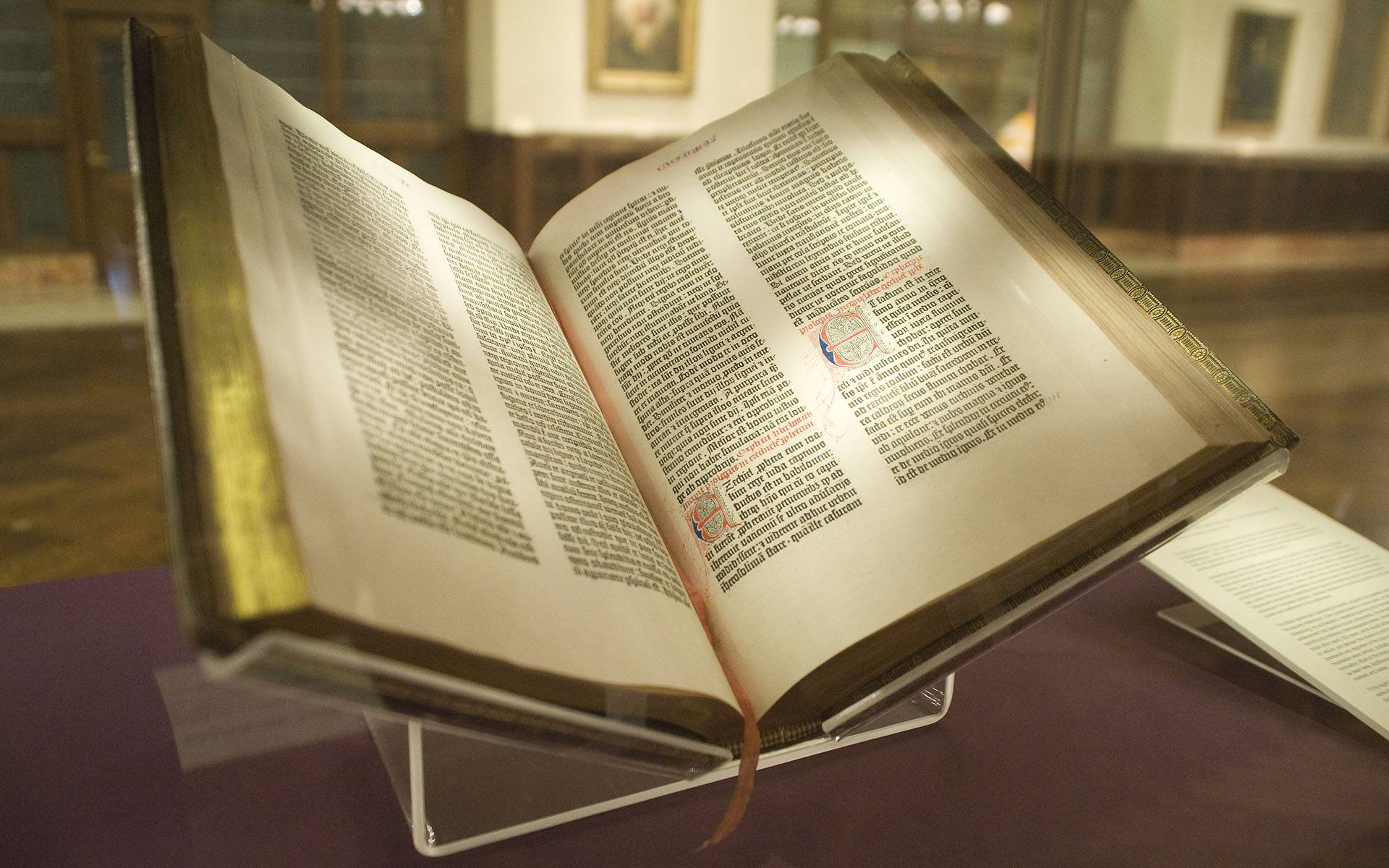
Lorenzo almost certainly never read it. For 19 years after it was written, the book circulated only in manuscript among friends. Machiavelli died on June 21, 1527, aged 58, still a disappointed man of letters. In 1532 the Roman printer Antonio Blado published it with the permission of the Medici pope Clement VII — 5 years after the author's death.[1]
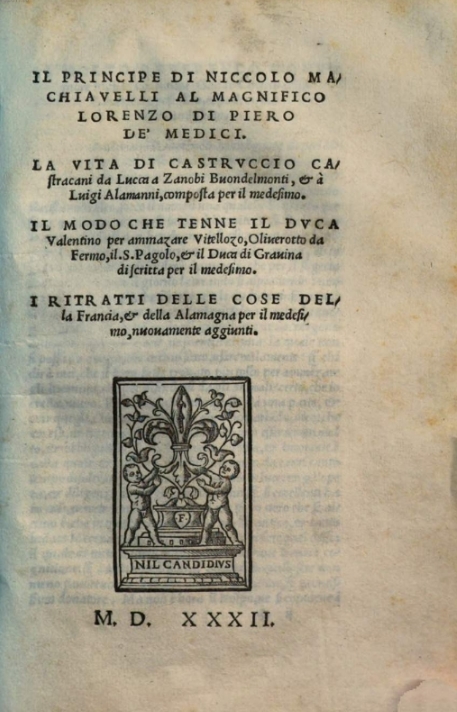
Less than 30 years after it appeared in print, the Church put it on the Index of Prohibited Books. In 1559, the Index of Paul IV banned The Prince together with the Discourses on Livy. By then about 15 editions were already in circulation.[1][2]
Chapter ThreeThe Borgia Lesson
The longest chapter of The Prince is Chapter 7, and its hero is Cesare Borgia. Machiavelli takes two new princes who rose by fortune: Francesco Sforza of Milan, who kept what he won by ability, and Borgia, who won his state through his father's power and lost it when his father died. But Machiavelli says Borgia "did everything that a wise and able man ought to do" — only fortune refused him.[5]
Borgia was the illegitimate son of Pope Alexander VI. In 1498 he resigned the cardinalate and became a condottiero. With his father's money and French troops, he conquered the Romagna within a few years. When Machiavelli met him on his mission in 1502, he wrote home to Florence that this lord was "splendid and magnificent," a man who "knows neither danger nor fatigue."[2]
What Machiavelli admired most was how Borgia handled the Romagna. The province had been a patchwork of petty lords, full of robbery and violence. Borgia sent his lieutenant Ramiro de Lorqua to govern it with full powers. Ramiro restored order with an iron hand — and made enemies everywhere. So on the morning of December 26, 1502, Borgia had Ramiro's body cut in two and left in the square at Cesena, with the block and a bloody knife beside it. Machiavelli writes in the book that the spectacle left the people "both satisfied and stunned": the cruelty belonged to Ramiro alone; the order belonged to the duke.[5]
Five days later, on December 31, 1502, Borgia invited the rebel captains to a banquet at Senigallia; by the next dawn they had been bound back to back and strangled. Machiavelli witnessed the scene himself and wrote a separate account of it, calling it "the most beautiful deception."[2][5]
But Machiavelli also wrote down how it ended. In August 1503 Alexander VI died suddenly, Borgia lost his protector, and his state collapsed overnight. On March 12, 1507, he died in a skirmish in Navarre, Spain, aged only 31, with no one beside him knowing who he was.[4]
In Chapter 8 Machiavelli spells out the method: he distinguishes cruelty "well used" from cruelty "badly used" — cruelty applied once, all at once, to found order, as against cruelty dragged out to feed revenge. The first makes men afraid; the second makes them hate. And fear can hold a state together, while hatred only invites destruction.[5]
The point of the chapter is simple enough: the most dangerous moment for a new prince is not winning power but keeping it. Machiavelli closes Chapter 7 almost with regret: his complaint is not that Borgia did anything wrong, but that he was born in the wrong time — his father died too soon.[5]
Chapter FourThe Fox and the Lion
The chapters that truly unsettle readers are 15 through 18. In Chapter 15 Machiavelli states his method plainly: he will write not about imaginary republics but about the "effectual truth" of things — how things actually work. A prince who does only what he "ought" to do will come to ruin among so many who do what they ought not to do.[5][6]
Chapter 17 asks: is it better to be loved or feared? The answer has been quoted for 500 years, and misquoted for 500 years. What he actually says is that if a ruler cannot have both, "it is much safer to be feared than loved." Love rests on obligation, which men break whenever it serves them; fear rests on dread of punishment, a dread that "never fails." But he adds a condition that is usually left out: a prince may be feared, but he must never be hated. And the way to avoid hatred is concrete: do not touch your subjects' property — or their women.[5]
Chapter 18 goes further: should a prince keep his word? Machiavelli says a prince must be both fox and lion — "one must be a fox to recognize traps, and a lion to frighten wolves." The lion cannot protect himself from traps; the fox cannot protect himself from wolves. A prince who only keeps his word will not last long in a world full of liars; but he must also seem to keep it — seem merciful, faithful, religious — because people judge by their eyes, and what they see outweighs what they touch.[5]
One correction is owed to Machiavelli: the line most often hung on him — "the ends justify the means" — he never wrote. The closest passage, in Chapter 18, is this: "In the actions of all men, and especially of princes, one judges by the result." He wrote a doctrine of results, not a licence. Pinning a sentence he never wrote on his name, then denouncing him for it for 500 years, is itself a very Machiavellian trick: build an image first, then let the image do the talking.[5][6]
Chapter FiveFortune Is a River
In Chapter 25 Machiavelli turns to fortune. Fortune, he says, is the arbiter of half our actions; the other half — perhaps a little less — she leaves to us. Fortune is like a river in flood: when it rises no one can hold it back, but a wise man builds dikes and embankments in fair weather, so that when the flood comes the water has somewhere to go.[5]
This is the most overlooked chapter in the book, and the key to understanding Machiavelli. He is not teaching men to do evil; he is teaching them to see one thing clearly: politics is not a moral examination, it is a river. You can stand on the bank and curse the dirty water, or you can roll up your sleeves and build the dike. The man who curses stays clean. The man who builds survives. Machiavelli spent his life building dikes: he raised a citizen militia in Florence because he had seen that mercenaries could not be trusted; he warned princes against other men's armies because he had watched borrowed troops turn around at the decisive hour.[5][6]
In Chapter 24 he settles the account: why did the princes of Italy lose their states one after another? Not because of fortune, but because in quiet times they prepared nothing. Chapter 26, the last, suddenly changes tone: he calls on a prince to rise and free Italy from the "barbarians." It reads almost like a different book — some say it was his last calling card to the Medici; others say it was the real purpose of the whole work: not to teach a prince how to do evil, but to teach Italy how to survive.[1][5]
EpilogueThe Banned Book That Lived 500 Years
In the year The Prince finally appeared in print, Machiavelli had been dead for 5 years. He never knew what that little book of about 30,000 words would become: a banned book of the Church, a bedside book of princes, a textbook of revolutionaries, a case study in business schools. His name became an adjective meaning "unscrupulous, stop at nothing" — a definition he himself would probably not have accepted.[1][6]
But the book survived precisely because it got one thing right, and that thing does not age: power has a logic of its own, and it does not obey the logic of morality. Every generation reads The Prince and finds its own fear in it: the 16th century found religious war, the 18th found revolution, the 20th found totalitarianism, the 21st finds populism and lies on social media. The book has not changed. Its readers have.
In 1762 Rousseau took up Machiavelli in The Social Contract: on his reading, Machiavelli only seems to teach princes — in fact he teaches the people, laying the prince's methods open so that everyone can see what to guard against. The reading may not be what Machiavelli intended, but it makes the point: the same book can be a tyrant's handbook and a people's warning at once. The difference is not in the book. It is in which side the reader stands on.[6]
Five hundred years after his death, his book is still in print, still quoted, still misread. And that letter of December 10, 1513, is still the most famous private letter in Western literature — an unemployed middle-aged man, on a winter night in a farmhouse, changing into clean clothes to talk with the ancients, and writing a job application that changed the world. The application failed. The book succeeded — so completely that even he might have been frightened by it.