PrologueFirst the Light, Then the Fire
On July 14, 1789, a Paris crowd stormed the Bastille. That day is often treated as the beginning of the Revolution; in truth it was more like the end of a long experiment in thought — before the gunpowder caught fire, the spark had been burning for a century in studies, salons, and printing shops.
The Enlightenment had no headquarters, no manifesto, no leader. It was a movement nobody declared open and nobody declared over; later historians gave it a span, 1687 to 1789, from the publication of Newton's Principia to the fall of the Bastille.[14] In those hundred years, Europeans learned something that had never before happened on such a scale: to question everything — the king, the Church, tradition, and everything they had been taught since childhood.
This book is not a catalogue of names and titles. It is the story of a change of mind. For the first time, human beings collectively believed that the world — including politics, religion, and morality — could be understood by reason, debated in public, and remade by hand. Once that belief took root, it could never be pulled out again. It rewrote people's minds first, and only then rewrote the world.
Chapter OneThe Laws of Heaven, the Measure of Earth
It all began with an apple and a question. On July 5, 1687, Newton's Philosophiae Naturalis Principia Mathematica appeared, setting out the three laws of motion and the law of universal gravitation in a single book: the force that drops an apple to the ground is the same force that keeps the Moon in orbit around the Earth.[6] Heaven and Earth were no longer two separate worlds.
But what truly unsettled people's minds was not the laws themselves — it was Newton's method. Newton refused to invent causes out of thin air; he drew laws from phenomena alone, and openly admitted that he framed no hypotheses — whatever could not be deduced from phenomena, he would not claim as truth.[6] The universe was no longer a code that only priests could read; it was a machine that could be observed, measured, and understood. The philosophes at once carried this method into human society: if the motions of the heavens obeyed laws, why should government, society, and morality not have laws of their own to discover?[5]
The irony is that Newton himself remained a devout believer, convinced that God had built this precise machine. But his universe no longer needed God to intervene day by day. A well-wound clock implied a world that could be understood — and that implication was more subversive than any single law. For once people believed the world could be understood, the next question followed at once: if the world can be understood, then why should the king's power and the Church's dogmas not also be understood, tested, and questioned?
That was the Enlightenment's first foundation stone: reason is not a body of learning but an attitude — the habit of asking why about everything, and the belief that the question has a right to be asked.
Chapter TwoRights Are Not the King's to Give
In December 1689, John Locke's Two Treatises of Government was published anonymously, barely a year after the Glorious Revolution deposed James II.[1] In it, Locke did something close to treason in his day: he moved the foundation of politics from heaven down to earth. Government was not God-given, and power was not a matter of blood. Before entering society, human beings were born with natural rights to life, liberty, and property; government was only a contract people made to protect those rights.[1]
The force of this argument lay in its logic, which cut both ways. If government is a contract, then the contract has conditions: when a ruler tramples the people's rights and governs arbitrarily, the people have the right to resist — and the right to replace the government.[1] In the age of divine right, when a king did wrong it was the people's sin; in Locke's age, when a king did wrong it was the king's sin. That single reversal took humanity thousands of years.
Locke's wager rested on an optimistic assumption about human nature: that people are born free and equal, and capable of restraining themselves by reason. The assumption was never proven — Locke knew that himself. But once spoken, it began to grow in people's minds like a seed. Nearly a century later, Thomas Jefferson, drafting the Declaration of Independence, borrowed Locke's language almost directly, changing only "property" to "the pursuit of happiness."[12] A philosopher's hypothesis had become a nation's birth certificate.
Locke, of course, had his blind spots. His theory of property was later used to justify the seizure of colonial land, and his "all men are equal" did not then include women, slaves, or the poor. The Enlightenment was incomplete from the start — its ideals ran further than its practice. But that is precisely what ideals are for: they run ahead, so there is a direction to follow.
Chapter ThreeRevolution in the Salon
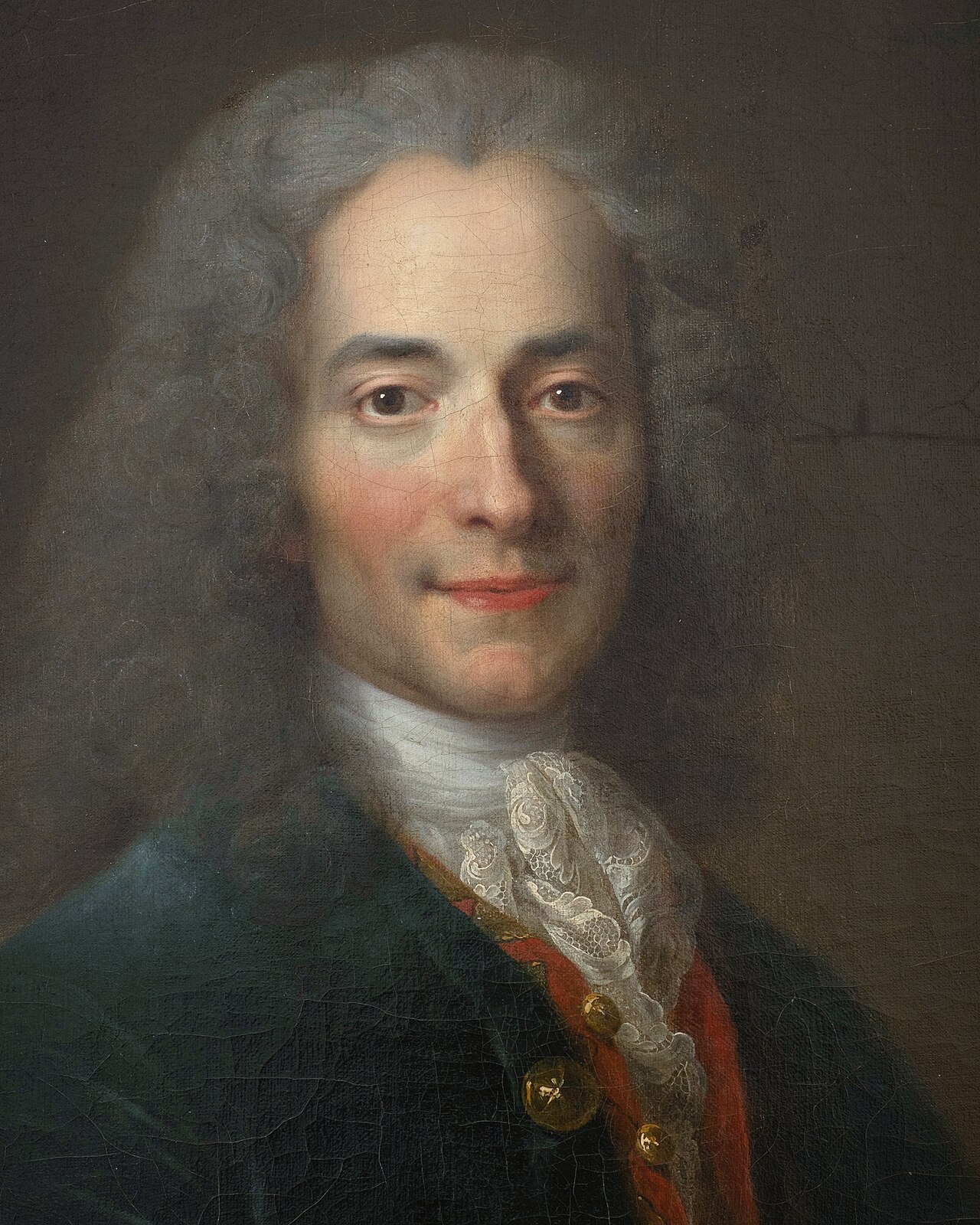
If Locke gave the Enlightenment its skeleton, Voltaire gave it a mouth. Born in 1694 and dead in 1778, Voltaire lived 83 years, wrote more than 20,000 letters and 2,000 books and pamphlets, sat in the Bastille, and was exiled to England.[8] What he brought back from England was not merchandise but a whole way of comparison: his Lettres philosophiques of 1734 laid England's parliamentary government, religious tolerance, and scientific spirit before French readers — and the book was publicly burned in Paris while its author fled.[8]
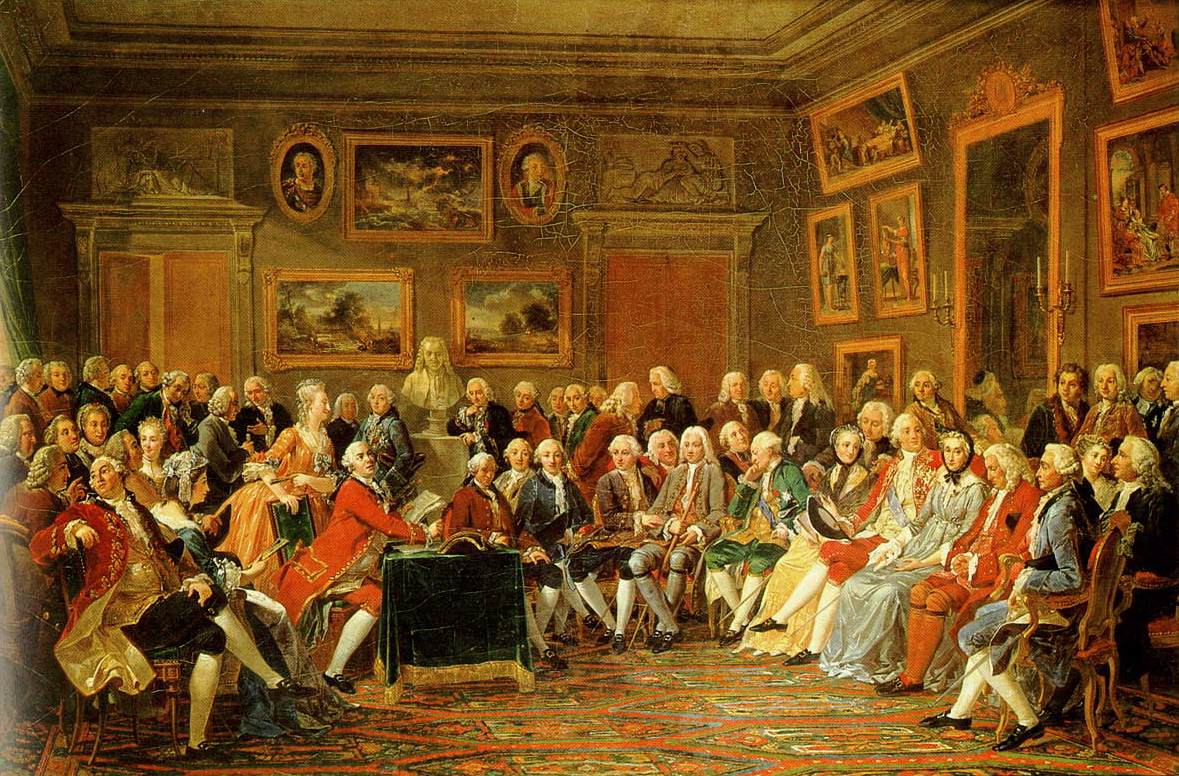
But burning one book cannot burn away a standard of comparison. Voltaire's real battlefield was not the study but the salon — the Wednesday dinners hosted by aristocratic women. In Madame Geoffrin's salon, philosophers, scientists, playwrights, and diplomats ate at the same table, read new work aloud, and argued with one another. Lemonnier's famous painting of 1812 shows one such evening in 1755, a reading of Voltaire's tragedy The Orphan of China; the scene is an imagined reconstruction — many of those depicted never actually met — yet it captures one truth exactly: in the Enlightenment, thought was not one person's meditation but a conversation among many.
Voltaire's sharpest weapon was laughter. After the great Lisbon earthquake of 1755, he wrote Candide (1759), mocking Leibniz's optimism — the claim that we live in the best of all possible worlds — with a chain of absurd disasters.[8] Laughter is harder to defend against than argument: an argument can be banned, but laughter travels on its own. A sharp witticism passed from the salon to the coffeehouse, from the coffeehouse to a letter, from a letter across all of Europe — the Enlightenment's first mass medium was not the newspaper, but wit itself.
Here lies a secret of crowd psychology: ideas do not win by persuading everyone. They win by first winning a small circle of people with a voice, and then letting their conversation become the air of the age. The salon was the machine that manufactured that air.
Chapter FourFitting the World into a Book
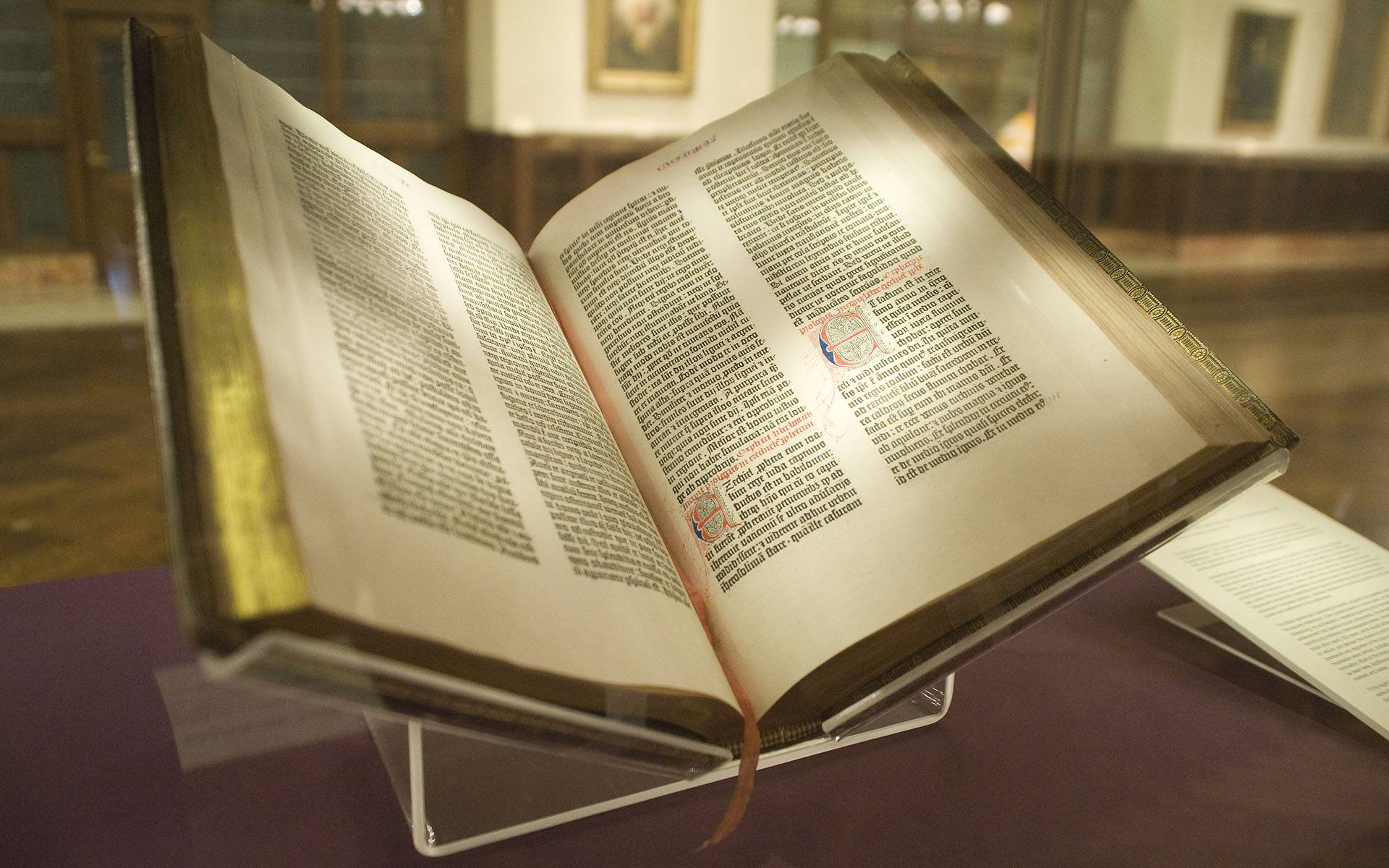
On June 28, 1751, the first volume of the Encyclopédie appeared in Paris: 914 large folio pages, opening with d'Alembert's Preliminary Discourse, a genealogy of all human knowledge.[13] The project had begun modestly enough: in 1745, a Paris bookseller wanted to translate Ephraim Chambers's English Cyclopaedia for a profit. When Diderot took over as editor in 1747, it became something entirely different — a work meant to organize the whole of human knowledge by reason.[2]
The final result exceeded everyone's imagination: 17 volumes of text, 11 volumes of plates, 74,000 entries, more than 200 contributors; subscribers did not receive the last volume until 1772.[2][3] More important was its philosophy of arrangement: the crafts of shipbuilding, weaving, and tanning stood beside philosophy and theology as equals. Knowledge was no longer the monopoly of aristocrats and clergy, but public property — something to be looked up, compared, and questioned.
The authorities understood the danger at once. In 1759, the Catholic Church placed the Encyclopédie on its Index of Prohibited Books, its publishing license was revoked, and d'Alembert resigned as editor; but Diderot pressed on in secret, and the work was complete by around 1780.[2][3] A banned book sells better than an unbanned one — the ban itself became its best advertisement.
The Encyclopédie's true revolution was not in its contents but in its posture. It taught a whole generation of readers a new habit: when you do not know something, look it up; when an authority speaks, ask for the evidence. Once that habit took hold, the old regime could no longer govern people's minds. The printing press printed more than words — it printed a new order of mind.
Chapter FiveThe Contract, the General Will, and the Guillotine
By the middle of the 18th century, the Enlightenment's political thought had split into two directions. In 1748, Montesquieu published The Spirit of the Laws, arguing that power must be divided and balanced: if legislative, executive, and judicial powers were concentrated in one person or one group, liberty would be impossible.[10] That design later became the skeleton of the American Constitution. Fourteen years later, Rousseau took a different road in The Social Contract (1762): sovereignty lay neither in the king nor in parliament, but in the "general will" of the whole people; a person is truly free only when obeying laws they helped to make.[10]
The two roads looked complementary, but a tension ran between them. Montesquieu feared the concentration of power; Rousseau feared a people hollowed out by representation — and once anyone could claim to speak for the general will, it could become the tyranny of the majority over the minority. Rousseau himself probably never imagined that, 30 years later, his "general will" would be invoked by revolutionary tribunals as a reason for execution.
In 1784, Kant gave the whole movement its definition in "What Is Enlightenment?": enlightenment is humanity's emergence from its self-incurred immaturity — the courage to use one's own reason. His motto was two Latin words: Sapere aude — dare to know.[4] The short essay appeared in the December 1784 issue of the Berlinische Monatsschrift; it was brief, yet it was the Enlightenment's most honest self-portrait, admitting that enlightenment is not a finished state but a posture that requires courage.[11]
Then thought walked out of the study. On July 4, 1776, the 13 North American colonies issued the Declaration of Independence, proclaiming that all men are created equal, endowed with unalienable rights to life, liberty, and the pursuit of happiness — Locke's language, become for the first time the language of a nation.[12] Thirteen years later, on July 14, 1789, a Paris crowd stormed the Bastille; on August 4, the National Constituent Assembly abolished feudal privileges; on August 26, the Declaration of the Rights of Man proclaimed that men are born free and equal in rights.[7] The vocabulary of the Enlightenment was written out for the first time by a people in action.
But the same revolution exposed the Enlightenment's most dangerous side. Once reason is treated as absolute truth, it can demand obedience and punish heresy just like the dogmas it overthrew. The Terror of the French Revolution proved it: ideas can liberate people, and they can devour them. Rousseau's general will, Montesquieu's checks and balances, Kant's courage — all three are indispensable; remove any one corner, and the Enlightenment collapses into its own opposite.
EpilogueAn Unfinished Enlightenment
In that short essay of 1784, Kant asked a question: do we live in an enlightened age? His answer was no — we live in an age of enlightenment.[4] More than 240 years later, the sentence is still accurate.
The Enlightenment was neither completed nor defeated. What it left behind is not a set of answers but a way of asking: question everything, demand reasons from every authority, and treat every institution as something that can be redesigned. Once that way of asking was invented, it became the common inheritance of humanity — available to anyone, in any age, including to question the Enlightenment itself.
It is worth remembering that in the very decades when Paris salons debated the rights of man, China on the other side of the world stood at the peak of the Qianlong era: the Qianlong Emperor reigned for 60 years, and under him the Qing Empire's territory, population, and economy were the largest in the world; the imperially commissioned Complete Library of the Four Treasuries gathered some 3,450 works in 36,000 volumes.[9] One empire compiled books to preserve order; another continent compiled books to question it — the same century, two civilizations holding opposite attitudes toward knowledge. And history has shown which side traveled further.
The Enlightenment's true legacy lies in no single book, but in the moment an ordinary person first dares to say to themselves: I can think for myself. The Bastille can be stormed, and it can be rebuilt; but once a person has learned to think for themselves, no one can ever close their mind again for them. That is why the gunpowder of 1789 went out, while the book of 1751 is still burning.