PrologueTwenty-Four Hours in a Day — Who Decides?
In 1817, in a textile mill in New Lanark, Scotland, the mill owner Robert Owen said something that sounded like arithmetic and was in fact a declaration of war: eight hours’ labour, eight hours’ recreation, eight hours’ rest. Twenty-four hours in a day, cut into three equal parts, with labour taking only one.[6]
Before the factory, time belonged to sunrise, the seasons, and the church bell. After the factory, time became a raw material that could be bought and sold — and the buyer set the terms. Owen’s question was never “how many hours are reasonable?” It was “whose time is it?” It took nearly 200 years to arrive at a provisional answer, and that answer is still being rewritten.
The most radical part of Owen’s three-way split was not the eight hours of labour but the eight in the middle — recreation. Until then, a worker who was not working was worth nothing; Owen insisted that a person must have time to live for no employer at all: to read, to talk, to raise children, to be a citizen. At New Lanark he built schools, believing education should last a lifetime. The fight over time was never only about working less. It was about being more of a person.
Chapter OneThe Factory Ate Time
The Industrial Revolution herded thousands of people into factories, and since the machines never stopped, neither could the people. In 1810, Owen cut hours at his own mill to ten a day — already a concession at the time. Seven years later he pushed the target to eight, and gave it a form anyone could do in their head: 24 divided by 3.
The arithmetic was almost naively simple, and precisely because it was simple, it punctured an order that pretended to be natural. Why should the boss’s share of a day be 12 hours, 14, 16, while your own share is only what is left for sleep? Owen had no power to make other mills follow; New Lanark was an island. But the slogan survived, because it translated a struggle over power into arithmetic everyone could do: there are only 24 hours in a day, and whoever takes more leaves less for everyone else.
The factory changed not only the length of working time but its nature. In the fields, time followed daylight, its pace set by the seasons; in the factory, time followed the machine, its pace set by the production line. Piece rates converted every minute into money, and time no longer belonged to the worker — it belonged to the boss’s ledger. When time can be sold by the pound, human dignity is reduced to bargaining power — and a single worker, alone, has none. That is why the eight-hour day could never be won by individual negotiation. It had to be won together.
The gears of institutions turned slowly. In 1847, the British Parliament limited women and children to a ten-hour day; adult men were still outside protection. In August 1866, the International Workingmen’s Association wrote the eight-hour day into its demands at its Geneva congress. A mill owner’s experiment had become a movement’s banner — but the banner still had no army.
Chapter TwoChicago, May 1886
In October 1884, the Federation of Organized Trades and Labor Unions fixed a date: May 1, 1886, the eight-hour day would take effect. It was not a request. It was an ultimatum.
On May 1, between 300,000 and 500,000 workers struck across the United States; in Chicago alone, 30,000 to 40,000 took to the streets. The anarchist Albert Parsons marched with his wife Lucy and their children at the head of 80,000 people down Michigan Avenue. The slogan was a single line: eight-hour day with no cut in pay. For the first time, time itself was being bargained over like wages — one hour less of labour could not mean one cent less of pay.
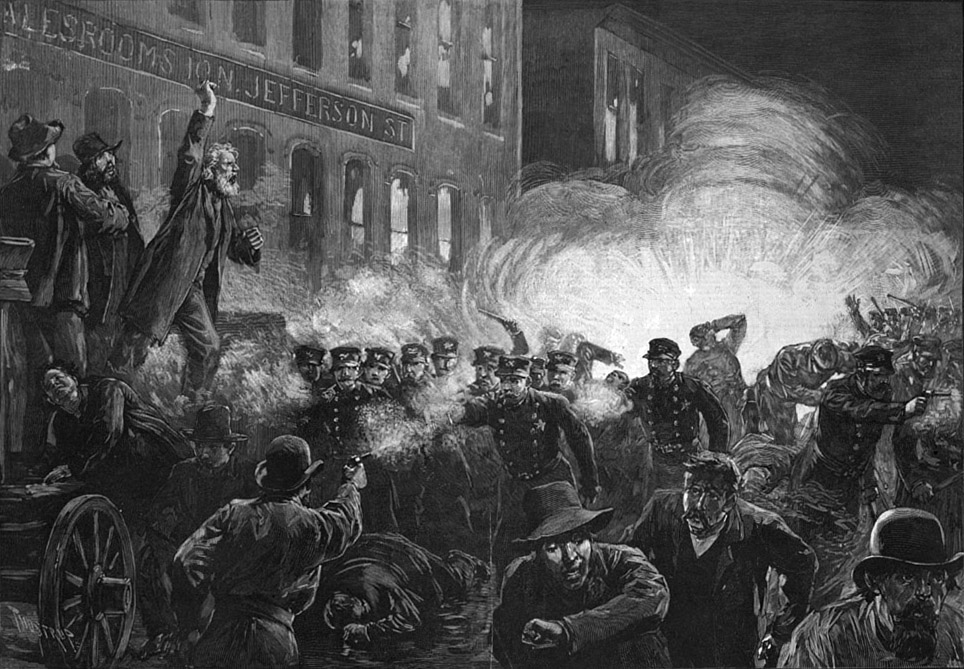
On May 3, outside the McCormick Harvesting Machine plant, police fired on striking workers; two strikers were killed. The next evening, workers gathered at Haymarket Square to protest. The rally began peacefully; at about 10:30 p.m., as police moved in formation to disperse it, a bomb exploded among them. Seven police officers and at least four civilians died, and scores were wounded.[3]
Eight anarchists were charged with murder. The trial was followed around the world, but no evidence showed that any of the men on trial had thrown the bomb. On November 11, 1887, four of them were hanged. Haymarket was a devastating setback for the eight-hour movement, and the American eight-hour day was delayed by half a century. But May 1 became International Workers’ Day. The state had answered the question of time with the gallows; the answer did not make the question go away, it only made it heavier.
The repression worked at once: the American eight-hour movement fell silent for nearly a decade, and unions were branded as thugs. But memory outlasts fear. On May 1, 1890, workers took to the streets for the eight-hour day again, in strikes across Europe and America. Haymarket did not end the movement; it turned May 1 into a date — a day on which, every year, the world remembers that the eight-hour day was bought with lives.
Here lies power’s starkest logic: how a bomb thrown by an unknown hand turned a negotiation over working hours into a war over order. Once a demand is called a riot, repression has a name. And every repression reminds everyone of the same thing: time was never neutral. It is a question of who gets to decide.
Chapter ThreeThe Eight Hours the Boss Gave Away
On January 5, 1914, Henry Ford and his vice president James Couzens stunned the world: Ford Motor Company would pay five dollars a day for an eight-hour day. The old rate was $2.30 for nine hours.[2]
Ford had not suddenly become a philanthropist. The moving assembly line had cut the time to build a Model T from 12.5 hours to 93 minutes, and production soared — but workers could not stand the monotony, and labour turnover reached 370 percent. Machines can run forever; people cannot. What Ford bought was not charity but stability: a fat pay packet that made the tedium of the line tolerable, and that stopped the bleeding cost of hiring and training.
But the five dollars was not free. The base wage was still $2.30; the other $2.70 was a profit-sharing bonus, paid only to workers who met the company’s conditions: no drinking, no abuse of their families, no boarders, a clean home, regular savings. Ford created a Sociological Department and sent inspectors into workers’ homes to ask probing questions about how they lived; workers who fell short were coached, and the full bonus was withheld until the “problems” were corrected. The department was largely dissolved by 1921.
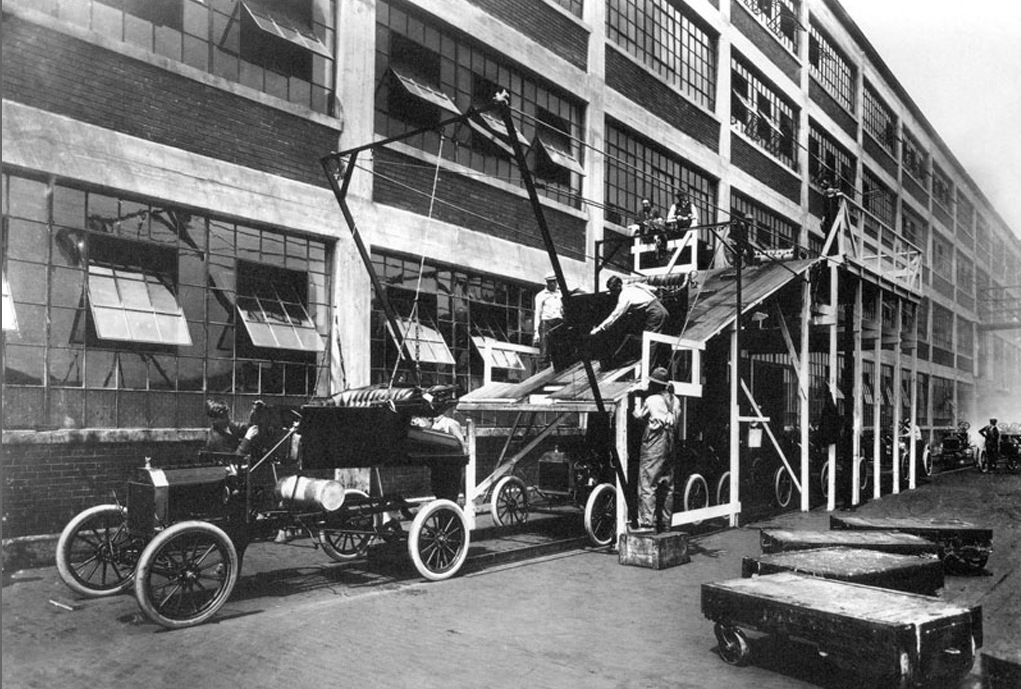
This was the eight-hour day arriving by another route: not won, but calculated. The boss discovered that rested workers with money to spend were worth more than exhausted ones. Time stopped being a battlefield and became a business. Yet the conditions gave the game away: once working time can be bought and sold, life after hours can be priced too. The eight-hour day was a concession — and a new jurisdiction, with the company now running the living room.
Ford’s arithmetic spread quickly. Other carmakers raised wages to keep their workers, and parts suppliers followed. Before long, a decent wage and a decent life had become the new normal for American workers. Ford had proved, almost by accident, that sharing money with workers is not necessarily a cost — it can be good business. But he had also proved something else: that generosity comes with a price tag, and freedom is billed separately.
Chapter FourAfter It Became Law
On November 28, 1919, the International Labour Organization adopted its first convention in Washington: industrial working hours of no more than eight a day and 48 a week. It came into force on June 13, 1921 — the first time humanity legislated the length of a day by international treaty. The irony is that before 1919, only four countries in the world had eight-hour laws: Cuba, Panama, Uruguay, and Ecuador. And to this day, only 46 of the ILO’s 187 member states have ratified Convention No. 1.[1]
Once the eight-hour day was in the treaty, the next number was already queuing up. In 1935, the International Labour Organization adopted the Forty-Hour Week Convention, pushing the goal from eight hours a day to 40 hours a week. But to this day only New Zealand has ratified it, and it has never come into force. The eight-hour day took a century to travel from slogan to treaty; the 40-hour week has spent 90 years lying in the treaty drawer. Institutions always turn more slowly than demands.
In 1938, the Fair Labor Standards Act finally wrote the eight-hour day into American federal law. Signed on June 25 and effective October 24, it capped the working week at 44 hours in the first year, 42 in the second, and 40 by October 1940; anything beyond was paid at time and a half, and the minimum wage was 25 cents an hour. But the law did not ban long hours — it only made them expensive. And the line it drew left people outside it: farmworkers and domestic workers were excluded outright, and salaried executives, administrators, and professionals were exempt from overtime altogether.[4]
Taiwan moved more slowly still. A 2000 amendment cut the legal week from 48 hours to 84 hours every two weeks, effective January 1, 2001; civil servants got the two-day weekend the same day. Workers waited another 15 years: on May 15, 2015, the legislature passed the cut to 40 hours a week, effective January 1, 2016, benefiting about 3.4 million workers. Nearly 200 years had passed since Owen first divided the day into thirds.[5]
Yet the law can police the time clock; it cannot police the message. Responsibility systems, on-call duty, late-night replies — working time has leaked out of the factory and into the phone, from countable hours into uncountable availability. The eight-hour day won the statute and lost the boundary. Every victory came with a compromise, and every compromise grew a new way around. Institutions are never the finish line; they are where the next fight begins.
EpilogueThe Next Fight Over Time
From 16 hours to 8 took humanity more than a century, paid for with strikes, a bomb, a gallows, and negotiations. The eight-hour day was never a law of nature. It was a negotiated settlement. And the negotiation is not over: now that work can come home, come to bed, come into every waking moment, the boundary of those eight hours is being redrawn.
After the two-day weekend, what is the next number? Some say a four-day week, some say a basic income, some say we should redefine what counts as work. There is no answer yet, but the question itself has changed: no longer “how many hours a day can a person work?” but “how many hours a day should a person live for?” The question Owen asked in 1817 has not aged a day.
The next time you clock in, work late, or answer a message past midnight, remember how those eight hours were won. They were not a gift from the boss, nor a natural product of the law — they are time that generations bought with time. The question has never changed: 24 hours in a day — who decides? The answer is not on the clock. It is in who holds the power to divide it — and the division can always be renegotiated.