PROLOGUEA Name That Grew from a Sandbar into an Island
When we say “Taiwan” today, we mean an island. But 400 years ago, “Taiwan” was the name of a single small sandbar. In the summer of 1624, a Dutch fleet came ashore on that sandbar and began to build a fort. From that year on, the name grew, step by step, until it became the name of a whole island. This essay is about that year: why the Dutch came, where they had meant to go, and how a fort on a sandbar pulled Taiwan onto the map of world trade.
Before 1624, Taiwan sat at the centre of no empire’s map. Portuguese sailors passing by in the mid-16th century called it Formosa — beautiful island — but that was a passing compliment, not the start of rule. The people who actually lived on the island were the Austronesian indigenous peoples; on the plains of the southwest coast, Siraya villages grew rice, hunted, and traded with passing merchants. Chinese and Japanese ships had long haunted these waters too, slipping through the cracks of the Ming sea ban to trade quietly around Tayouan. The island had a life of its own. It just had not yet been written into the world’s ledger.
CHAPTER ONEThey Had Wanted Penghu
The Dutch did not come for Taiwan. They came for China. The Dutch East India Company (VOC), founded in 1602, had one overriding goal in Asia: to break into the Chinese market. Chinese silk and porcelain fetched high prices in Europe and Japan, and Japanese silver was the hard currency that bought Chinese goods. The problem was that Ming China forbade foreigners from trading on Chinese soil, the Portuguese held Macao, the Spanish held Manila, and there was no way in for the Dutch.
In July 1622, a Dutch fleet sailed from Batavia and, together with the English, seized the Pescadores and built a fort at Fengguiwei. The calculation was blunt: use Penghu as a bargaining chip to force Ming China to open a port in Fujian. Ming’s answer was equally blunt — the Pescadores were Chinese territory; there was nothing to discuss. In February 1624, the Fujian governor Nan Juyi sent troops to besiege the fort, and the two sides stared at each other across Fengguiwei for more than half a year.
The deadlock was broken by a sea merchant. Li Dan, a merchant from Quanzhou, stepped in to mediate, brought in Zheng Zhilong as interpreter for the Dutch side, and urged the Dutch to leave Penghu for Tayouan. In August 1624, the Dutch tore down the Fengguiwei fort and withdrew from the Pescadores. Their commander, Cornelis Reijersen, had favoured Taiwan all along, though the council had once overruled him; by now there was no better choice. Under their first governor, Martinus Sonck, the fleet sailed a single day and arrived at Tayouan.
This was not the first time the Dutch had come to Penghu. In 1604, they had landed there too, only to be driven off by the Ming general Shen Yourong. In fact, as early as 1623, Reijersen had sent men to survey the Tayouan area, and that October he sent soldiers and workmen to build a simple fort on the sandbar at the southern side of the Tayouan bay entrance. When the fighting tightened in March 1624 and men ran short, he ordered the little fort torn down and its garrison pulled back to Penghu. In other words, the Dutch withdrawal to Tayouan was no improvisation — they had had their eye on the place for more than a year.
CHAPTER TWOTayouan, a Day’s Sail Away
What was Tayouan? Stand in Anping, Tainan, today and you stand on solid land. But in 1624 this was a long, narrow sandbar, open sea in front and a lagoon behind — the Taijiang inner sea. The tip of the sandbar commanded the channel into the inner sea. Whoever held it controlled who came and went in the bay.
The first thing the Dutch did after landing was to build. First a temporary fort of wood and earth; four years later, work began on a permanent stone fortress on the largest sandbar — Fort Zeelandia. It took a full 10 years, from 1624 to 1634, to complete. Its walls were built of brick and coral-lime mortar, its bastions mounted with cannon, facing the sea — and facing the land. The fort was said to be named after the ship Sonck had arrived in, the Zeelandia; its position came from a colder calculation: China was a day’s sail away, the sandbar was easy to defend, and the inner sea could shelter, repair and unload ships.
What the Dutch wanted was not a colony but a warehouse, a fortress and an entrepôt. The southwest corner of Taiwan had just been placed on the VOC’s map of Asia.
CHAPTER THREEThe Far Shore, Bought for 15 Pieces of Cloth
But a sandbar, however good, is only a sandbar. A fort needs people, food and goods, and for those you have to go ashore. In 1625, Sonck bought a tract of land around Chihkan, across the bay, from the Sinkang villagers, paying 15 pieces of cloth — cangans, in Dutch. The deal later became known as the first piece of land the Dutch “bought” in Taiwan, but its real significance was not the price; it was the direction. The Dutch had stepped off the sea and onto the land.
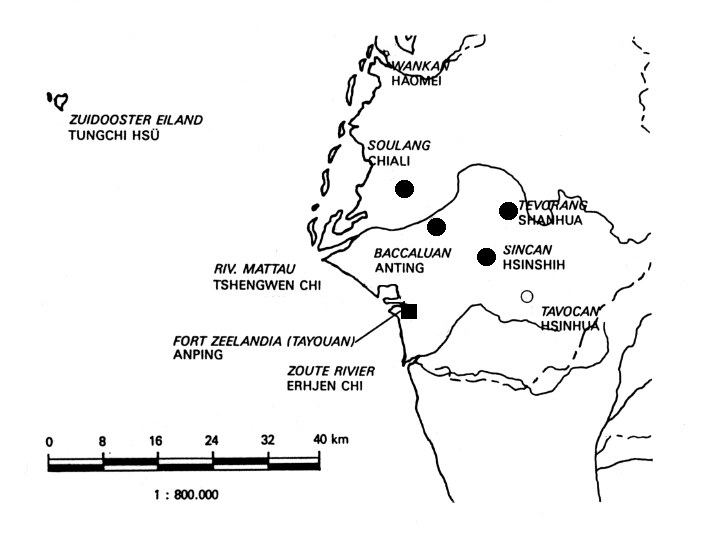
What happened next decided what the Tayouan factory would trade in. Chinese junks brought silk and porcelain, Japanese ships brought silver, and the Dutch, caught in the middle, took the margin on the re-export trade. And Taiwan itself began to export something: deerskins. Indigenous hunters took the deer, Chinese middlemen bought the hides, and the Dutch shipped them to Japan in exchange for silver and Japanese goods. The deerskin trade looked small, but it carried a symbolic weight: the Dutch had begun to draw profit from Taiwan itself, not merely to use it as a transshipment pier.
For the Dutch, deerskins carried a political meaning too: controlling the deerskin trade was a way of announcing to everyone that this harbour answered to them. Sometimes control of a port is asserted not with cannon, but by deciding whose goods pass through it.
CHAPTER FOURCaught Between China and Japan
The Tayouan factory’s business was, at its core, a business conducted in a narrow gap. Ming China would not let the Dutch trade in China directly, so the Dutch had to wait for Chinese ships to bring the goods to Tayouan themselves; the Tokugawa shogunate allowed the Dutch to trade in Japan, but their position there was never secure. In 1628, a violent clash between the Dutch and Japanese traders broke out, and all VOC business in Japan ground to a halt until 1633. The Dutch quickly learned their lesson: doing business in East Asia depended not on stout ships and cannon, but on holding a fragile balance between China, Japan and the island itself.
By the mid-1630s, Japan had closed its doors, forbidding Japanese from travelling abroad — and the Dutch became the only Europeans still allowed to remain in Japan, because they were Protestants who did not preach. The Dutch factory on Dejima in Nagasaki and the factory at Tayouan became the two ends of a single sea route: Chinese silk and porcelain gathered at Tayouan and sailed on to Japan, while Japanese silver flowed back to buy more Chinese goods. Taiwan became a node on the network of world trade for the first time — not because of what it produced, but because it happened to stand in the middle.
The Spanish came too. In 1626 they landed in the north of Taiwan and occupied Keelung; in 1642 the Dutch drove them out. From then on, Taiwan’s fate was tied to the contest among European powers in Asia — the island was no longer just a name passed on a sea chart.
CHAPTER FIVEThat Same Year, Europe Was at War
Pull the camera back. In 1624, Europe was fighting the Thirty Years’ War — a war that ran from 1618 to 1648, begun in a religious quarrel in Bohemia and ending with most of Europe dragged into it. The Dutch were at war themselves: their Eighty Years’ War with Spain was not yet over, and their independence was not yet recognised. The VOC fleets seizing harbours and raising forts across Asia were following a single logic: fight overseas the wars that could not be won at home; earn overseas the money that could not be earned at home.
In China, 1624 was the fourth year of the Tianqi era. The Tianqi Emperor, Zhu Youjiao, sat on the throne while the eunuch Wei Zhongxian ran the court; the war in Liaodong was going badly, and the sparks of rebellion were already lit. Twenty years later, the Ming dynasty fell. The year the Dutch reached Tayouan, the Ming was entering its final 20 years — though no one knew it then.
In that same year, three threads of history — in Europe, in China, in Taiwan — each ran its own course, unaware of the others. But it was in that year that they crossed, on a sandbar called Tayouan. World history is sometimes like that: it is not great events colliding with great events, but a small place that happens to stand in the middle of them all.
EPILOGUE38 Years Later, the Name Remained
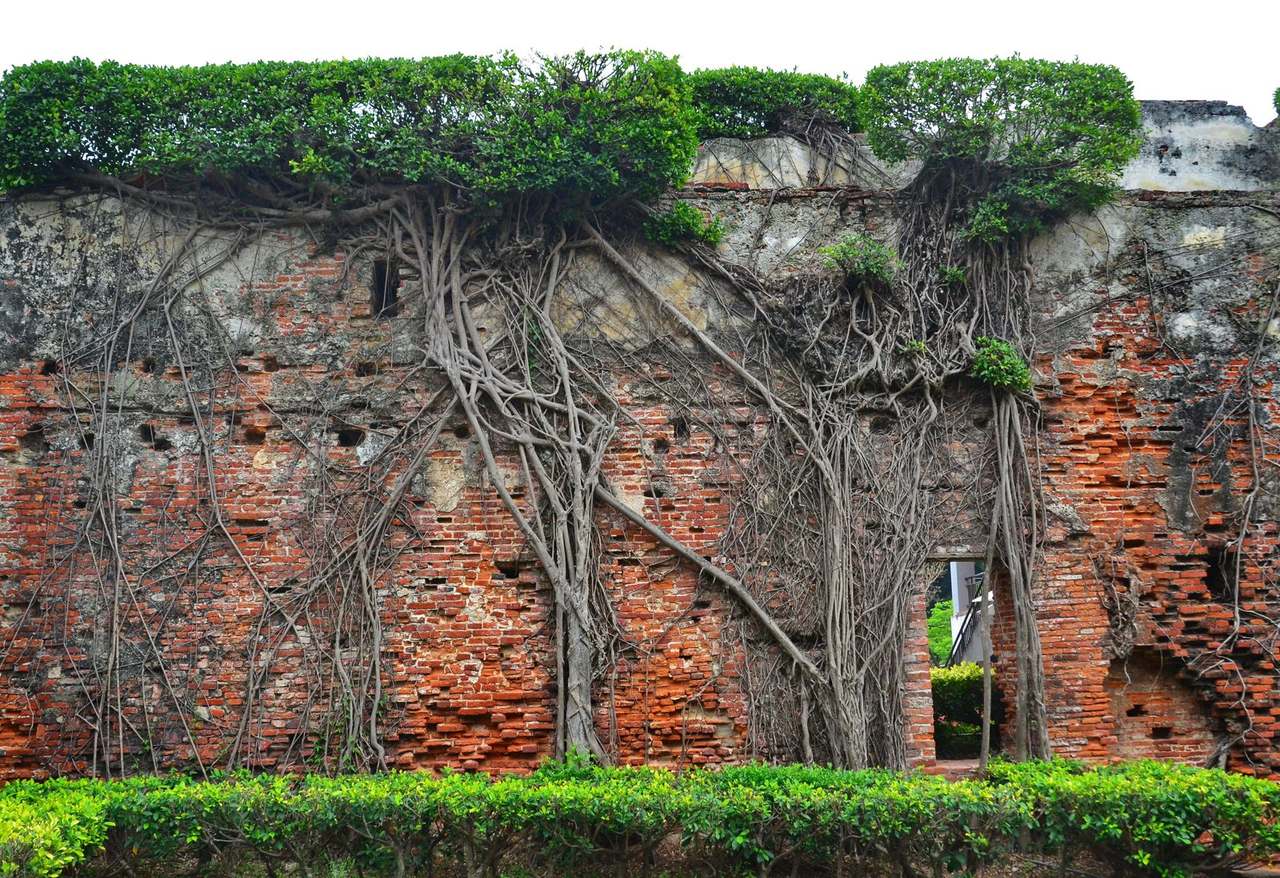
The Dutch stayed in Taiwan for 38 years. On 30 April 1661, Koxinga laid siege to Fort Zeelandia; on 1 February 1662, the last governor, Frederick Coyett, signed the surrender, and the Dutch left Taiwan. Fort Zeelandia was later renamed Fort Anping, then Taiwan City; its walls crumbled, section by section, in war and weather, and today only ruins remain, kept as Anping Fort.
But one thing stayed — and kept growing: the name. Tayouan — linguists believe it comes from the Siraya taywan, meaning “the people’s place” — had been only the name of a sandbar. After the Dutch left, the name grew first into the name of the whole island, and finally into a name we say every day: Taiwan.
1624 is worth remembering not because the Dutch came, but because from that year on, Taiwan was written into the world’s ledger for the first time: its harbour appeared on VOC sea charts, its deerskins appeared in Japanese markets, its name appeared in European letters. For the 400 years since, Taiwan’s fate has never left the map of world trade — sometimes a node, sometimes a pawn, sometimes a protagonist. But the starting point was the summer of 1624, a fort on a sandbar.
A name can grow from a sandbar into an island. When Taiwan first appeared on the map of the world, it was a place in somebody else’s story. Four hundred years later, how shall we tell our own?