Prologue14 April 1949: A Single Regulation
On 14 April 1949, the Taiwan Provincial Government issued a regulation with an awkward name: the Regulations Governing the Lease of Privately Owned Farmland in Taiwan Province. Its core was a single sentence: from now on, the rent a tenant farmer paid to a landlord could not exceed 37.5% of the year's harvest.[9] No gunshots sounded in the fields that day; nobody took to the streets. But a reform that would rewrite who owned the land began with that one sentence.
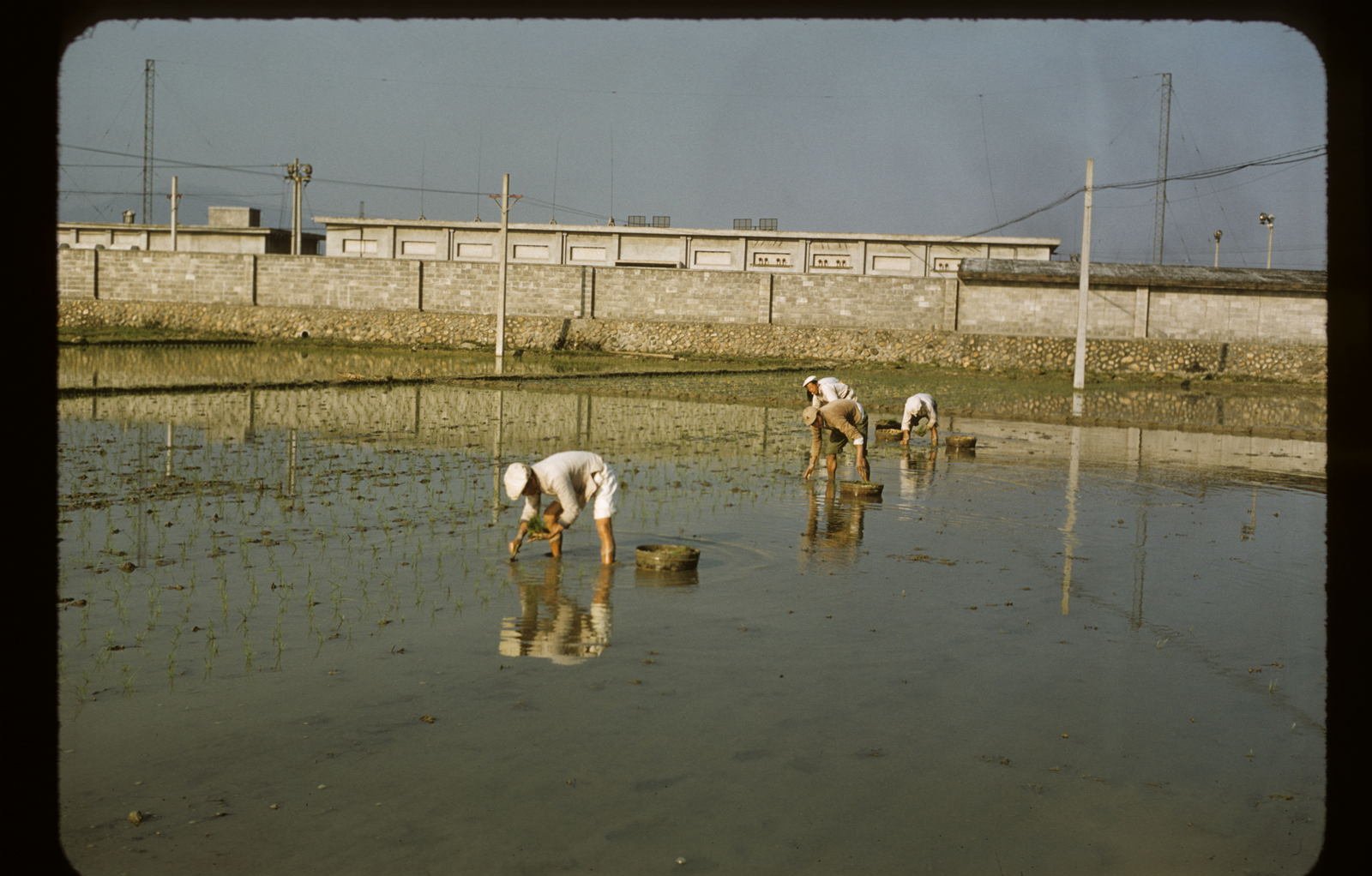
To grasp its weight, stand in the tenant's shoes. In 1949, a tenant family in Taiwan handed over more than half of everything it grew — sometimes as much as 70%.[7] What was left had to feed a household. The land was not theirs; the harvest was not theirs. They were people sweating in someone else's fields.
Four years later, the picture was entirely different. By the end of 1953, more than 194,000 tenant households had received land of their own, and the share of farmland owned by the people who tilled it had leapt from 57% to 90%.[7][10] The reform moved in three steps: the 37.5% rent reduction, the sale of public land, and land-to-the-tiller. It shed no blood — yet it reshuffled an island's land, wealth, and people.
This article tells how those three steps were taken, why they worked, and what they left behind — including the parts that are less honourable.
Chapter 1An Island of Tenants
In 1948, 38.7% of Taiwan's farm households were tenants.[2] Nearly 4 in every 10 farming families owned no land of their own. That figure was not an act of nature; it was the residue of a system built over decades.
During Japan's 50 years of rule over Taiwan, land drifted into fewer and fewer hands. The Japanese took over the Qing dynasty's official lands, and local Taiwanese landlords kept expanding through purchase and mortgage. By the time Japan was defeated in 1945, about 40% of Taiwan's farmland was tilled by tenants who did not own it.[2]
How hard was a tenant's life? Start with the rent. Customarily it ran from 50% to 70% of the harvest, and often there was no written lease at all — a landlord could take the land back at will.[2] Tenants also had to pay a large deposit just to rent a plot. Worse, they had no reason to improve the land: whatever effort they put into levelling a field or enriching the soil, the landlord could reclaim the plot tomorrow, or raise the rent. So the fields were farmed year after year, yields stagnated, and people stayed poor.
This was not only a question of farmers going hungry. In 1949, the Nationalist government had just retreated from mainland China to Taiwan, its footing still unsteady. Across the strait, the Communists were winning peasants over with the slogan of beating the landlords and dividing the land. A new regime that could not answer the question "whose land is this?" could not hold its ground. That was the reform's first motive: political survival.
The second motive came from America. The Sino-American Joint Commission on Rural Reconstruction (JCRR), founded in 1948, arrived in Taiwan with American aid, technical staff, and funding; Washington understood that for a new regime to hold in Asia, the countryside had to be stabilised first.[3] Chiang Monlin, a JCRR commissioner, became the most important advocate of the 37.5% rent reduction.
Chapter 2How 37.5% Was Calculated
The figure 37.5% looks arbitrary. It was, in fact, an arithmetic problem. Chiang Monlin's calculation ran like this: suppose the seed, fertiliser, tools, and labour a farmer put in came to about 25% of the year's harvest; the remaining 75% should be split evenly between landlord and tenant — and half of 75% is exactly 37.5%.[7]
The cleverness of the formula was that it turned a class struggle into a sum. The landlord was not overthrown; the tenant was not handed charity. Each side took what it was "owed". Chen Cheng took office as chairman of the Taiwan Provincial Government on 5 January 1949, and on 14 April he promulgated the rent-reduction regulations.[6][9]
The details mattered. Rent was calculated not on that year's harvest but on the average yield of 1947 and 1948 — a fixed amount, not a rate. In a bumper year, the extra harvest belonged to the tenant; in a bad year, the tenant paid no more.[9] For the first time, tenants had something they had never had: a reason to believe that extra work would pay. On 25 May 1951, the Legislative Yuan went further and passed the 37.5% Arable Rent Reduction Act, fixing all leases at six years and barring landlords from terminating a lease at will during that term. A tenant's rights had legal protection for the first time.[9]
The results came fast. In 1949 alone, 296,043 farm households benefited — 44.5% of all farm households — covering 256,557 hectares under new contracts, 31.4% of all farmland.[9] Rice output climbed from 1.037 million metric tons in 1948 to 1.172 million in 1949, and to 1.517 million in 1952 — a 46% rise in four years.[7]
More telling was how tenants behaved. Between 1949 and 1953, 66,328 tenant households used the money saved from lower rents to buy 35,522 chia of land from landlords — about 34,454 hectares.[2] Rent reduction did more than lighten a burden; it gave tenants, for the first time, a realistic hope of buying the ground beneath their feet.
Chapter 3The Government Was the Biggest Landlord
Rent reduction was only the first step. It governed contracts between private landlords and tenants, but it left untouched another, larger holding: public land. When the Japanese left Taiwan, they left behind vast tracts of official farmland, and the Nationalist government that took them over became the island's largest landlord.
Starting in 1951, the government sold this public farmland to the farmers who actually tilled it, in nine phases.[10] Together with a trial sale in 1948, a total of 138,957 hectares was released to 286,287 farming households.[10] The price was set at 2.5 times the land's annual main-crop yield, payable over ten years in instalments — each year's payment roughly equal to the rent the farmer used to pay, so the burden did not grow, and after ten years the field was his own.
The clever part was what happened to the money. The sale brought in about 367 million kilograms of rice and about 1.255 billion kilograms of sweet potatoes, and every bit of it was channelled into a fund to help owner-farmers — money from the land went back into the land, financing the next round of reform.[10]
The sale of public land also did something rent reduction could not: it let the government demonstrate, with its own actions, that land reform was not a slogan. A government that demanded sacrifices from private landlords while sitting on vast public estates of its own would never have carried the reform through. Sell your own land first, then touch other people's — the order itself was a form of persuasion.
Chapter 4Land to the Tiller
On 26 January 1953, the president promulgated the Land-to-the-Tiller Act, and the reform reached its final and hardest step: the compulsory purchase of private landlords' surplus tenanted land, to be resold to the tenants who farmed it.[1][10]
The Act was full of compromises. A landlord could keep 3 chia of paddy field (about 2.9 hectares) or 6 chia of dry land (about 5.8 hectares); only the excess was expropriated.[10] Farmhouses, drying grounds, ponds, fruit trees, and bamboo groves that tenants used were expropriated along with the land, so that tenants received fields they could actually live on, not bare plots.[1] The purchase price was 2.5 times the land's annual main-crop yield, and tenants repaid it over ten years, with each year's instalment capped at what they used to pay in rent after the reduction.[1]
The compensation paid to landlords was the reform's most ingenious — and most contested — design. Seventy percent of the land price was paid in government-issued land bonds in kind, bearing 4% annual interest and repayable over ten years; the remaining 30% was paid at once in shares of four state-owned enterprises: Taiwan Cement, Taiwan Paper, Taiwan Agriculture and Forestry, and Taiwan Industry and Mining.[10] In other words, the government did not put a gun to landlords' heads. It converted land capital into industrial capital with bonds and shares — landlords lost their fields but gained a ticket into the industrial age.
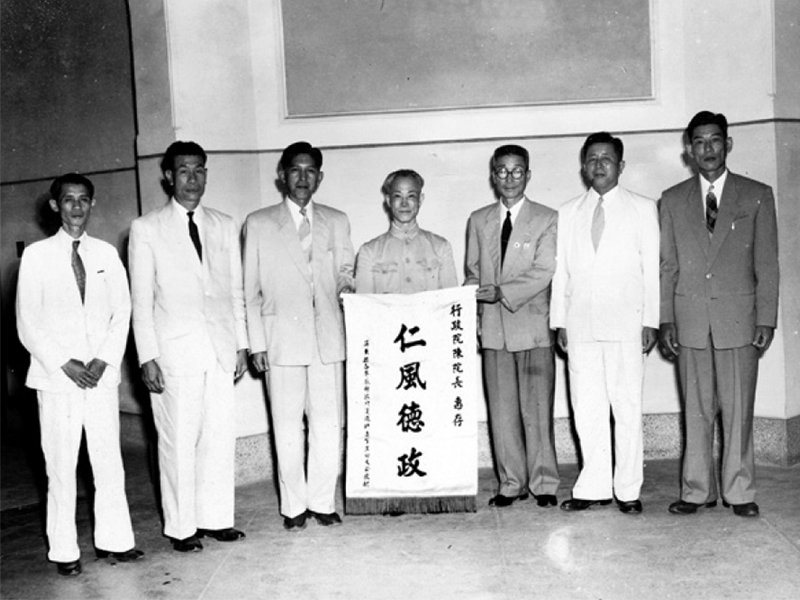
By December 1953, land-to-the-tiller was complete: the government had compulsorily purchased 139,249 hectares from 106,049 landlords and resold it to 194,823 tenant households.[10] A transfer of property involving 100,000 landlords and nearly 200,000 tenants was finished within a year, without large-scale resistance.
But the story of the bonds and shares has a second half. Many small and medium landlords did not trust the paper they were given and sold their shares as soon as they could; Taiwan's five great families bought them up cheaply — the Ku family of Lukang took control of Taiwan Cement, which later grew into the Hsin Group.[10] The wealth of the land flowed along another channel into the pockets of industrial capitalists. The reformers' design — turning land capital into industrial capital — worked out even more thoroughly than planned; only the beneficiaries were not all the original landlords.
Chapter 5Behind the Numbers, Beyond the Myth
Add the three steps together and the numbers are startling. The share of farmland owned by its tillers jumped from 57% in 1951 to 90% in 1953;[7] tenant households fell from 239,939 (38.65% of farm households) in 1949 to 106,856 (12.61%) in 1965; and the share of farmland tilled by tenants dropped from 41.15% in 1949 to 16.32% in 1953.[2] In four years, Taiwan's countryside changed its class structure.
But the other side of the numbers deserves a cool look. An economic-history study published in November 2025 recalculated the record: the three phases together redistributed more than 71% of all rented land, yet they account for only a 5.7% increase in GDP per worker between 1956 and 1966 — a period in which Taiwan's real GDP per worker grew by 101%.[3] In other words, land reform was not the engine of Taiwan's economic miracle; the driving force came later, from export industrialisation and the spread of education.
So what did land reform actually change? The answer lies not in output but in distribution and incentives. Once a tenant became an owner, every bit of effort put into improving the land was his own; every dollar saved for a child's schooling had a purpose; rural savings began to flow into schools, factories, and cities. The reform did not make the fields grow more rice, but it gave the people who grew the rice a reason to plan for tomorrow.
One more contrast cannot be left out. In the same years, mainland China across the strait was also carrying out land reform — by a wholly different method: landlords were struggled against, land was confiscated, and the process was accompanied by large-scale violence. Taiwan chose peaceful redemption: legislation, pricing, bonds, shares, one household at a time. Taiwan's official English-language journal called it a "bloodless revolution".[7] The contrast is not offered to defend either side, but to show that the same problem can have two solutions, at vastly different costs.
Peace, of course, had its own price. Were the bonds and shares landlords received truly worth the land they lost? Under martial law, landlords dared not complain in public, and the question went without open debate for decades. The Land-to-the-Tiller Act was formally repealed on 30 July 1993,[10] but the argument over whether the compensation was fair did not die with it.
EpilogueThe Weight of a Title Deed
Today, Taiwan has fewer than 800,000 farm households, farmland is steadily converted to other uses, and land reform is a term in history textbooks. Yet the question left by that 1949 regulation remains: when a society must redistribute its most important asset, what counts as fair?
The rent reduction answered with arithmetic: 25% of capital, a 75% split, and 37.5% is fair. The sale of public land answered by example: the government sells its own land first. Land-to-the-tiller answered with conversion: land for bonds, bonds for shares, shares for factories. None of the three answers was perfect, but they shared one belief: distribution can be designed, and the quality of the design decides how much a society has to pay.
The day a tenant received his title deed, what changed was not only his property but the way he saw himself. He was no longer "a man sweating in someone else's fields" but someone with a say over his own tomorrow. That change is hard to fit into GDP statistics, yet it was the quietest, firmest foundation on which an island moved from the countryside into the industrial age.
Land reform invented no new variety of rice, and it did not make Taiwan rich overnight. It did something plainer: it let the people who tilled the land own the ground beneath their feet. And whether a society can let people own the fruits of their own labour — that question has not gone out of date since 1949.