PrologueA Halloween Email
On Friday, 31 October 2008 — Halloween — at 18:10 UTC, an email titled "Bitcoin P2P e-cash paper" appeared on the Cryptography mailing list. The sender called himself Satoshi Nakamoto. The first line read: "I've been working on a new electronic cash system that's fully peer-to-peer, with no trusted third party." Attached was a nine-page paper titled Bitcoin: A Peer-to-Peer Electronic Cash System.[2][3]
That year, the whole world was talking about the same thing: whether money could still be trusted. Six weeks earlier, Lehman Brothers had fallen; four weeks earlier, the United States Congress had passed a $700 billion rescue bill. Into that autumn, a person no one had ever seen sent a design no one took seriously to a small group of cryptographers. No press conference, no company, no photograph of the founder. Only nine pages.[3]
This book is about those nine pages. It will not tell you how to buy or sell bitcoin, and it will not predict a price. It asks an older question: when we no longer trust banks, what can we trust instead?
Chapter 1The Year Trust Went Bankrupt
In the early hours of Monday, 15 September 2008, Lehman Brothers Holdings filed for Chapter 11 bankruptcy protection in the United States Bankruptcy Court for the Southern District of New York. The filing listed about $639 billion in assets and about $613 billion in liabilities — the largest bankruptcy in American history at the time. Between the close of trading on 12 September and the bankruptcy announcement, Lehman's shares fell 93%.[5]
Lehman was not the first financial firm to fall, but it was the first to teach the world that "too big to fail" could fail. The government had rescued Bear Stearns, Fannie Mae and Freddie Mac; it did not rescue Lehman. Over that weekend, the Treasury Secretary and the chairman of the Federal Reserve watched the rescue talks collapse. When markets opened on Monday, everyone learned the same lesson: no one could promise who would be next.
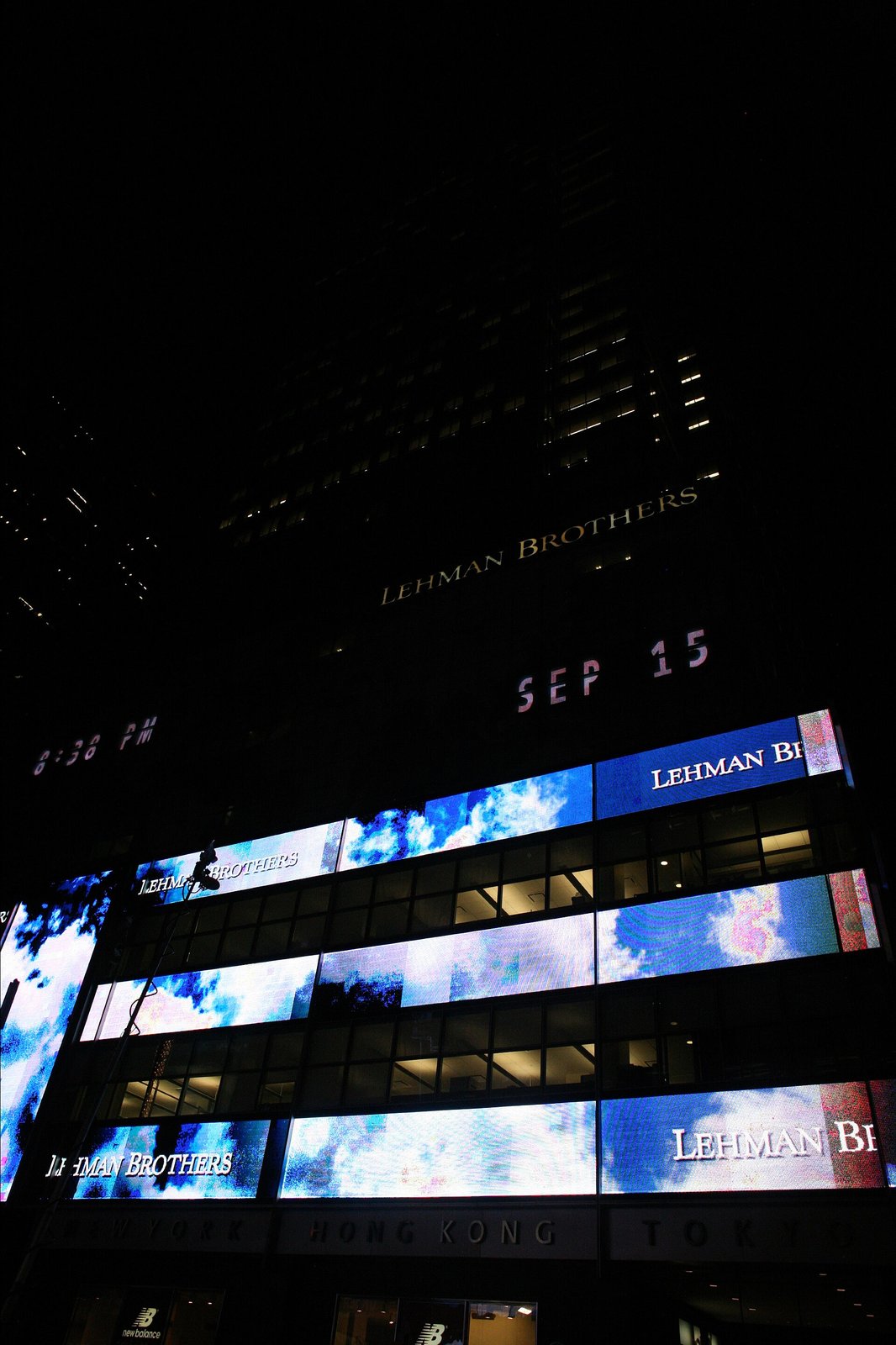
On 29 September, the House of Representatives first rejected the rescue bill; on 3 October, President Bush signed the Emergency Economic Stabilization Act of 2008, authorizing the $700 billion Troubled Asset Relief Program. The bill passed, but trust did not come back. Banks stopped lending to each other, companies could not borrow short-term money, and ordinary people watched their retirement accounts shrink without knowing whom to blame.[3]
The other face of that same year came on 8 August 2008, at 8 p.m., when the Beijing Olympics opened in the Bird's Nest stadium. 91,000 spectators sat in the stands as 15,000 performers staged an opening ceremony that cost more than $100 million. In a single year, the world put on its grandest celebration and suffered its worst collapse. The fireworks and the bankruptcy were less than six weeks apart.[7]
What the financial crisis truly destroyed was not money, but trust. Banks no longer trusted banks, depositors no longer trusted banks, and governments no longer trusted markets to fix themselves. Once trust goes bankrupt, no amount of printed money can buy it back. That was the soil the white paper grew in. It did not talk about bailouts or regulation. It asked a different question: if trust is bankrupt, can money exist in another form?
Chapter 2A Design Without Banks
The white paper itself is short. The version in circulation today runs to nine pages: an abstract, twelve sections, and eight references at the end — about 3,600 words in all. It does not mention the financial crisis once. It does not mention Lehman, the bailout, or price. It does exactly one thing: it describes a payment system that does not need banks.[1][3]
The first sentence of the abstract holds the soul of the whole document: "A purely peer-to-peer version of electronic cash would allow online payments to be sent directly from one party to another without going through a financial institution." There is nothing new in those words. What is radical is "without going through". For centuries, money had to pass through an intermediary — a bank, a clearing house, a central bank. Nakamoto said the intermediary could be removed.[1]
Remove the intermediary and the hardest problem becomes double-spending: the same digital coin spent twice. The paper's answer was to write every transaction into a public chain of time, use proof-of-work to decide who gets to write the next page, and use the rule "the longest chain is the true one" to let the whole network agree on the ledger. No one gives orders. Consensus is computed.
A purely peer-to-peer version of electronic cash
would allow online payments to be sent directly
from one party to another without going through
a financial institution.
There are two things the white paper does not say. First, it never writes the number 21 million. It says only that the number of new coins is predetermined; the 21 million cap comes from the halving rule in the code that followed, not from these nine pages. Second, it never uses the word "blockchain". The term that would later echo around the world does not appear in the paper even once.[10][12]
Both omissions are revealing. Nakamoto was not concerned with terminology, or with price, or even with money itself. He was concerned with the structure of trust: can a system let strangers trade with each other without first trusting any single person? The white paper is an engineering document, and underneath it sits a political question.
Chapter 3A Newspaper Headline in the First Block
On Saturday, 3 January 2009, at 18:15:05 UTC, the first block of Bitcoin was mined. The so-called genesis block contained a single transaction: a mining reward of 50 bitcoin. Because of a quirk in the software, those 50 bitcoin can never be spent.[4]
What made the block immortal was a line of text hidden in the transaction data: "The Times 03/Jan/2009 Chancellor on brink of second bailout for banks." It was the front-page headline of that day's Times of London: the Chancellor of the Exchequer was on the brink of a second bailout for the banks.[4]
The line served two purposes. Technically, it was a timestamp: anyone can look up that day's newspaper and prove the block could not have been created before 3 January 2009. Politically, it was a declaration. Sixty-four days after the white paper, on the first day the system went live, Nakamoto cast that morning's headline into the opening of the ledger — as if to say: if you want to know what this is for, read the newspaper.[4]
Block 1 did not appear until 9 January, six days later. That day, version 0.1 of the Bitcoin software was released. Three days after that, on 12 January 2009, the first real transfer took place: Nakamoto sent 10 bitcoin to the cryptographer Hal Finney, recorded in block 170. Finney was the first person besides Nakamoto to run the software, and one of the early developers of the PGP encryption program. Until then, bitcoin had only ever been created, never handed from one person to another.[8]
Ten bitcoin were worth nothing at the time. It was a test. After receiving the coins, Finney wrote to Nakamoto reporting bugs in the software, and the two began working together. An anonymous person and a named one, on the open internet, using money that had no price yet, made a transaction with no bank in the room.
Chapter 4Money, Handed to Mathematics
Bitcoin's issuance rules live in the code, not in the white paper. New bitcoin is born in only one way: as the reward for mining a block. At first, each block paid 50 bitcoin; every 210,000 blocks, the reward is cut in half. Blocks arrive about every 10 minutes, so a halving happens roughly every four years. 50 became 25, 25 became 12.5, 12.5 became 6.25, and after the fourth halving in April 2024, each block pays only 3.125 bitcoin.[10]
Add up that geometric series and the total comes to just under 21 million bitcoin. On this schedule, the last satoshi — the smallest unit of bitcoin, equal to 0.00000001 bitcoin — will be mined around the year 2140. Counted from 2009, that is an issuance timetable 131 years long.[10]
To keep "about every 10 minutes" honest, the network adjusts the mining difficulty every 2,016 blocks, roughly once every two weeks. More miners, harder puzzles; fewer miners, easier ones. No one holds a meeting, no one signs anything; the rhythm maintains itself.[10]
The most striking thing about these rules is the contrast with 2008. On 25 November 2008, the Federal Reserve announced the first round of quantitative easing, buying $600 billion of mortgage-backed securities. The total supply of money was decided by a small group of people in a meeting room, and it could be changed at any time. Bitcoin's total supply is decided by a piece of public code, and no one can change it — or at least, changing it would require nearly the whole network to agree to run different rules. This is not to say one is better than the other. It is to say that two kinds of money rest on two entirely different kinds of trust. One trusts people. The other trusts mathematics.[6]
Chapter 5Pizza and the Birth of a Price
On 18 May 2010, Laszlo Hanyecz, a programmer in Jacksonville, Florida, posted on the Bitcoin forum: "I'll pay 10,000 bitcoins for a couple of pizzas.. like maybe 2 large ones so I have some left over for the next day." Four days later, on 22 May 2010, the deal was done. Another forum user ordered two large pizzas from Papa John's for him, and Hanyecz sent the 10,000 bitcoin. The two pizzas cost about $25; at the time, the 10,000 bitcoin were worth about $41.[9]
It was the first time anyone had used bitcoin to buy something in the real world. Strictly speaking, the pizzeria never touched bitcoin: the middleman paid with a credit card and took the bitcoin in return. That does not diminish what happened. Until then, bitcoin had circulated only among miners and enthusiasts, and no one knew what it was "worth". From that day on, it had a price: about $0.004 per bitcoin.[9]
People since have loved to joke about those two pizzas, calculating what they would be worth now. The joke misses the point. Hanyecz was not "throwing away a fortune". He was answering a question: can a digital currency with no state behind it and no bank guaranteeing it buy dinner? The answer was yes. From that day on, price stopped being a philosophical question and became a market question.
From nine pages to two pizzas took one year and seven months. A system cannot survive on design alone; someone has to be willing to trade it for something. Hanyecz was hungry, and so bitcoin was eaten for the first time — a sentence that sounds like a joke, and is one of the most honest pages in the whole history of money.
Chapter 6The Man Who Vanished
On 12 December 2010, Nakamoto made his last public post on the Bitcoin forum. It read like a maintenance note: version 0.3.19 of the software added some limits to protect against denial-of-service attacks. No farewell, no explanation. Four months later, on 23 April 2011, he wrote to the developer Mike Hearn: "I've moved on to other things. It's in good hands with Gavin and everyone." Nothing has been heard from him since.[11]
Nakamoto's true identity has never been proven. Over more than a decade, every person named has denied it or failed to produce evidence. On 14 March 2024, the High Court in London ruled that Craig Wright, who had long claimed to be Nakamoto, was not the author of the white paper and did not create the system. All a court could do was rule out one wrong answer.[11]
But perhaps anonymity was part of the design. A system with a founder has a center that can be bought, sued, or silenced. A system without a founder can only be understood, not negotiated with. Nakamoto left the code and nine pages, and took his name with him. Since then, Bitcoin has had no spokesperson, no headquarters, and no one who can speak for it — which is both its most fragile feature and the hardest thing about it to destroy.
Crowd psychology has an old observation: people follow leaders, and they also distrust leaders. Nakamoto's disappearance neatly sidestepped that trap. No one can worship him, and no one can be disappointed by him. All that remains is a set of rules, and a crowd of strangers who choose to follow them.
EpilogueAfter Nine Pages
Eighteen years after it was published, the white paper is still on bitcoin.org, free to download. It predicted no price, promised no return, and guaranteed nothing. It made a diagnosis: when money must flow through intermediaries worth trusting, and the intermediaries are no longer worth trusting, there is a problem. Then it offered an answer: move trust off people and onto mathematics and a public ledger.
Whether the answer is right remains unsettled. Bitcoin has been through four halvings, its price has risen and fallen more times than anyone can count, and the praise and the criticism have never stopped. But one thing is certain: the question asked in that autumn of 2008 has not gone away. Banks still fail, governments still print money, and ordinary people still lie awake wondering whether their money is safe.
Questions Without Answers
To be honest, the following have no reliable answers, and this book will not pretend otherwise:
- Who Satoshi Nakamoto is: no confirmed answer exists. The only evidence that would settle it is a message signed with the private key of an early block, and no such signature has ever appeared.
- Why the cap is 21 million: Nakamoto never explained it in public. The number is not in the white paper, and the code carries no note giving a reason.
- Why six days passed between the genesis block and block 1: there is no definitive explanation, and any account of it is speculation.
Nine pages cannot change the world. What they can do is write a question down clearly, leave it there, and let the world come back to answer it. On 31 October 2008, the world was busy fighting fires, and few people noticed the email. But once a question is written down, it does not go away. It waits — for the next time trust goes bankrupt, when someone will pull it out and read it again.