PROLOGUEOne Island, Half the Planet
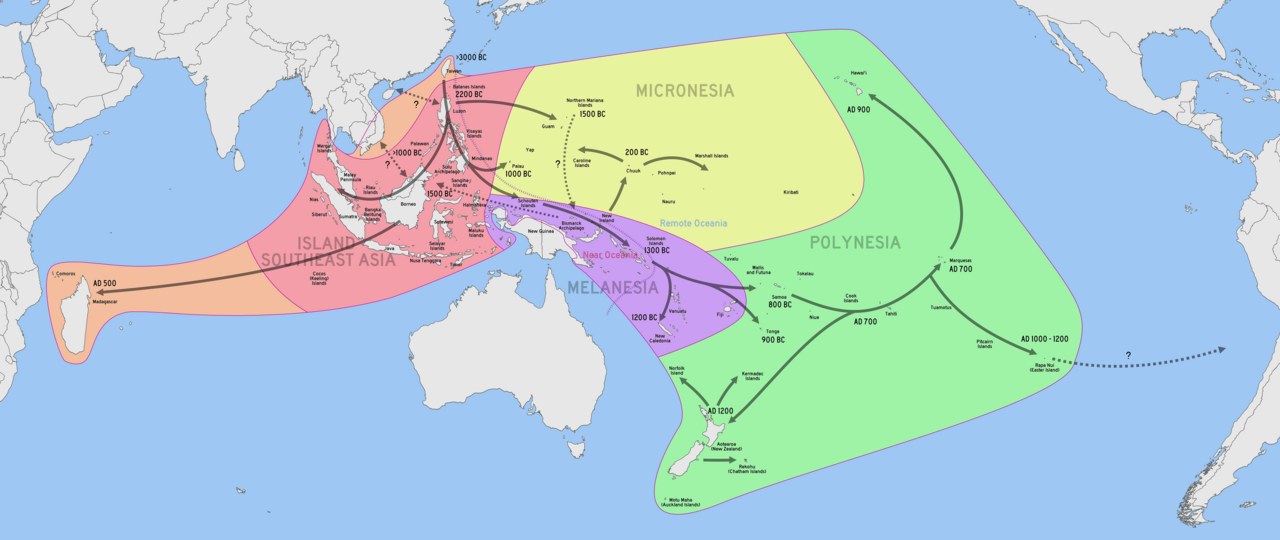
If you plotted everyone who speaks an Austronesian language on a single map, the range would run from Madagascar, off the east coast of Africa, all the way to Rapa Nui (Easter Island) at the eastern edge of the Pacific, and from New Zealand north to Hawaii — half the planet. More than 300 million people speak these languages, nearly 1,250 of them. And all of it began on an island of about 36,000 square kilometres: Taiwan. This book is about the Indigenous peoples who live on that island — how they became the homeland of a language family, and how, after four hundred years of outside rule, they have been taking back their names and their languages, one sentence at a time.
Start with a simple fact: Taiwan's Indigenous peoples today make up only about 2.5 percent of the island's population, roughly 600,000 people. How could so small a group be the starting point of a language family spread across half the Earth? The answer is not in numbers but in language. Linguists have found that the diversity of Taiwan's Indigenous languages is the deepest in the entire Austronesian world — so deep that it can only mean the family began here.
CHAPTER ONENine to One
In 1999, the American linguist Robert Blust proposed a classification that remains mainstream today: the Austronesian family has ten primary branches, nine of which exist only in Taiwan — the Formosan languages — while the single remaining branch, Malayo-Polynesian, contains the nearly 1,200 languages spoken outside Taiwan. In other words, the linguistic diversity of one island matches the rest of the world nine times over. This is the "centre of gravity" principle in linguistics: the place where a family's diversity runs deepest is most likely its homeland.
About 26 Formosan languages survive in Taiwan today, but at least ten have already gone extinct, and another four or five are moribund. Every language that disappears takes with it a way of knowing the world: how a people name the wind, count their kin, speak to their ancestors. From these languages, linguists have reconstructed the words of ancestors five thousand years ago — rice, millet, pig, canoe — words that, like fossils, mark where a farming people came from and where they went.
The name "Austronesian" itself points the way: it comes from the Latin auster, south wind, and the Greek nēsos, island. Austronesian speakers are people who rode the south wind from island to island. And the port they sailed from was Taiwan.
Archaeology points the same way. Between about 3500 and 3000 BC, Neolithic farmers from the Fujian coast crossed the Taiwan Strait and left behind the Dapenkeng culture in northern Taiwan: rice and millet farming, polished stone tools, cord-marked pottery, domestic pigs. The Council of Indigenous Peoples notes that archaeological evidence places human activity in Taiwan as far back as 12,000 to 15,000 years ago; but the Austronesian story truly begins only after these farmers landed.
Where a language family's diversity runs deepest is where it was most likely born. One island, Taiwan, holds nine of Austronesian's ten branches.
CHAPTER TWOSetting Out: A Five-Thousand-Year Voyage
About 5,000 years ago, the descendants of those farmers began leaving Taiwan. They sailed south first, reaching the Batanes Islands and northern Luzon in the Philippines around 2200 BC, then on into the islands of what is now Indonesia. Around 1400 BC the expansion forked: one branch turned west, crossing the Indian Ocean to reach Madagascar, off Africa's east coast, around AD 500; the other turned east, following the trail of dentate-stamped Lapita pottery through Melanesia to reach Fiji, Tonga, and Samoa between about 1000 and 800 BC.
Then came a long pause, and then a second departure. Between about AD 1190 and 1293, East Polynesia was settled in a single concentrated pulse: Rapa Nui around AD 1200–1253, Hawaii around AD 1219–1266, New Zealand around AD 1230–1282. In little more than a century, Polynesian voyagers discovered nearly every island in the eastern Pacific. It was the farthest voyage in human history before the age of writing.
The "Out of Taiwan" model is not without dispute. Some argue the Austronesian dispersal was a multi-directional network rather than a single route; others question whether Taiwan was merely a way station. But the linguistic, archaeological, and genetic evidence broadly points in one direction: Taiwan is the starting point. What is debated is not the origin but the details of the route.
It is worth noting that this expansion was not conquest. Many of the islands the Austronesian voyagers reached had never been inhabited at all: Hawaii, New Zealand, Rapa Nui — they were the first people ever to set foot there. They brought not only language but rice, taro, pigs, chickens, and the canoe — a complete kit for making a new life on a new island.
CHAPTER THREESixteen Names
Back in Taiwan: the government today officially recognises sixteen Indigenous peoples, about 600,000 people in all. The largest is the Amis, roughly 220,000 people spread along the Hualien–Taitung rift valley and coast; the smallest is the Kanakanavu, just 441 people in 2024, living in Namasia, Kaohsiung. In 2014, the Kanakanavu and the Hla'alua became the fifteenth and sixteenth officially recognised peoples — until then they had long been classified under the Tsou.
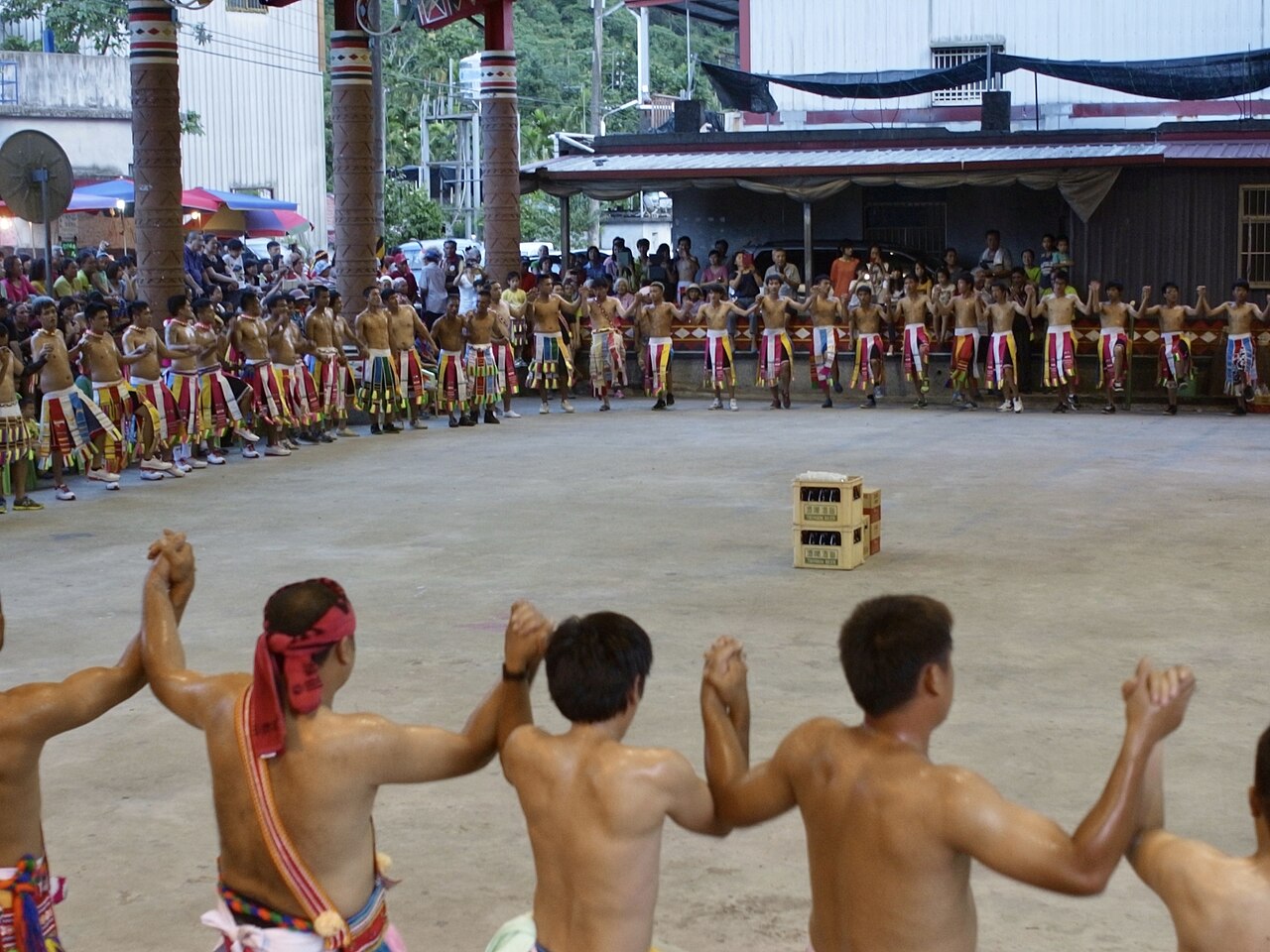
Sixteen names, sixteen languages, sixteen ways of life. The Amis harvest festival, Ilisin, is one of the island's grandest Indigenous ceremonies: from July to September each year, villages take turns holding it, dancing and singing through the night in thanks to the ancestors and the harvest. In Fakong village, Fengbin Township, Hualien, Ilisin is held every year from August 5 to 10, and in September 2024 the Ministry of Culture listed it as a national folk custom — the sixth Indigenous tradition among Taiwan's 24 national folk customs.
The Bunun eight-part polyphony, Pasibutbut, is a single song that made it into the history of world music. Before the millet is sown each year, six to twelve men stand in a circle and sing a prayer for a bountiful millet harvest, their voices layering upward like a waterfall, like bees. In 1943, the Japanese musicologist Takatomo Kurosawa heard it for the first time in the field and was stunned; in 1953 he presented his study of the song at the annual conference of the International Council for Traditional Music, overturning Western music theory's understanding of harmony.
The Tao live on Lanyu (Orchid Island), a volcanic island about 62 kilometres southeast of Taiwan, home to just six villages. Their calendar is set not by the moon but by the flying fish: from February to June each year, flying fish ride the Kuroshio Current north, and Tao fishermen paddle their carved canoes out to sea for the fish-summoning festival. In the Tao language the flying fish is libangbang, a gift from heaven. During the flying fish season, catching reef fish is forbidden, and dried flying fish must be shared with relatives — and with the pigs and dogs. The taboo is itself a system of fisheries management.
CHAPTER FOURThe Silenced Languages
And yet all sixteen of these languages are endangered today. Sixteen languages, 42 dialects — not one of them is safe. On UNESCO's atlas of endangered languages, Saisiyat is listed as severely endangered, while Kanakanavu, Kavalan, Hla'alua, and Thao are critically endangered. A language at the critically endangered stage means only a handful of elders in the whole world still speak it.
How did languages get here? Under Japanese rule, the colonial government pursued assimilation: Indigenous languages and customs were treated as marks of backwardness. After the war, the government imposed a Mandarin-only policy; mother tongues were suppressed in schools and public life, and children were punished for speaking them at school. Generation after generation, the languages retreated from the home to the village, and from the village to the festival. Today, many young Indigenous people can understand their grandmother's words but cannot speak them back.
The loss of a language is not natural ageing; it is the result of a series of policy choices. That matters, because it means the loss is not fate — it can be reversed.
CHAPTER FIVEAfter the Apology
The turn began with law. In 2005, the Indigenous Peoples Basic Law was passed, recognising the collective rights of Indigenous peoples. On August 1, 2016, President Tsai Ing-wen apologised to Indigenous peoples on behalf of the government — the first time in Taiwan's history that a head of state had done so, for four hundred years of suffering and injustice. Representatives of all sixteen peoples sat in the audience; Tsai's own grandmother was Paiwan, making her Taiwan's first president of Indigenous descent. On the same day, the Presidential Office established the Indigenous Historical Justice and Transitional Justice Committee.
On June 14, 2017, the Indigenous Languages Development Act took effect, designating the sixteen peoples' languages as national languages of Taiwan — usable in legislative and judicial proceedings, with local governments beginning to issue official documents written in Indigenous languages. The law lifted these tongues from "dialects" to "national languages." That was more than a change of name: it meant the state acknowledged that these languages are not accents to be corrected, but part of what this country is.
There is also a later justice still arriving. In 2022, the Constitutional Court ruled that the Pingpu peoples, long excluded from Indigenous status, have the right to apply for recognition; in October 2025, the Legislative Yuan passed the Pingpu Indigenous Peoples' Identity Act, and ten Pingpu groups began the application process. If all are recognised, Taiwan's Indigenous population could grow from about 600,000 to more than 1.5 million. Who counts as Indigenous is a question Taiwan has been asking for a hundred years. The answer is still being written.
The work of revival is under way in the villages: language certification, immersion kindergartens, tribal colleges, young people returning home to open guesthouses, make documentaries, write songs in their mother tongues. Reviving a language was never just about preserving recordings; it is about the next generation speaking again at home. A child calling her grandmother by name in her own language — that is revival.
EPILOGUEThe Homeland Is Not in the Past Tense
The word "homeland" easily sounds like the past: a starting point that is over. But the Austronesian homeland is not in the past tense. The languages that set out from Taiwan are still spoken today in Madagascar, Hawaii, New Zealand, and Rapa Nui, and Taiwan's Indigenous peoples are still fighting for their names, their land, and their languages.
How does one island become the homeland of half the planet? Not because it is large, but because it was the first to speak — and never truly stopped. Languages can die, and they can also be reborn; peoples can be renamed, and they can take their names back. Five thousand years ago, farmers paddled out of Taiwan in canoes and carried a language to half the Earth; five thousand years later, their descendants are still on this island, singing harvest songs in words grown from that same language. That is what a homeland means: the starting point is still here, and the story is not finished.
Questions That Remain Open
In honesty, the following two things have no settled answer, and this essay does not pretend otherwise:
- Where exactly in Fujian did the Dapenkeng pioneers set out from, and in how many waves did they cross? The archaeological evidence is still being pieced together, and the details of the departure are unsettled.
- The route of the "Out of Taiwan" dispersal is still debated: a single route, or a multi-directional network? The linguistic, archaeological, and genetic evidence broadly points to Taiwan as the origin, but scholars are still arguing over the details of the route.