PrologueSeptember 1918: A Parade in Philadelphia
On 28 September 1918, Philadelphia held a parade. It was a Liberty Loans parade, to sell war bonds for the First World War, and tens of thousands of people marched through the city centre while crowds lined the streets. The city's director of public health had insisted the mounting deaths were only ordinary flu. Ten days later, more than 1,000 Philadelphians were dead, and another 200,000 were sick. By March 1919, more than 15,000 citizens of Philadelphia had lost their lives.
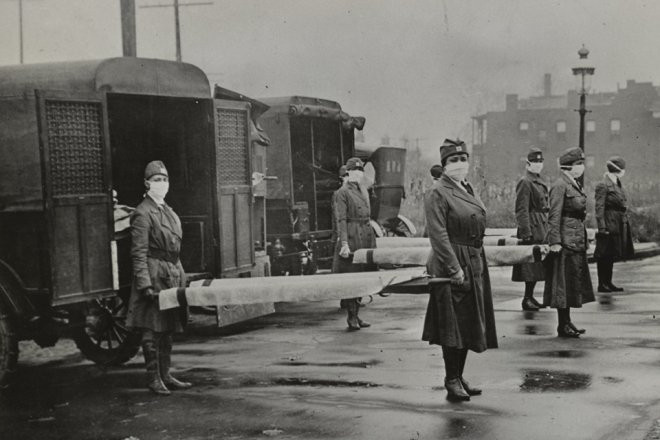
Three hundred kilometres away, St. Louis cancelled its parade. Its health commissioner closed schools and theatres within two days of the first cases. St. Louis's peak weekly death rate was 30 per 100,000 people. Philadelphia's was 250. The two cities had the same virus, the same month, the same country. What differed was one decision, made in time, and one made too late.
The 1918 influenza pandemic infected about 500 million people — roughly a third of the world's population — and killed somewhere between 17 million and 50 million, possibly as many as 100 million. It killed more people than the First World War. And it did so in two years, while the world was looking the other way.
Chapter OneA War's Shadow
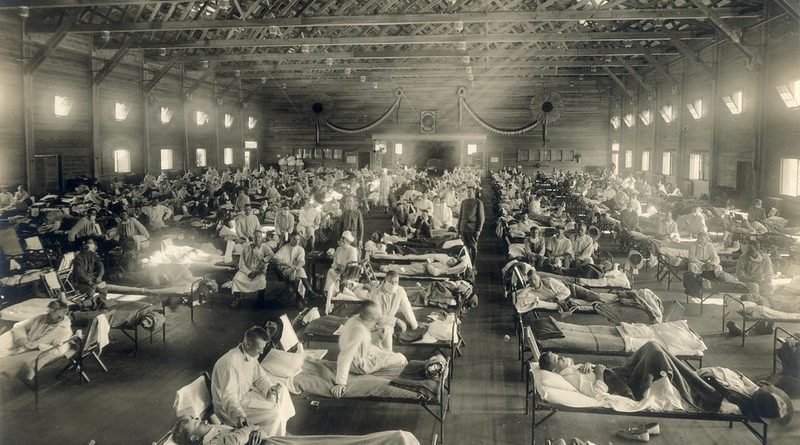
The pandemic came in three waves. The first, in the spring of 1918, was mild: people fell ill, recovered in a few days, and few died. The second, beginning in the second half of August 1918, was the killer — victims died within hours or days, their skin turning blue as their lungs filled with fluid. A third wave followed in the spring of 1919. The whole pandemic ran from February 1918 to April 1920.
The war was the pandemic's engine. Troop ships carried the virus across the Atlantic; crowded barracks and trenches gave it endless new hosts; censorship kept it quiet. The warring governments suppressed news of the disease, because bad news was bad for morale and bad for the war effort. Only neutral Spain reported freely — and so a pandemic that began nobody knows where (the earliest documented cases were in Haskell County, Kansas, in March 1918, though the true origin remains disputed) was named after the one country honest enough to report it. The "Spanish flu" was not Spanish.
It also killed the wrong people. Ordinary flu kills the very young and the very old. The 1918 flu killed healthy young adults in their twenties and thirties — the same age as the soldiers in the trenches. The mortality curve was W-shaped: high among infants, low among children, high again among young adults, low among the middle-aged, high among the old. The leading explanation is that the young adults' strong immune systems overreacted, flooding the lungs — a cytokine storm that drowned the patient from the inside. The people with the most to live for died fastest.
Chapter TwoTwo Cities, One Virus
Philadelphia and St. Louis became the pandemic's controlled experiment — the same virus, two different responses, measured in bodies.
Philadelphia's health director, Wilmer Krusen, refused to cancel the parade. Even as deaths mounted, he insisted it was ordinary flu. The city closed saloons and theatres only after the parade had seeded the disease through tens of thousands of spectators. Hospitals overflowed; bodies piled up faster than they could be buried; the city ran out of coffins. Philadelphia's total pandemic mortality was 748 deaths per 100,000 people — among the highest of any American city.
St. Louis acted within two days of its first cases: schools, theatres and churches closed, gatherings banned. Its total mortality was among the lowest of any major American city, and its peak weekly death rate was barely an eighth of Philadelphia's. The difference was not medicine — there was no vaccine, no antiviral, no antibiotic for the secondary pneumonia that killed most victims. The difference was timing. St. Louis did the same things Philadelphia eventually did, only two weeks earlier. Two weeks was the difference between a bad month and a mass grave.
This is the lesson the two cities teach, and it is the lesson every pandemic since has had to relearn: in an epidemic, the measures that look like an overreaction on the day they are taken are the ones that look like common sense a month later. The cost of acting early is embarrassment. The cost of acting late is counted in funerals.
Chapter ThreeThe World the Flu Left Behind
The pandemic's death toll — at least 50 million by the most widely cited estimates, possibly 100 million — exceeded all military and civilian deaths of the First World War combined. In the United States alone, about 675,000 people died. Villages in Alaska and the Pacific islands lost a third of their people. In India, an estimated 12 to 17 million died. The flu redrew the demographic map of the world in two years, and then it vanished — the virus receded into the ordinary seasonal flu, and the world moved on with indecent speed.
It moved on so fast that the pandemic was almost forgotten. There are no great memorials to the 1918 flu. The war got the monuments, the novels and the remembrance days; the flu got silence. Part of the reason is that the flu's victims died one by one, in hospital wards and at home, without a battlefield to name them. A pandemic has no enemy to blame and no victory to celebrate, so memory has nowhere to hang it.
But the flu left institutions behind. It pushed governments to build public health systems — the world's first ministries of health date from the years just after 1918. It taught epidemiology the value of the map and the count: the Philadelphia–St. Louis comparison became the founding case study of non-pharmaceutical intervention, cited again in every pandemic since, including COVID-19. And it left a scientific legacy: in 2005, researchers reconstructed the 1918 virus from preserved tissue samples, confirming it was an H1N1 influenza A virus of avian origin — and showing how a virus that jumps from birds to humans can kill on a scale no war can match.
Chapter FourWhy We Forgot, and Why It Matters
Societies forget pandemics for the same reason individuals forget trauma: remembering is expensive. The 1918 generation had a war to mourn and a world to rebuild; the flu was folded into the general grief and left there. It took a century — and another pandemic — for the 1918 flu to return to public memory as more than a footnote.
Forgetting has a price. Every generation that forgets 1918 has to rediscover, at full cost, what Philadelphia and St. Louis already proved: that early action works, that crowds are the virus's best friend, that the measures which feel excessive in week one are the ones that save lives in week four. The science of pandemics advanced enormously between 1918 and 2020 — vaccines, antivirals, intensive care — but the social lesson did not change at all. The virus changes; the arithmetic of timing does not.
There is also a quieter lesson. The flu's name was a lie, born of censorship: the countries that hid the disease escaped blame, and the country that reported it honestly was blamed for it. Honesty was punished and secrecy rewarded — and the punishment lasted a century. Every time a government today weighs whether to report an outbreak early, it is deciding whether to repeat that bargain.
EpilogueThe Parade and the Clock
The 1918 pandemic ended the way pandemics end: not with a cure, but with the virus running out of easy targets, and with the survivors carrying immunity forward. By April 1920 it was over. The world went back to work, rebuilt, and forgot.
Philadelphia's parade is still the clearest image of the whole catastrophe: a city celebrating a war effort, marching together in the streets, while a virus rode along in the crowd. No one at the parade meant any harm. No one had to. The harm was in the timing — in the decision to hold the parade at all, and in the days lost while officials insisted everything was normal.
Two years, a third of humanity infected, tens of millions dead — and the difference between the cities that buried thousands and the cities that buried hundreds was measured in days. That is the pandemic's final lesson, and it fits in one sentence: in an epidemic, the calendar is the weapon. Use it early, or it will be used against you.