PrologueThe Last Legal Drink
Late on the night of January 16, 1920, bars across America were packed. At midnight, alcohol would no longer be legal.
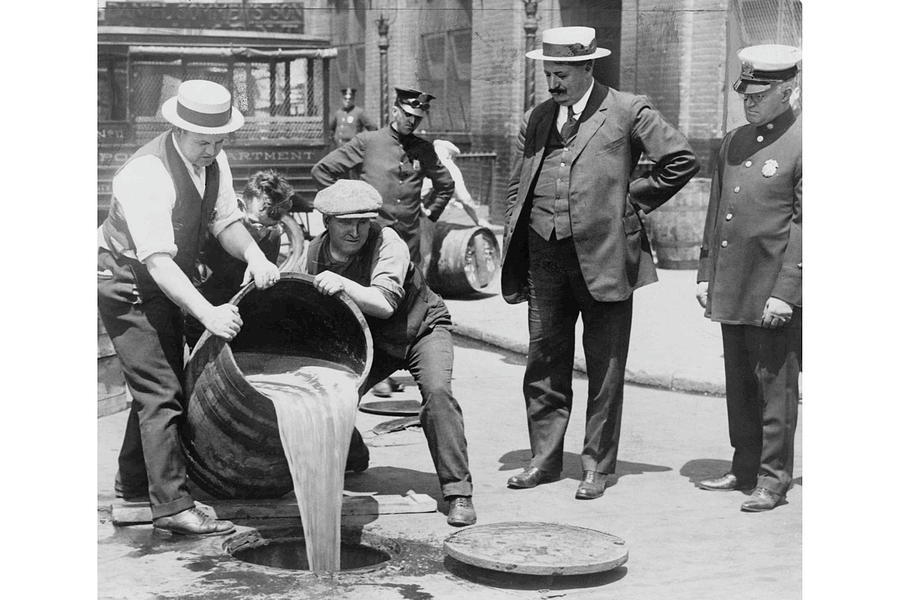
That night, some raised a farewell glass, some emptied their cellars in a hurry, and some poured whole barrels of whiskey into the street sewers, watching the liquor run across the paving stones — as if desire itself could be flushed away fast enough. The next morning, America woke to a different country: an everyday habit had become a crime overnight. No one imagined the experiment would take 13 years to admit defeat.
The story of Prohibition is often told as a farce — gangsters, speakeasies, bootleg liquor, Tommy guns. Beneath the farce lies a more serious question: when a society uses the law to forbid a desire, what actually happens? The answer is not in the statute books. It is in the lives of every American during those 13 years.
This is the story of those 13 years: how a nation used a constitutional amendment to declare war on its own desires — and how, in a single night, it turned law-abiding citizens into accomplices, gangsters into businessmen, policemen into bribe-takers, and, in the end, the government itself into a poisoner.
Chapter OneA Century-Long March — How Morality Entered the Constitution
Prohibition did not fall from the sky overnight. It was the endpoint of a moral crusade that had marched for a century. In the early 19th century, the temperance movement spread from churches and women's groups; the Woman's Christian Temperance Union carried its cause into schools and legislatures, while Wayne Wheeler of the Anti-Saloon League turned Prohibition into a precise political business — he spoke little of theology and much of votes, mobilizing voters to unseat any legislator who refused to go dry.
In the eyes of the prohibitionists, the saloon was more than a place that sold drink. It was the heart of immigrant neighborhoods, the only parlor working men could afford after a shift — and also a nursery of domestic violence and poverty. All three descriptions were true at once, and that was precisely what made the problem so complicated: alcohol did ruin many families, but the saloon was also the only social space many people had. The movement saw the first fact clearly and looked away from the second.
The coalition behind the movement was broader than it looked: churches and women's groups on the front lines, Progressives who saw Prohibition as one reform among many, and factory owners who had done the arithmetic — a hungover worker on Monday morning produced far less than a sober one. Even industrialists like Henry Ford publicly backed the dry cause. People of different motives marched toward the same goal, and that was both the movement's greatest strength and its fatal weakness: once the goal was reached, the coalition dissolved, leaving behind a law nobody truly knew how to enforce.
World War I tipped the balance. Calls to conserve grain, hostility toward German-American brewers, and a wartime prohibition law turned nationwide Prohibition from a fringe demand into a patriotic duty. On December 18, 1917, Congress proposed the Eighteenth Amendment; on January 16, 1919, Nebraska became the 36th state to ratify it, writing the amendment into the Constitution; one year later, on January 17, 1920, nationwide Prohibition took effect.[1]
Few laws have set out with such pure intentions and failed so completely. And the seeds of failure were sown at the very moment of victory: what the law was fighting was not alcohol, but a nation's drinking habit — and habits cannot be written into statutes.
Chapter TwoA Nation of 0.5 Percent
The Volstead Act, passed on October 28, 1919 over President Wilson's veto, defined "intoxicating liquor" as any beverage containing more than 0.5 percent alcohol. Beer, wine, and spirits all fell under the ban.[1] But the amendment left a fatal loophole: it prohibited manufacture, sale, and transportation, but not possession or drinking. A person could finish the liquor stored at home without breaking the law — the statute punished the supplier and spared the consumer. From the first day, the law was only half a law.
Demand did not disappear; supply simply changed hands. New York had 15,000 legal saloons before Prohibition; within a few years, the number of speakeasies was estimated at 32,000 — more than double the legal era. Other estimates put the city's speakeasies between 30,000 and 100,000; no one could count them, because counting them was never a possible task.[7][8]
Speakeasies had their own etiquette: a knock, a password, membership rules, little rooms hidden behind barbershops and flower stores. Liquor came by sea — smuggling ships lined up beyond territorial waters in "Rum Row," with small boats ferrying cargo ashore at night — and from the countryside, where "bathtub gin" was distilled at home, harsh to the taste and drunk all the same. A whole city learned to speak in code, to enter through back doors, to pay in cash. Lying became, for the first time, a daily skill shared by all.
The speakeasy had one more consequence the prohibitionists never foresaw: it turned drinking from a men's saloon pastime into a mixed nightlife. Before Prohibition, respectable women did not enter saloons; a speakeasy had no signboard and no respectability to protect, and women entered public drinking spaces in large numbers for the first time — bobbed hair, short skirts, jazz. Jazz itself traveled north through these underground rooms, from the riverboats of New Orleans into the nights of Chicago and New York. Prohibition set out to make America more decorous, and ended up incubating the most uninhibited side of the Roaring Twenties.
Chapter ThreeThe Golden Age of the Gangster
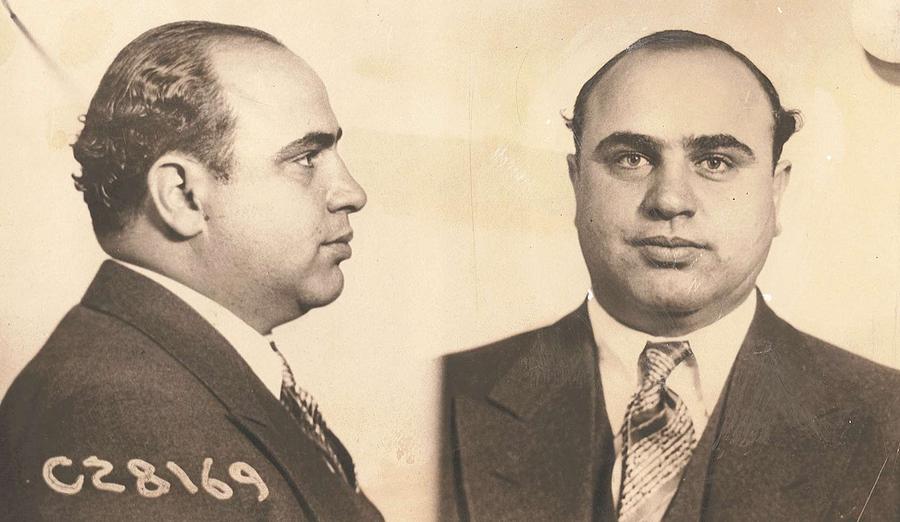
Prohibition's most loyal beneficiaries were those who never believed in the law. Johnny Torrio understood the arithmetic: a market abandoned by the law is a gold mine. In 1925, he handed the Chicago business to a 26-year-old Al Capone. Capone's empire was built on forbidden drink: alcohol alone earned him about $60 million a year, and at their peak, all of his enterprises together brought in more than $100 million a year.[5]
So much money had to be guarded with guns. Between 1920 and 1930, roughly 700 people died in Chicago gang warfare; on February 14, 1929, the St. Valentine's Day Massacre left seven members of a rival gang executed in a garage, shocking the nation.[5] But bribery was a more effective weapon than bullets: police, judges, and mayors were all on Capone's payroll. When law enforcers are paid by lawbreakers, the law is left with only its skin.
Capone was not brought down by a gun but by a ledger. Unable to prove his bootlegging in court, the federal government prosecuted him for tax evasion: on October 17, 1931, a jury convicted him on five counts of tax evasion, sentencing him to 11 years in prison, a $50,000 fine, and $215,000 in back taxes.[6] A man who grew rich on Prohibition was finally defeated by the tax code — the sharpest irony in the whole drama.
Chapter FourThe Theater of the Absurd
The federal government sent out Prohibition agents who numbered just 960 at the start, and no more than 2,300 at their peak, to police a continent-spanning nation.[11] The budget rose from $4.4 million a year to $13.4 million; the Wickersham Commission reported in 1931 that two-thirds of the federal law-enforcement budget was consumed by Prohibition. Over 13 years, direct enforcement cost about $300 million, lost alcohol taxes were estimated at $11 billion, and the federal prison population swelled from 3,720 in 1920 to 13,352 in 1933.[10]
Behind the numbers was pure theater of the absurd. New York's most famous agents, Izzy Einstein and Moe Smith, made 4,932 arrests and seized more than five million bottles of liquor in a thousand disguises, becoming newspaper celebrities — while the city's speakeasies only multiplied.[11] The harder enforcement pressed, the more it proved the law's impotence.
The darkest chapter was written by the government itself. Industrial alcohol was outside the ban, and bootleggers redistilled it for drinking; the Treasury Department therefore ordered manufacturers to lace it with methanol and other poisons, in ever stronger doses. An estimated 10,000 Americans died as a result; at Christmas 1926, dozens in New York alone were hospitalized by tainted liquor and more than 20 died.[9] A movement begun in the name of saving lives ended up poisoning the very people it meant to save. This was no accident. It was the face of a system in despair: when the law cannot make people obey, it tries to make them afraid instead.
Chapter FiveWhat the Numbers Say
To be fair, Prohibition was not a total failure. Economists Jeffrey Miron and Jeffrey Zwiebel estimated that alcohol consumption fell at first to about 30 percent of its pre-Prohibition level, though it later rebounded to 60 to 70 percent.[4] Drink did become scarcer, dearer, and harder to buy. For families that had suffered from a husband's drinking, those 13 years were not entirely a loss.
But the other side of the ledger is crowded with costs: the taxes were gone, the gangsters were rich, the police were corrupted, the prisons were full, poisoned liquor killed, and law-abiding citizens learned to despise the law. Most damning of all, consumption had already climbed back toward its pre-Prohibition level before repeal — the law paid the full price and bought only half the result, and the result was still shrinking.[4]
Then the stock market crashed in 1929, the Great Depression arrived, and the federal government desperately needed revenue. In the 1932 election, the Democratic Party wrote repeal into its platform, and Roosevelt won; the Depression turned the alcohol tax from a moral question into a fiscal one — a government with soaring unemployment and an empty treasury could hardly keep taxing its citizens while refusing a ready source of revenue. On March 22, 1933, President Roosevelt signed the Cullen–Harrison Act, first legalizing beer at 3.2 percent alcohol;[15] within months, the demand to repeal Prohibition became irresistible. What killed Prohibition was not moral argument but economic reality: a bankrupt government could not afford a law that earned nothing.
EpilogueDecember 5, 1933
At 5:32 p.m. on December 5, 1933, Utah became the 36th state to ratify the Twenty-first Amendment, and Prohibition was formally repealed.[13] The Eighteenth Amendment became the only amendment in American constitutional history ever to be repealed.[14] That evening, Americans legally raised their first drink in 13 years.
The legacy Prohibition left behind is worth more thought than the liquor itself. It proved one thing: the law can ban a product, but it cannot ban a desire; it can close the bars, but it cannot close the human wish to sit down somewhere, have a drink, and talk. When law collides head-on with human nature, it is usually the law that loses — and the price of losing is the people's trust in the law itself.
Thirteen years later, the drink came back, but the gangsters never fully left: they carried the organizations, bribery networks, and violence honed during Prohibition into gambling, drugs, and other trades. Prohibition never banned only alcohol. It banned a society's ability to face itself honestly. America took 13 years, $11 billion in lost taxes, and thousands of lives to learn that lesson — and having learned it, still cannot be sure it will not make the same mistake again.
One more thing is often overlooked: Prohibition changed how Americans relate to the law. Before it, most law-abiding citizens treated the law as common sense written down; after it, a whole generation learned to grade each law in their heads first — this one is reasonable, I will obey it; that one is absurd, I will work around it. That habit of selective obedience did not vanish with repeal; it stayed in American political culture. Whenever a later government reaches for a ban to solve a social problem, the ghost of Prohibition is called to testify: a law can be beautifully written, but if it asks a whole society to pretend it is not itself, society will answer with pretense of its own.