PrologueThe Black Ships Arrive
On July 8, 1853, four black ships sailed into Uraga Bay, their steam smoke rising over Edo Bay.
Japan had sealed itself off for more than 200 years, leaving only Nagasaki cracked open to the outside world. Commodore Perry brought no merchant fleet. He brought a letter from the President of the United States and a single sentence: I will return next year, and I will expect an answer. The shogunate had no navy to meet him, and could not even stage a refusal. A nation that had spent two centuries building a wall discovered in a single afternoon that the people outside it had learned to fire cannons.
The real shock was not on the ships but inside people's minds. The Black Ships turned "backwardness" from an abstract word into something visible and tangible: smoking steamers, guns that outranged anything Japan owned, vessels that sailed without looking at the wind. Humiliation has a strange power — it can crush a people, or it can wake one up. Japan woke up, and woke up fast.
This book tells the story of the next 30 years: how an island nation turned humiliation into fuel and foreign pressure into domestic revolution; how a class of samurai abolished the samurai with their own hands, dismantling the floor they stood on; and what that sharp turn ultimately cost. The Meiji Restoration is not only a chapter of history. It is an answer to a question: how far behind must a society fall before it admits that it is behind?
Chapter OneBringing Back the Emperor
For 15 years after the Black Ships, Japan fell into a strange paralysis. The shogunate still existed but could decide nothing; the domains argued endlessly, yet no one could speak for the country as a whole. The slogan "Revere the Emperor, Expel the Barbarians" was shouted to the skies, until even those shouting it realized that slogans alone could not drive the black ships away.
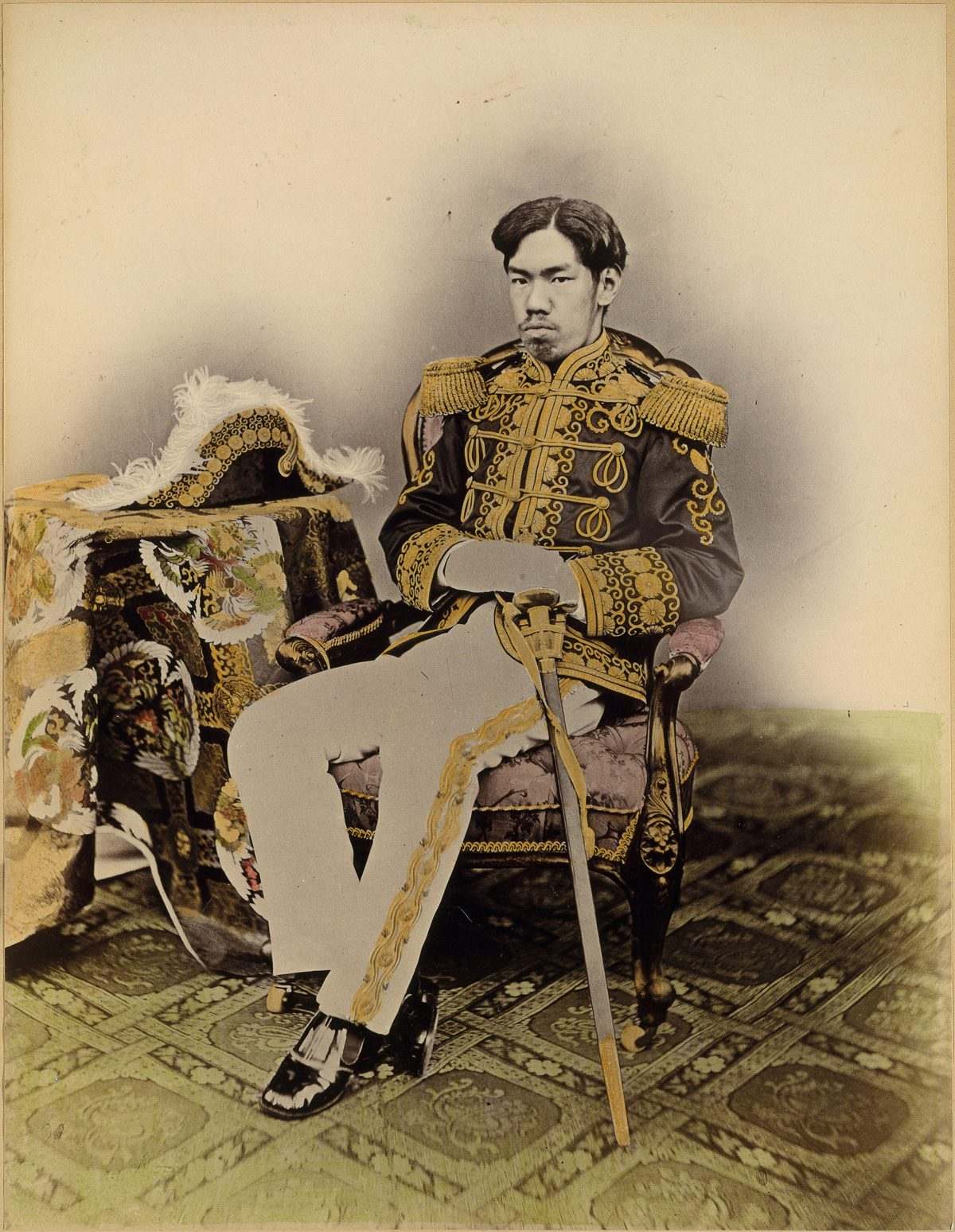
The turning point came from a group of low-ranking samurai. In 1866, Satsuma and Chōshū — two domains that had been bitter enemies — formed an alliance. In November 1867, the last shogun, Tokugawa Yoshinobu, returned political power to the imperial court. On January 3, 1868, the restoration faction staged a coup in Kyoto, proclaimed the restoration of imperial rule, and placed the 15-year-old Emperor Meiji on the throne in name, while real power fell to young reformers from Satsuma and Chōshū. The Boshin War followed, but the outcome was decided before the fighting began: the old order had no one left willing to die for it.
The new government's first act was to move the capital from Kyoto to Edo and rename it Tokyo — "the Eastern Capital." Its second was the Charter Oath of April 1868, promising public discussion, the pursuit of knowledge throughout the world, and the breaking of old customs. Only five articles, vaguely worded, but they were the charter of the entire Restoration: learn from the whole world.
Here lies the Restoration's most intriguing maneuver: it was a revolution flying the flag of restoration. The reformers invented no new legitimacy. They brought the oldest authority of all — the emperor — back to center stage, and used that ancient banner to push through the most radical changes. A crowd needs a familiar symbol before it dares to follow into an unfamiliar future. That is not deception. It is a basic fact of politics: people only follow a flag they recognize.
Chapter TwoAbolishing Themselves
The most astonishing scene of the Restoration came in 1871. By a single decree, the government abolished the domains: more than 260 han became prefectures overnight, and the daimyo surrendered their lands and armies in exchange for stipends. Two years earlier, in 1869, the return of lands and registers had already made the daimyo hand their domains "back" to the emperor; the decree of 1871 simply played the scene to its end.
More thorough still was the liquidation of the samurai class itself. The Conscription Ordinance of 1873 made every man a soldier, ending the samurai monopoly on war; in 1876, the sword ban and the commutation of stipends forbade samurai to wear swords and converted hereditary stipends into one-time government bonds. A class that had ruled Japan for 700 years was dissolved by its own members.
How was it possible? Because the reformers were samurai themselves — low-ranking samurai. They saw most clearly that the samurai class was already hollowed out, buried in debt, its stipends a burden on the state rather than a glory. Better to dismantle it themselves than wait to be crushed by the times. Self-revolution by the privileged sounds like a violation of human nature, but it follows human nature: what people fear most is not losing privilege but losing control of the future. Tear it down yourself, and at least you choose the order of demolition.
Not everyone agreed, of course. In 1877, Saigō Takamori raised an army in Satsuma, and the Satsuma Rebellion broke out. It was the old samurai's last stand and the new government's final examination: government troops — conscripted farmers' sons with modern weapons — won the war, and Saigō died on the battlefield. After that, no one could fight the machinery of the state with a sword again. The age of the samurai ended — not defeated by a foreign enemy, but buried by its own students.
Chapter ThreeGoing West to Learn
In December 1871, the Iwakura Mission sailed from Yokohama: more than 50 senior officials and a party of over 100 people, crossing the Pacific to spend nearly two years touring the United States and 12 European countries, inspecting parliaments, factories, schools, shipyards, and courts, and bringing home a five-volume report. The mission's purpose was stated with disarming frankness: to select, from the institutions of every nation, those best suited to Japan.
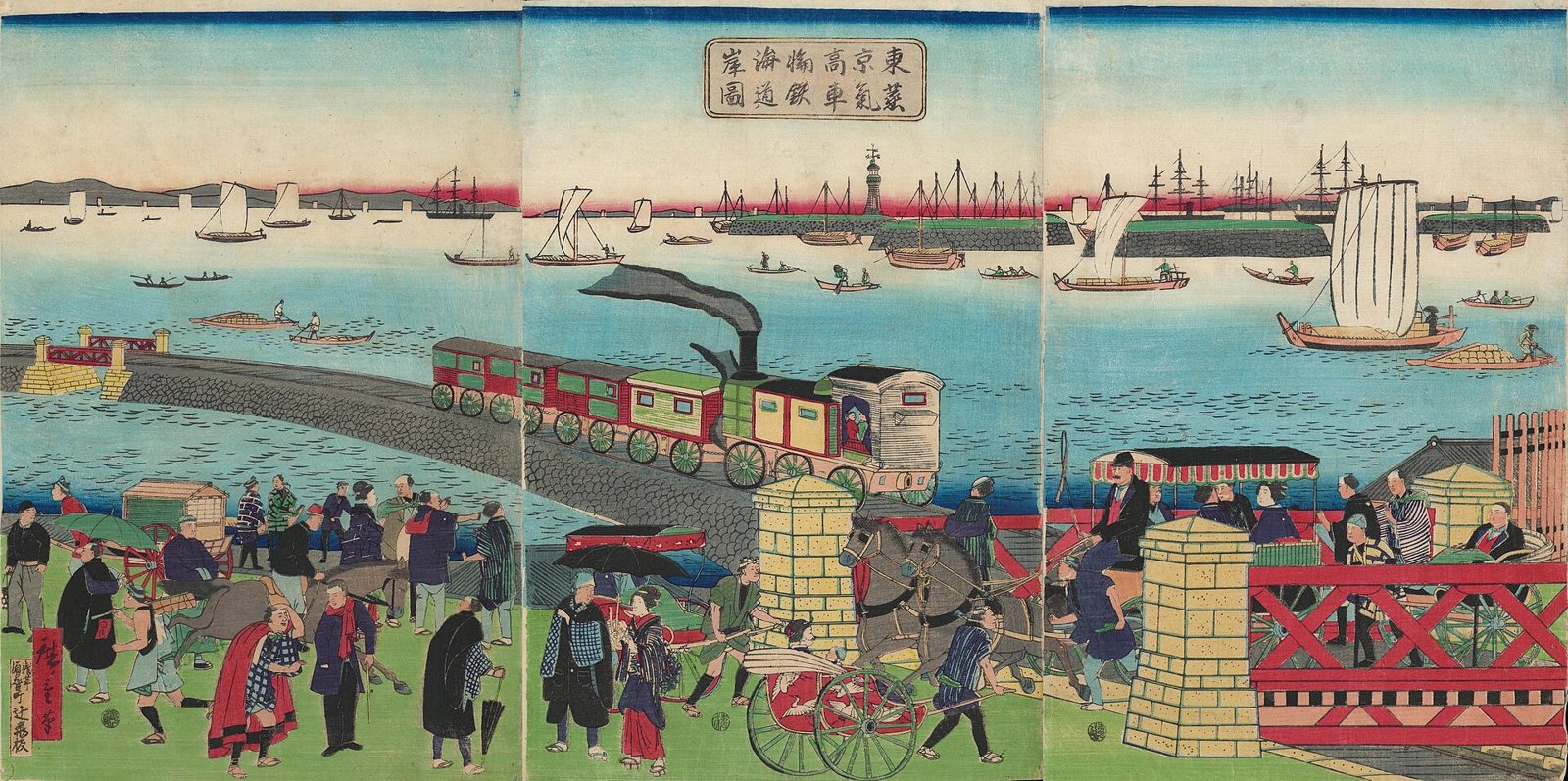
What they learned became law at once. The Education Order of 1872 began compulsory schooling; the Land Tax Reform of 1873 replaced payment in kind with a cash tax of 3 percent of land value, giving the state a stable fiscal foundation for the first time; the Conscription Ordinance of the same year set three years of service; a national postal system opened in 1872, and a national bank was founded in 1873. On October 14, 1872, Japan's first railway opened between Tokyo and Yokohama, with the emperor himself aboard the first train — a locomotive carrying a nation from the age of agriculture into the age of industry.
Japan's way of learning from the West deserves a closer look. It was not wholesale copying but shopping by department: the army from Germany, the navy from Britain, the constitution from Prussia, education from America — each taken from the best in its field at the time. Behind this lay a rare clarity: learning is not worship, it is procurement. Worship makes you lose yourself. Procurement does not.
And procurement requires capital — a literate people. Compulsory schooling carried classrooms into every village, and literacy caught up with Europe within decades. This was the Restoration's most underrated investment: railways and factories can be seen, but the farmer's child who learns to read cannot — and yet the second is what makes the first work. Before a nation can modernize, its people must be able to read the instructions.
Chapter FourDressing Power in a Constitution
By the 1880s, the new government faced a new problem: railways and armies were not enough. As long as the world refused to recognize Japan as a "civilized nation," the unequal treaties would never go away. Foreigners who committed crimes in Japan were not tried by Japanese courts; Japan could not even set its own tariff rates. A country could own trains and factories and still stand beneath others in a courtroom.
The answer was a constitution. Itō Hirobumi led a team to Europe to study, and returned to draft the Meiji Constitution of 1889, modeled on Prussia, with a two-house parliament. The first election to the House of Representatives was held in 1890, returning 300 members — but the vote belonged only to men paying at least 15 yen a year in national taxes, about 1 percent of the population. The constitution granted the people rights while keeping power firmly with the emperor and the elder statesmen. It was a suit cut to measure: constitutional on the outside, authoritarian underneath.
The suit worked. On July 16, 1894, Britain and Japan signed the Treaty of Commerce and Navigation, under which extraterritoriality would end when the treaty came into force on July 17, 1899; the other powers followed. After 40 years, Japan had recovered judicial sovereignty at the negotiating table. The success of treaty revision proved one thing: the international community only recognizes a language it understands, and constitutions, parliaments, and legal codes were the common language of the day.
But the suit had a price. In learning to meet Western standards to win Western recognition, Japan also learned to apply Western standards to others. The other face of "civilization and enlightenment" was the arrogance of "leaving Asia, entering Europe": now that we have modernized, are our neighbors who have not simply backward by their own fault? That question received a bloody answer in 1894.
Chapter FiveTwo Wars as Examination
In 1894, the First Sino-Japanese War broke out. In less than a year, Japan defeated Qing China, and on April 17, 1895, the Treaty of Shimonoseki was signed: China ceded Taiwan, the Pescadores, and the Liaodong Peninsula, paid an indemnity of 200 million silver taels, and recognized Korea's independence. An island nation founded only 27 years earlier had beaten an empire more than ten times its population. Six days later, Russia, Germany, and France intervened, forcing Japan to return Liaodong — the fruit of victory was snatched away before it had even cooled.
Ten years later, Japan settled the account with Russia. The Russo-Japanese War began in February 1904; at Mukden in March 1905 and at Tsushima on May 27–28, 1905, Russia's Baltic Fleet was annihilated. The Treaty of Portsmouth, signed on September 5, 1905, gave Japan southern Sakhalin and the lease of Port Arthur — but no indemnity. Riots erupted in Tokyo's Hibiya Park, as crowds felt the government had "won the war and lost the peace."
The ledger of the two wars is cold and clear. Some 80,000 to 90,000 Japanese died, and the country took on heavy foreign debt; but it bought the recognition of the great powers: an alliance with Britain in 1902, and after 1905, Japan stood as the first Asian nation in modern times to defeat a European great power. From the Black Ships to Tsushima, 52 years. A nation spent half a century turning humiliation into medals.
Only the reverse of the medal carried another message. Winning taught the Japanese that expansion worked and war paid. Once nationalism tastes victory, it is hard to stop. The Meiji Restoration taught Japan how to become strong, but not how to stop once it was strong. At the end of that sharp turn stood a question: for a nation that proves itself by fighting, when is the proof ever enough?
EpilogueLooking Back from 1912
In 1912, Emperor Meiji died, after a reign of 44 years. He had ascended the throne at 15 and died at 59, his life spanning Japan's entire journey from seclusion to great-power status. The country he left behind had railways, a parliament, and colonies — and the seeds of a militarism about to run out of control.
Looking back, the true miracle of the Meiji Restoration was not the railways or the warships, but the speed: in 30 years, one society completed a journey that had taken others 200. The secret of that speed can be put in a single sentence: the Japanese admitted they were behind, then threw the whole nation's strength into catching up. In the same era, Qing China was also "strengthening itself": a foreign-affairs office in 1861, the Jiangnan Arsenal in 1865, the Fuzhou Navy Yard in 1866 — ships and guns were not lacking. But China borrowed only the hardware and left the system untouched: the emperor remained the emperor, the examinations remained the examinations. In 1895, the student defeated the teacher.
Admitting backwardness is the hardest lesson of all. To admit it is to admit that everything you believed was wrong. One person can barely do it; a nation even less so. Japan did it, not through some genius, but through collective humiliation converted into collective action: the fear the Black Ships brought became a national consensus; consensus became institutions, institutions became railways, railways became warships, warships became victory.
But the story has no perfect ending. The Japan that learned to be strong eventually turned its strength to aggression. The success of the Restoration and the disasters that followed ran on the same logic: to survive, one must be strong; to be strong, anything may be sacrificed. This book leaves behind neither praise nor condemnation, but a reminder: a society that can travel from seclusion to strength in 30 years does so by honestly facing its own backwardness; whether it can stop once it is strong depends on another, harder honesty — admitting that strength itself can corrode a nation.