PrologueA Thin Old Man Rides Out
In January 1605, a Madrid bookshop put a new book on display.[3] The title was long, the author unknown, and the story was about a skinny old country gentleman who had gone mad and believed himself a medieval knight-errant, riding an old horse out to look for a fight. Nobody guessed that this joke of a book would become the ancestor of every novel that followed.[1]
The first chapter explains the madness at once: Alonso Quixano, a hidalgo of La Mancha, read chivalric romances until he forgot to eat and sleep, sold his land to buy books, and finally burned his brains out. Cervantes is merciless about the cause — it was not magic that drove him mad. It was books. A man who reads too many stories ends up being read by them.
More than four hundred years later, we still read this book, and not because it is funny. Funny books are plentiful, and they expire. This one has not expired, because it is not about a madman. It is about an illness everyone carries: believing the story inside your head more than the world in front of your eyes.
Chapter OneHow Books Drove a Man Mad
What Quixano read was the bestselling popular fiction of 16th-century Spain: the chivalric romance. Amadís of Gaul fought giants, rescued princesses, kept vigil for his lady — books like these were the television dramas of their day, and everyone followed them.[1]
How far did he go? He stopped sleeping, day and night. He sold his fields to buy books and forgot his meals. The village priest and the barber could not stand it any longer, and in Part One, Chapter 6, they held an inquest over his library and burned most of it.[4] But fire burns paper. It cannot burn a worldview out of a man's head.
His madness was not chaotic. It was orderly. He fitted the world into a complete system of explanation: the inn was a castle, the village girl a princess, the barber's brass basin the enchanted helmet of Mambrino. Everything had its place inside his theory. Once a theory is self-consistent, it no longer needs reality's permission.
That is what makes this book genuinely frightening. Quixano does not ignore the world — he looks at it very carefully. It is only that everything he sees is first translated through the book in his head. We laugh at him, but each of us carries a few "chivalric romances" of our own: a story about ourselves, a story about the world. Once such a story takes shape, facts have a hard time rewriting it.
Chapter TwoThe Windmills
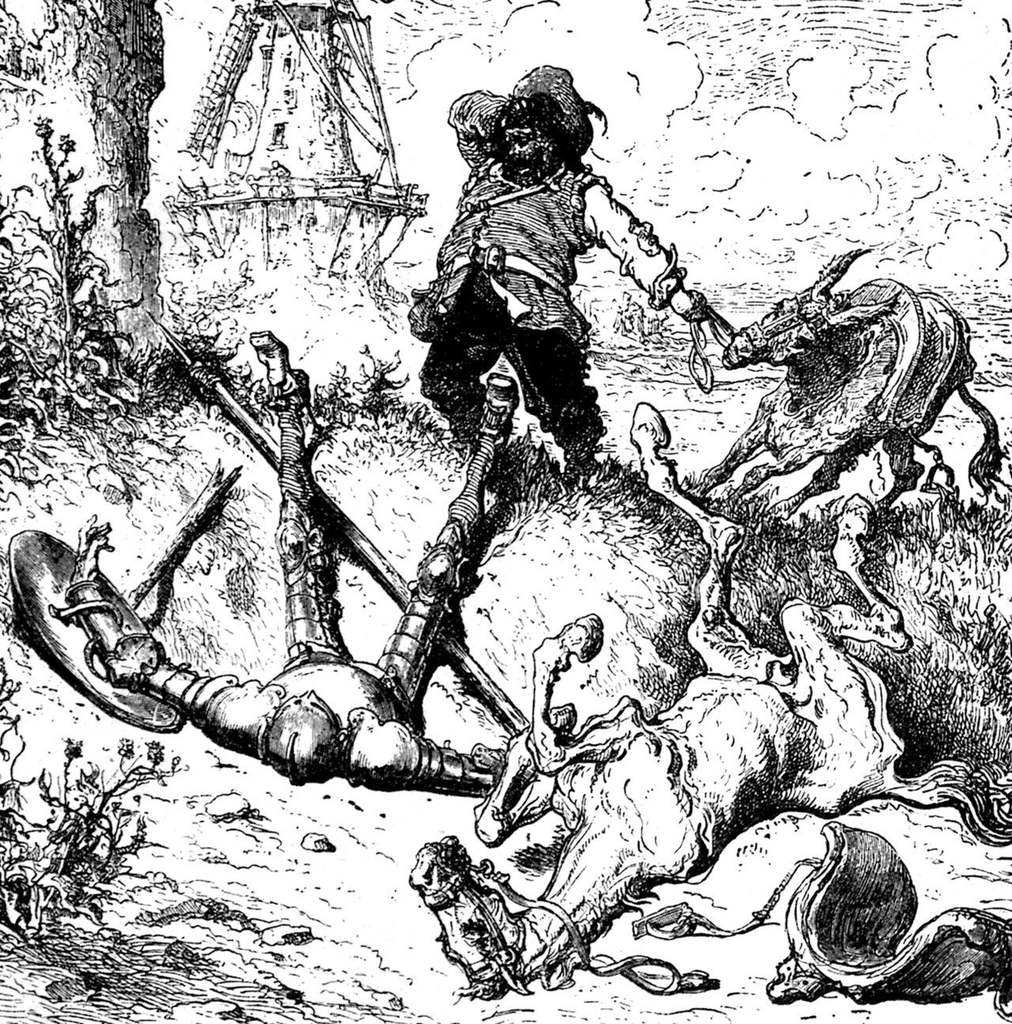
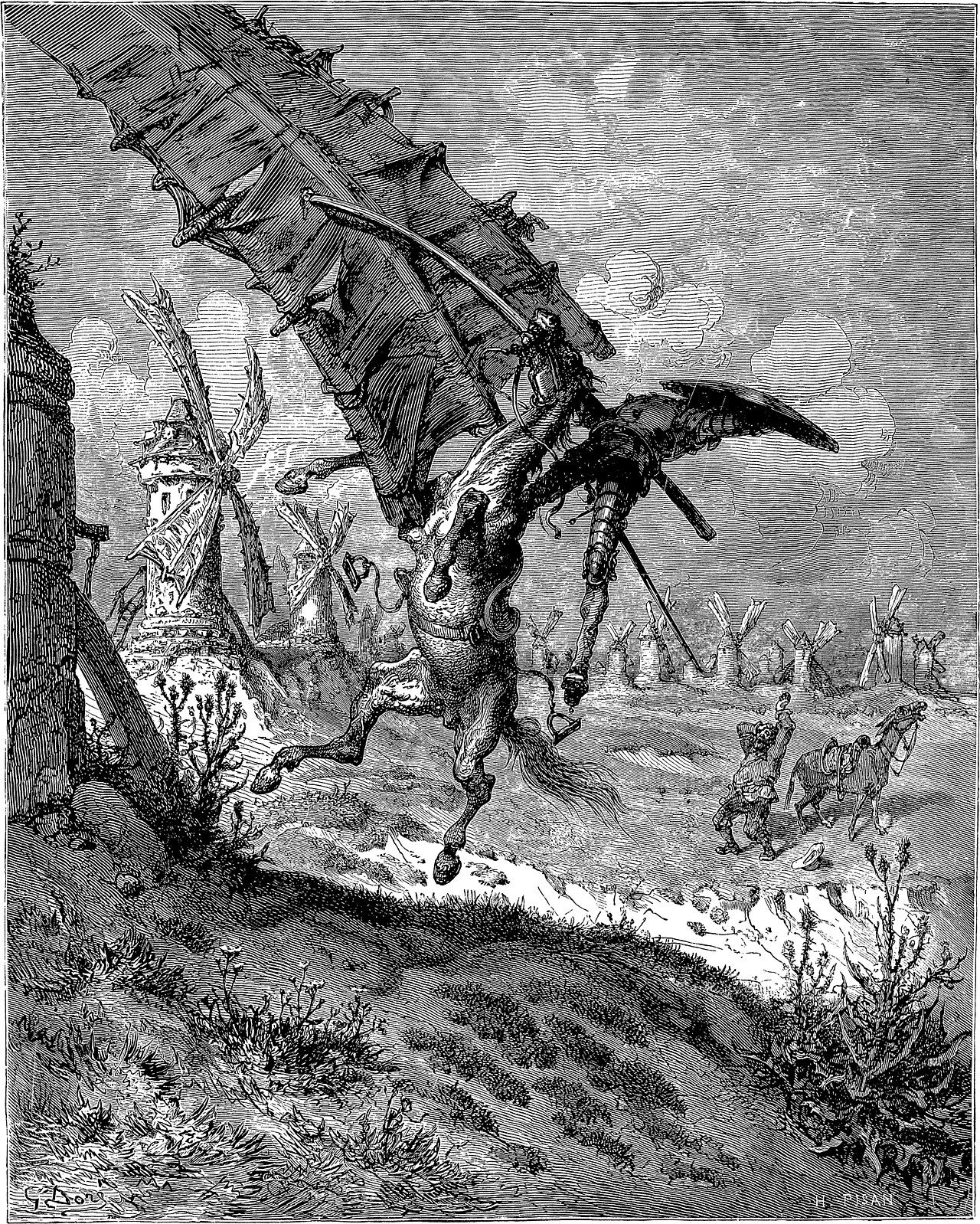
In Part One, Chapter 8, the story reaches its most famous scene. Master and squire come to a plain and see thirty or forty windmills. Don Quixote says: Look, Sancho, there stand thirty or more giants, stretching out their long arms, waiting for me to deal with them.[4]
Sancho says: Master, those are not giants, they are windmills, and those arms are sails. Don Quixote answers: You know nothing of adventures. He digs in his spurs and charges with his lance levelled. The wind catches the sail, the lance shatters on the spot, and horse and rider are flung to the ground, unable to move.[4]
Sancho runs to help him. Don Quixote gets up, dusts himself off, and says: It must have been the enchanter Friston, the same one who stole my study and my books, who turned those giants into windmills to rob me of my victory.
That is his genius — he never "learns his lesson", because his theory comes with a built-in repair kit. If he wins, it is the knight's glory; if he loses, an enchanter interfered. A theory that can explain away its own failures has a name: unfalsifiable. It can never be wrong, so it can never learn anything.
The same scene repeats through the whole book: the inn is a castle, a flock of sheep is an army, a basin is a helmet, a village girl is a princess. His beloved Dulcinea is, in real life, Aldonza Lorenzo, a farm girl from the next village — he does not love a person, he loves a position: a knight must have a lady, and who she actually is hardly matters.[4]
Chapter ThreeSancho's Sanity
If the book had only Don Quixote in it, it would be a mere joke. What makes it literature is the peasant on a donkey riding beside him: Sancho Panza.
Sancho cannot read. He has never opened a chivalric romance. He sees things plainly: a windmill is a windmill, an inn is an inn. He follows his master at first for a single reason — the promise that one day he will conquer an island and make Sancho its governor.
But he stays. As the days pass, the reason changes. He cannot bear to leave the madman — when the madman is beaten, it is Sancho who lifts him up; when the madman goes hungry, it is Sancho who shares his bread. By Part Two, their places quietly reverse: Sancho starts inventing stories to humour his master, claiming Dulcinea has been enchanted into a village girl; Don Quixote believes him and becomes the deceived one. The sane man learns to talk madly, and the madman starts believing other people's madness.
The greatest reversal comes in the middle of Part Two: Sancho actually becomes governor of the island of Barataria. And he governs astonishingly well — judging fairly, taking nothing, and after ten days resigning of his own accord, saying the office weighs too much and he would rather go back to farming.[4] The sanest act of government in the whole book comes from an illiterate peasant; the most deluded quest in the whole book comes from a gentleman who read too many books. Cervantes turns the page gently here: reading a great deal does not guarantee seeing clearly, and never reading does not guarantee blindness.
Chapter FourThe Other Side of the Golden Age
Don Quixote did not go mad out of nowhere. In 1605, the whole of Spain was dreaming the same dream.
On the surface, Spain was the world's first empire: its lands ran from the Americas to the Philippines, from the Netherlands to Naples, an empire on which the sun never set. In the middle of the 16th century, the silver mines of Potosí were opened in the Andes, and silver poured into Seville like a tide. But the tide did not make Spain rich. It pushed prices up and destroyed the country's own manufactures — foreign goods were cheaper, the silver came in and flowed straight back out again, spent on wars and debts. The Crown defaulted again and again, and Spanish output per head peaked in the 1590s and fell to its lowest point by 1640.[8] The glittering "Golden Age" of Spanish culture was precisely the age when the nation's strength began to run out.
Cervantes himself was the empire in miniature. He was born in Alcalá de Henares in 1547; at the Battle of Lepanto in 1571 he took two bullets in the chest and lost the use of his left hand; on his way home in 1575 he was captured and spent 5 years a slave in Algiers, until his family raised 500 gold escudos to ransom him in 1580.[2] Back home he worked as a tax collector and spent time in prison; he was approaching 60 when the first part of Don Quixote appeared, and he had scarcely known an easy day in his life.[2]
So this book is not only laughing at a madman. An empire, too, once believed that glory could be maintained by its ancestors' swords, without ever facing the ledger. Chivalric romance was to Quixano what the imperial myth was to Spain: one man driven mad by reading too many romances is a joke; an entire age marching towards decline because it believed in an outdated glory is a tragedy. On the day Don Quixote rode out on his skinny horse, Spain's Golden Age was riding out on a skinny horse too — only nobody laughed at it, because it was still wearing armour.
Chapter FiveThe Impostor and the Second Part
Part One was published in Madrid in January 1605 and sold so fast that reprints and pirated editions followed within the year.[3] The first printing ran to only a few hundred copies, of which a mere 25 to 30 complete copies survive today.[10] In 1612, Thomas Shelton's English translation appeared in London, the first translation of the book into any language.[1]
Fame brought trouble. In 1614, a man calling himself Alonso Fernández de Avellaneda published a spurious sequel, finishing Don Quixote's story before Cervantes could.[1] Cervantes was furious, and in 1615 he brought out the genuine second part — in which he openly answered the impostor, letting his own characters mock the fake book.[1]
The most startling thing about Part Two is that its characters have read Part One. They know they are famous, they know someone is writing about them, and they even use episodes from Part One to set traps for Don Quixote. The novel begins to look in the mirror: the people inside the story know they are living inside a story.
Then there is the game of narration itself: the whole book claims to be translated from the manuscript of an Arab historian, Cide Hamete Benengeli, as if Cervantes had outsourced his own authority to a fictional man. Unreliable narrators, metafiction, intertextuality — every trick of the modern novel was already rehearsed here, four hundred years ago.
No wonder later ages placed it so high. Georg Lukács called it "the first great novel of world literature"; Lionel Trilling said all prose fiction is a variation on its theme. In 2002, the Norwegian Nobel Institute asked 100 writers from 54 countries, and a majority chose it as the greatest work of fiction ever written.[5] Encyclopaedia Britannica calls it the prototype of the modern novel — not because it was the earliest, but because it was the first to write down the modern condition: living inside a story while believing you live in reality.[1]
EpilogueThe Day He Woke Up
In Part Two, Chapter 74, Don Quixote falls ill. The fever breaks, and his mind clears. He declares that he is no longer a knight, becomes Alonso Quixano once more, makes his will, and dies.[4]
The saddest page in the book is not his madness. It is his sanity. Once he is sane, he has no reason left to live. Sancho weeps and begs him not to wake up, to go adventuring once more; he shakes his head and says it was all a dream. A man can lose so completely and still keep such dignity — that is Cervantes's last gift to the reader.
Cervantes himself died the year after Part Two appeared: on 22 April 1616 in Madrid, and was buried on 23 April.[2] By coincidence, Shakespeare also died on 23 April 1616 — but that was the Julian calendar, equivalent to 3 May in the Gregorian calendar, 10 days after Cervantes.[6] Two giants of literature left the stage in the same year, 10 days apart; one had written human madness to its end, the other human ambition.
We laugh at him for charging windmills, but each of us has a windmill of our own: an outdated glory, a belief that no longer holds, a theory that explains everything. A windmill never fights back and never apologises; it simply stands there and turns. The elegy of Don Quixote is not that he failed, but that he showed us a man can lose so completely and still keep his dignity. The joke of idealism, read to the end, is an elegy. And the other side of an elegy is a question: if you woke up tomorrow morning and found that your windmill was only a windmill after all, would you still ride out?