PrologueBrussels, October 1927
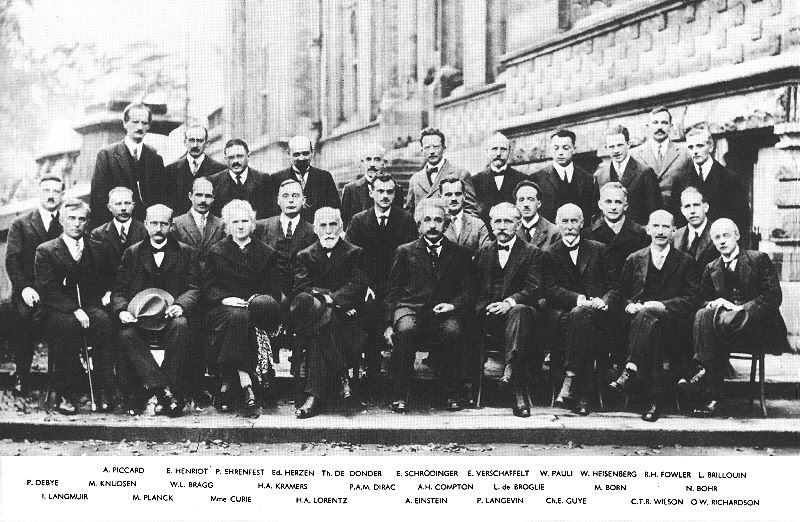
In October 1927, in Brussels, 29 people stood on the steps of a conference hall for a photograph that would later be called the most intelligent picture ever taken: Einstein, Bohr, Planck, Marie Curie, Heisenberg, Schrödinger, Dirac — all of them in one frame. Of the 29, 17 would go on to win Nobel Prizes.
They had just finished a conference on a newborn theory, quantum mechanics. When it ended, nobody could say clearly what the world was actually like. This essay is about what happened in the 27 years before that photograph: how some of the cleverest people alive were forced, step by step, to admit that at the smallest scales, the world stops making sense.
Quantum mechanics is hard not because the mathematics is hard, but because of how much it asks you to give up: orbits, certainty, and the most basic intuition of all — that things are simply there. And the most telling part is that almost nobody who tore the old world down did so willingly.
Chapter OneA Reluctant Revolutionary
By the end of the 19th century, physics looked almost finished: Newton's mechanics governed heaven and earth, Maxwell's electromagnetism governed light and electricity, thermodynamics governed heat and energy, and all that remained was filling in a few more decimal places. At least, that is what most people thought.
Then blackbody radiation broke the pattern. The spectrum of light from a heated cavity refused to fit any classical calculation: at high frequencies, theory predicted the energy would blow up to infinity — the so-called ultraviolet catastrophe. The laboratory data sat there quietly, waiting for someone to admit a mistake.
On 19 October 1900, the German physicist Max Planck presented to the German Physical Society a formula that matched the experimental data perfectly. But he had no derivation for it. To derive it, he was forced into an assumption he did not himself believe: energy is not exchanged continuously, but only in discrete packets, each of size equal to the frequency multiplied by a new constant — E = hν. He put this assumption forward formally on 14 December 1900, a date now treated as the birthday of quantum physics.
That constant, h, now called Planck's constant, is about 6.626×10⁻³⁴ joule-seconds — far too small to notice in everyday life, yet it is the threshold of the new world. Planck later called the assumption "an act of desperation".
Planck was no revolutionary: a conservative, rigorous scholar in the Prussian mould who believed in order. He introduced the quantum only because the formula could not be derived any other way. For more than a decade afterwards, he worked hard to squeeze the quantum back into classical physics, to explain h away as a mathematical trick rather than a fact about the world. He failed. In 1918 he received the Nobel Prize in Physics for the discovery of energy quanta.
Revolutions are rarely started by revolutionaries. They are started by people trying to save the old world who, with nowhere left to go, accidentally let the new one in. Planck opened a door and spent the rest of his life trying to close it; the door would never close again.
Chapter TwoThe Two Faces of Light
Planck treated the quantum as a mathematical trick. But in 1905, the 26-year-old Albert Einstein took it literally. He used the quantum to explain the photoelectric effect: light falling on metal knocks electrons loose, but only if its frequency is above a certain threshold — no matter how bright the light. Classical theory said brightness should matter; the experiment said frequency does. Einstein's conclusion was that light itself comes in packets of energy, later called photons. The paper won him the Nobel Prize in Physics for 1921, awarded in 1922 — for the photoelectric effect, not for relativity.
Physics was now living a kind of split personality: light was sometimes a wave, sometimes a particle, each with iron-clad experiments behind it — and the two contradicted each other.
In 1913, the Dane Niels Bohr carried the quantum into the atom. He proposed that electrons cannot occupy just any orbit, only certain ones, like the steps of a staircase with nowhere to stand in between; an electron absorbs or emits light only when it jumps from one step to another, the energy of the light exactly the difference in height. This explained why hydrogen's spectral lines fall exactly where they do.
In 1924, Louis de Broglie, a French aristocrat, asked the question in reverse: if light can be a particle, can matter be a wave? His doctoral thesis proposed that every particle carries a wave, its wavelength set by its momentum. Few took it seriously — not even, quite, his own examiners.
But the experiments were on his side. In 1927, Clinton Davisson and Lester Germer at Bell Labs fired electrons at a nickel crystal and saw not the scattering of particles but the diffraction pattern of waves, with a sharp peak at a scattering angle of 50 degrees for an accelerating voltage of 54 volts. Electrons really were waves.
The most unsettling evidence came from the double-slit experiment. Send electrons through two slits one at a time, and at first the landing spots look random; but as more accumulate, bright and dark interference fringes emerge, as if each electron had passed through both slits at once and interfered with itself. In 1989, Akira Tonomura and his colleagues at Hitachi's laboratory in Japan filmed this build-up: only one electron in the apparatus at a time, one dot after another, the fringes growing out of nothing.
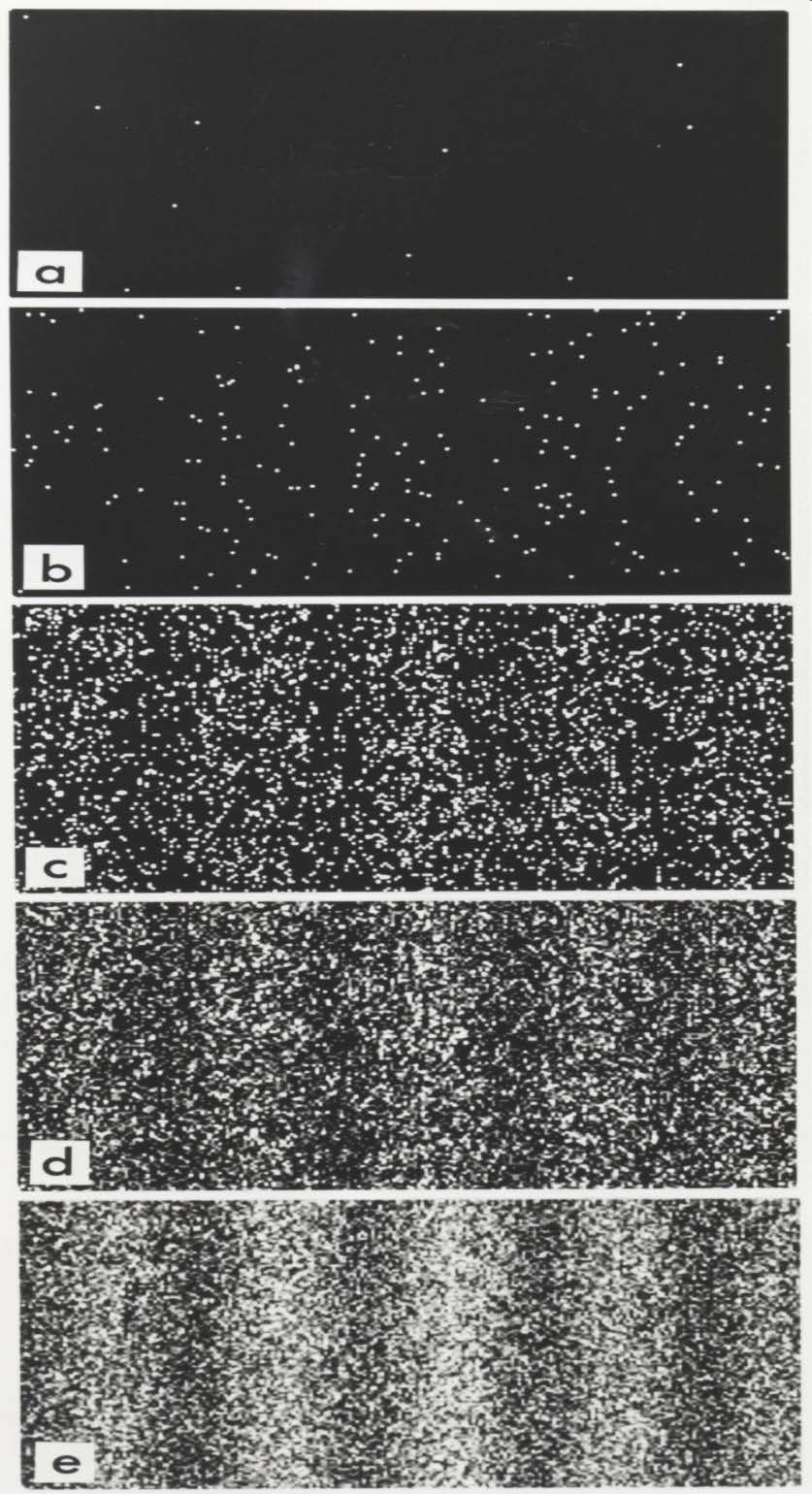
In fact, the first conclusive single-electron double-slit experiment had been done even earlier, in 1974, by Pier Giorgio Merli, Gian Franco Missiroli and Giulio Pozzi in Bologna, Italy — though few people noticed at the time.
Why is this so hard to accept? Because our brains evolved for a medium-sized world: stones, tigers, fruit. We are used to asking "where is it?" and "where is it going?" — but at the scale of the electron, those two questions cannot both have answers. Asking an electron "are you a particle or a wave?" is like asking a person "are you a father or a son?" The answer depends on how you ask. Bohr later called this complementarity: two mutually exclusive descriptions, both true, neither complete.
Chapter ThreeTwo Young Men, Two Mechanics
In June 1925, the 23-year-old Werner Heisenberg, tormented by hay fever, fled Göttingen for Helgoland, a treeless rock in the North Sea. On a sleepless night he saw the point: since nobody has ever seen an electron's orbit, why should a theory talk about orbits at all? He decided to talk only about what experiments can see: the frequencies and intensities of spectral lines. Back in Göttingen, he wrote down a new mechanics in which physical quantities were no longer numbers but tables of numbers, and when you multiplied the tables, the order mattered. His teacher Max Born recognised at once what the tables were: matrices. Matrix mechanics was born, the paper submitted at the end of July 1925.
Half a year later, a second theory arrived from a completely different direction. In 1926, the Austrian Erwin Schrödinger, working in Zurich, wrote down a wave equation: the electron is a smooth wave, and the mathematics is the differential equations physicists had used for a century. Everyone breathed a sigh of relief — here was something you could picture and compute. The young men on the two sides openly disparaged each other's mathematics, and argued all spring.
Then the argument suddenly ended. In the spring of 1926, Schrödinger himself and the American physicist Carl Eckart independently proved that matrix mechanics and wave mechanics were the same theory in two different forms, giving exactly the same numbers. Two languages, one world.
In the same year, Born added the most important sentence of all: the square of the wave function is not where the electron is, but the probability of finding it there. Physics retreated from "predicting what will necessarily happen" to "predicting the probability that it happens" — a retreat that became the foundation of the whole theory.
Chapter FourGod Does Not Play Dice
In February 1927, Heisenberg, in Copenhagen, wrote a 14-page letter to Wolfgang Pauli setting out the uncertainty principle: a particle's position and momentum cannot both be known precisely; the more precisely you know one, the fuzzier the other becomes. This is not a matter of better instruments. It is a property of waves themselves — a wave with a sharply defined position has an ill-defined momentum. The limit is set by Planck's constant, written into the basement of the world.
Einstein could not accept it. In December 1926, in a letter to Born, he wrote: "God does not play dice." He was not objecting to the calculations — those were accurate. He was objecting to probability as the nature of things. To him, probability was only a cover for our ignorance; behind it there must be a definite, not-yet-discovered reality.
The fifth Solvay Conference in October 1927 became the arena for this dispute. Twenty-nine physicists gathered in Brussels. Each morning Einstein proposed a thought experiment to show the new theory contradicting itself; each evening Bohr found the flaw — as Bohr later recalled, the two often argued late into the night. When it ended, neither man was convinced. But most of those present believed the revolution was over.
The dispute was not about technical details. It was about worldviews. Einstein wanted a world that exists whether or not anyone is looking; Bohr answered that physics is not about the world in itself, but about what we can say about the world. One wanted reality; the other wanted honesty. They argued for the rest of their lives, and never reconciled before Einstein's death.
There is one more detail that only became clear later: the name "Copenhagen interpretation" was not coined by Bohr and Heisenberg at all. The two never fully agreed with each other about the theory, and the label was introduced later by its opponents. In other words, even "orthodoxy" itself was named in the course of argument — by the other side — and then adopted by the textbooks.
The younger generation treated uncertainty as liberation: at last, nobody had to pretend the world was deterministic. The older generation saw it as surrender: how could science admit it cannot calculate? Generational change in the history of science is rarely accomplished by evidence. More often it is accomplished by the old guard gradually leaving the stage.
Chapter FiveThe Collapse of Certainty
What quantum mechanics really demolished was not any single law of physics, but a belief that had lasted more than 200 years. Since Newton, the world had been imagined as a precise machine: know the position and velocity of every part at one instant, and past and future can both be calculated. Laplace pushed the idea to its limit, imagining an all-knowing intellect that could see the whole history of the universe at a glance.
Quantum mechanics says: no. You cannot calculate it even in principle — not because information is missing, but because at the smallest scales the world simply does not have a simultaneously definite position and velocity to give you. Randomness is not a defect of measurement. It is written into the rules.
But the world did not fall apart. It worked better than ever. Semiconductors, lasers, magnetic resonance imaging, computers — all built according to these unreasonable rules, and all astonishingly accurate. A theory can be at once "against common sense" and "unbelievably useful": common sense was never a yardstick for the world, only a survival tool we evolved.
Einstein never accepted this outcome. In 1935, he joined Podolsky and Rosen in a paper asking whether quantum mechanics might still be incomplete: two entangled particles, measured far apart, seemed to decide each other's state instantly. At the time it read like philosophy; it would take decades before experiment could actually test it.
EpilogueLiving with Uncertainty
A century on, the argument continues. Many worlds, pilot waves, decoherence — each generation tries to give quantum mechanics a more comfortable interpretation. But one thing is no longer disputed: there is no road back to the classical world. Electrons will not turn back into little planets circling a nucleus just because we miss the orbits.
Without noticing it, what we ask of the world has changed. We used to want a definite answer; now we have learned to accept an honest probability. This change did not happen only in physics. It happens in every life: growing up is discovering the world has no instruction manual, only half-used clues — and learning to decide under uncertainty.
The old world Planck tried to save that night was not saved. But the constant h he left behind became the threshold of the new one: below it, common sense fails; above it, Newton returns. The world did not become incomprehensible. It simply turned out to be wider than we thought — wide enough to hold the definite orbits of planets and the indefinite electron at once.
The world does not make sense, but it follows rules. Learning to tell those two things apart is the most practical gift quantum mechanics leaves us. Sense is what we wish the world were like; rules are how the world actually runs. Mistake the first for the second and you will be disappointed; learn the second, and you can build sensible machines in a world that refuses to make sense.