PrologueThe Vanishing Website
Late on the night of February 24, 2014, the website of Mt. Gox, the world's largest bitcoin exchange, suddenly went blank.
Hours earlier it had still been trading normally. Users refreshed the page, then refreshed it again, and saw the same short notice: trading had been suspended. No explanation, no timetable, no one came forward to answer questions. An exchange that handled 70 percent of the world's bitcoin trading[1] had simply vanished from the internet.
The next day, a document claiming to be an internal crisis-management draft began circulating online, carrying a number that was hard to believe: some 850,000 bitcoins were unaccounted for. Four days later, on February 28, 2014, Mt. Gox filed for civil rehabilitation with the Tokyo District Court, admitting that 750,000 bitcoins belonging to customers and 100,000 of its own had gone missing, worth about $474 million, along with some $27.3 million in cash[3].
This is not the story of a theft. It is a story about trust. Bitcoin was created so that no one would ever have to trust an institution again — and the first thing to die was the institution people trusted most.
Chapter OneIt Started with a Card Game
The strange name Mt. Gox is short for Magic: The Gathering Online eXchange. In 2007, the American programmer Jed McCaleb bought the domain mtgox.com, intending to build an online marketplace for trading cards from the game Magic: The Gathering. The project never took off, and the domain sat idle[1].
In July 2010, McCaleb read about bitcoin on Slashdot and turned the idle domain into a bitcoin exchange, launching it on July 18. Bitcoin was barely a year and a half old, almost no one cared about its price, and the exchange itself was effectively the whole market.
In March 2011, McCaleb sold the exchange to Mark Karpelès, a French programmer living in Tokyo. At the handover, no one imagined that a website cobbled together in two men's spare time would, within three years, handle most of the world's bitcoin trading and hold the savings of hundreds of thousands of people[1].
The problem was buried there from the start. Mt. Gox was never built to the standards of a financial institution. It was a card-trading bazaar that had grown into a bank, with its ledger, its vault and its cash register all squeezed inside one man's head.
Chapter TwoAfter the First Theft
On June 19, 2011, a hacker logged in with credentials stolen from an auditor's computer, placed a huge sell order, and drove the price of bitcoin on the exchange from $17 down to $0.01 within minutes. About 2,000 bitcoins were spirited away, and the user database leaked with them[1].
That was the first alarm. But the fatal hole opened that September, when someone copied the hot wallet's private-key file. The theft ran quietly from late 2011 through the middle of 2013. The independent investigators at WizSec later traced the blockchain record and estimated that about 630,000 bitcoins had been carried off by mid-2013[5]. An indictment unsealed by the U.S. Department of Justice in June 2023 charged two Russian nationals with breaking into Mt. Gox's wallet server from September 2011 and stealing about 647,000 bitcoins[6].
The absurd part was that, on paper, everything looked fine. The exchange's system kept showing users their full balances, as if the coins were still there. Mt. Gox was probably already insolvent in 2011 — it was just that no one had ever opened the vault to look. It did not collapse in February 2014. That was merely when people discovered it had been dead for years.
Chapter ThreeThe False Boom
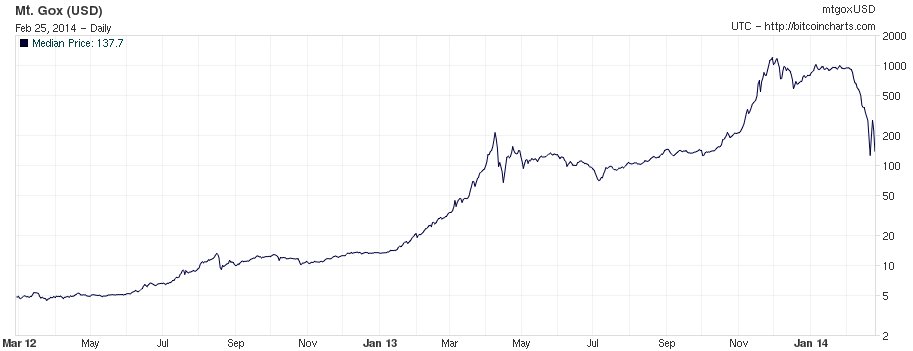
2013 was Mt. Gox's finest year. It handled 70 to 80 percent of the world's bitcoin trading, and its customer count reached about one million by the end of the year. The price of bitcoin took off with it, climbing from around $150 at the start of the year to more than $1,100 by the end of November[1].
But part of that rally was fake. Scholars who later analysed the leaked trading records found that, between February and November 2013, two suspicious traders bought about 600,000 bitcoins with money they had likely never paid. One was called Markus; the other, Willy. Willy used 49 accounts in rotation, each spending exactly $2.5 million and never selling. Together their buying pushed the price of bitcoin from around $150 to above $1,000. Karpelès later admitted in court that the exchange itself had operated the Willy accounts[4].
The warnings had been there all along. On May 2, 2013, the business partner CoinLab sued for $75 million, alleging breach of contract; on May 15, the U.S. Department of Homeland Security, on the grounds that Mt. Gox was operating as an unregistered money transmitter, seized its accounts with Dwolla and Wells Fargo, taking about $5 million by August; on June 20, the exchange suspended dollar withdrawals, and it was not until June 29 that it received a money services business licence from the Financial Crimes Enforcement Network[1].
Still, no one left. In those days, Mt. Gox was not just an exchange — it was the market itself. To leave Mt. Gox was to leave bitcoin.
Chapter FourEighteen Days in February
At the start of 2014, everything still looked fine. On January 6, bitcoin reached its high for the year at $1,017[7]. No one knew the vault was already empty.
On February 7, Mt. Gox abruptly halted all bitcoin withdrawals, blaming a flaw in the bitcoin protocol known as transaction malleability, which it said needed time to fix. Deposits kept flowing in; withdrawals stopped altogether. On February 10, the company issued a statement repeating the claim. But researchers who later examined a full year of network data found no large-scale malleability attacks before the exchange closed — the flaw was an excuse, not a cause[8].
On February 23, Karpelès resigned from the board of the Bitcoin Foundation. The next day, February 24, the exchange suspended all trading, and hours later its website went offline, leaving only a blank page. On February 25, the internal document recording the loss of 850,000 bitcoins leaked[2].
On February 28, Karpelès held a press conference in Tokyo, bowing in apology to creditors in Japanese, before filing for civil rehabilitation with the Tokyo District Court. The 850,000 bitcoins amounted to about 7 percent of all the bitcoins in the world at the time[8]. The image of one man bowing travelled around the world and became one of the most famous pictures in bitcoin's history.
Chapter FiveThe Two Hundred Thousand That Came Back
In March, the story took an absurd turn. On March 20, 2014, Mt. Gox announced that it had found 199,999.99 bitcoins in an old-format wallet that had been in use before June 2011 — a wallet everyone had believed was empty. The total loss was revised down to about 650,000 bitcoins[2].
That an exchange could not even say how much money it had was the whole problem in miniature. On April 24, the Tokyo District Court dismissed the rehabilitation attempt and ordered bankruptcy liquidation, appointing the lawyer Nobuaki Kobayashi as trustee[2].
In 2015, Karpelès was arrested in Japan. In March 2019, the Tokyo District Court handed down its verdict: acquitted of embezzlement, but convicted of falsifying electronic records and sentenced to two and a half years in prison, suspended. The court found that he had inflated the exchange's balances by about $33.5 million, but that there was no evidence he had directly stolen customers' coins[8].
The litigation and liquidation dragged on for a decade. On June 22, 2018, the case moved from bankruptcy liquidation to civil rehabilitation, so that creditors could finally receive bitcoin itself rather than cash at 2014 prices. The rehabilitation plan was confirmed in November 2021, and in July 2024 the trustee began repaying creditors in bitcoin and Bitcoin Cash[2]. Ten years and four months passed between the bankruptcy filing and the first repayment, and the repayment deadline has been pushed back to October 31, 2027[12].
Chapter SixA Decentralized Currency, a Centralized Death
Bitcoin's white paper promised a system that needed no one's trust: no banks, no middlemen, transactions verified by mathematics and a scattered network of nodes. But the promise only went halfway. To buy, sell or store bitcoin, most people still had to go through a company — and that company did exactly what a bank does: it held their money.
Mt. Gox died of precisely the thing it had been so good at hiding. One man was simultaneously the boss, the engineer and the trader; the separation between cold wallets and hot wallets was never enforced; audits were a formality; balances on the books could be invented out of thin air. The bitcoin protocol itself was never broken. What broke was a company's governance. A decentralized currency dying in the hands of a centralized exchange is not irony — it is inevitability: wherever the doorway is centralized, risk concentrates at the doorway.
For the ten years since, the whole industry has been paying tuition for that lesson: cold storage, multi-signature wallets, proof of reserves, licensing and regulation. Every time a new exchange falls, the reason wears a different name, but the substance never changes — the moment customers hand their coins over, the coins stop being theirs. The saying that circulates in the community is, in the end, Mt. Gox's epitaph: not your keys, not your coins.
There is one more cold irony: after Mt. Gox fell, bitcoin did not die, and neither did the exchange industry. What died was the idea that handing your money to someone else meant it was safe. Every tightening of regulation, every proof of reserves, every move to cold storage since then has echoed the same sentence — stop believing that any company will look after your money for you.
EpilogueTen Years Later
In July 2024, the first repayments finally reached creditors. Some people waited ten years to get back coins they had bought a decade earlier. The coins were still there, and their price was long past what it had been — but ten years of waiting is itself a loss no one can repay[2].
The question Mt. Gox left behind still has no settled answer. When a decentralized system can only be used through a centralized doorway, where exactly does trust live? The answer is not in the technology but in the institutions: who holds the keys, who checks the books, who is responsible when things go wrong. Bitcoin solved the problem of how money moves. It never solved the problem of whom to hand it to.
The 850,000 bitcoins never really disappeared. They only changed hands, scattered across countless wallets, most of them still unaccounted for. What truly vanished was the naive belief that "on the books" means "really there." Mt. Gox did not kill bitcoin. It killed blind trust in exchanges — and that trust should never have existed in the first place.