PrologueMidway upon the Journey of Our Life
"Midway upon the journey of our life, I found myself within a forest dark, for the straightforward pathway had been lost."
It is one of the most famous opening lines in Western literature, and Dante's first clue to the reader: this journey does not begin in Heaven. It begins with being lost. When he wrote those words, Dante was about 43 years old, a Florentine who had not been home for many years. He did not imagine Hell from a study; he wrote Hell from exile.
The Divine Comedy tells of a poet who, around Easter, travels through Hell, Purgatory, and Heaven. But what it really tells is something else: how a person who has lost everything learns to see the world again. Someone driven out of a society sees it more clearly than those still inside it — power, the Church, home, the beloved, everything you believed solid shows its cracks in the light of exile. And Dante wrote those cracks down, one by one, into poetry.
Chapter OneThe Exiled Man
Dante was born in Florence around 1265. Florence was then one of the richest, cleverest, and most divided cities in Europe: bankers' gold piled up like mountains, and partisan hatred ran just as deep. The city first split between the Guelphs, who backed the Pope, and the Ghibellines, who backed the Emperor; then the Guelphs split again into Blacks and Whites, fighting not over ideas but over who could drive the other out of the city gates. In 1300, Dante was elected one of the city's six priors and tried to mediate between the two factions; within 2 years, the balance flipped, the Blacks seized power with the support of Pope Boniface VIII, and the army of Charles of Valois marched into the city. Dante was in Rome on a diplomatic mission. He never made it home.[1]
In January 1302, he was condemned in his absence for corruption and opposition to the Pope: fined, stripped of his property, exiled for 2 years. In March of the same year, because he refused to confess and pay the fine, the sentence was raised to death by burning — set foot in Florence again, and he would be burned alive. He never returned.[1] For the next 19 years he lived on the charity of others, lodging in turn at the courts of Verona, Padua, Ravenna, and elsewhere. A man who had once governed a city had become a guest who watched his host's face.
Exile changed more than Dante's address; it changed his eyes. Those who stayed inside the city saw factions and scores; the man thrown out saw how the whole machine worked: the Pope turning faith into a weapon, bankers turning money into power, a city carrying out revenge in the name of the law. More cruel still, what destroyed him was not abstract fate but particular people — men he knew, had eaten with, had voted beside in council. When a majority decides to turn a minority into enemies, the procedure can run flawlessly and the result can still be persecution.
So he wrote his enemies into the poem, one by one. Popes, political rivals, usurers, traitors — all of them found their place in the Comedy. But this is not a book of revenge; had it been only revenge, it would not have outlived a generation. Dante's real question was: how does a society walk, step by step, to such a place? The answer had to be sought in Hell.
Chapter TwoHell Is a Mirror
The whole poem runs to 100 cantos: 34 for Hell, 33 each for Purgatory and Heaven, 14,233 lines in all, bound together in interlocking tercets.[2] The numbers are themselves a theology: 3 for the Trinity, 33 for the years of Christ's life, 100 for perfection. Dante was not showing off; he was speaking through form — even the skeleton of the poem must obey order, because what he was writing about was a world that had lost it.
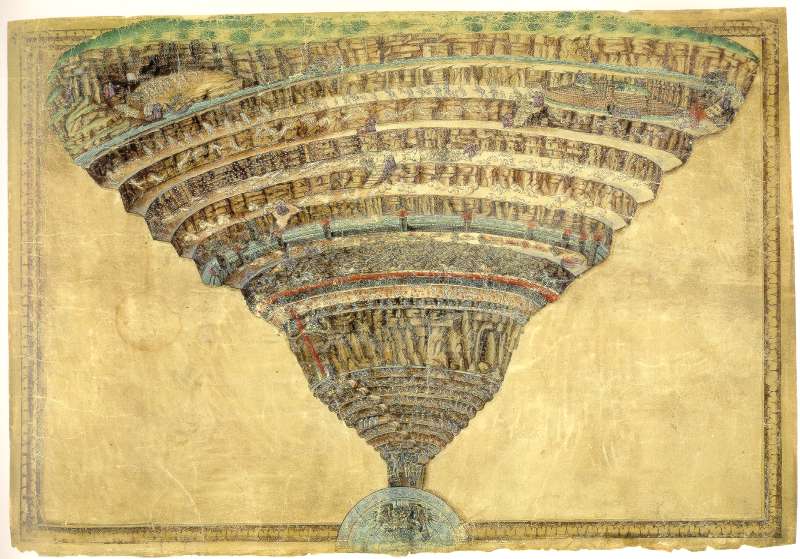
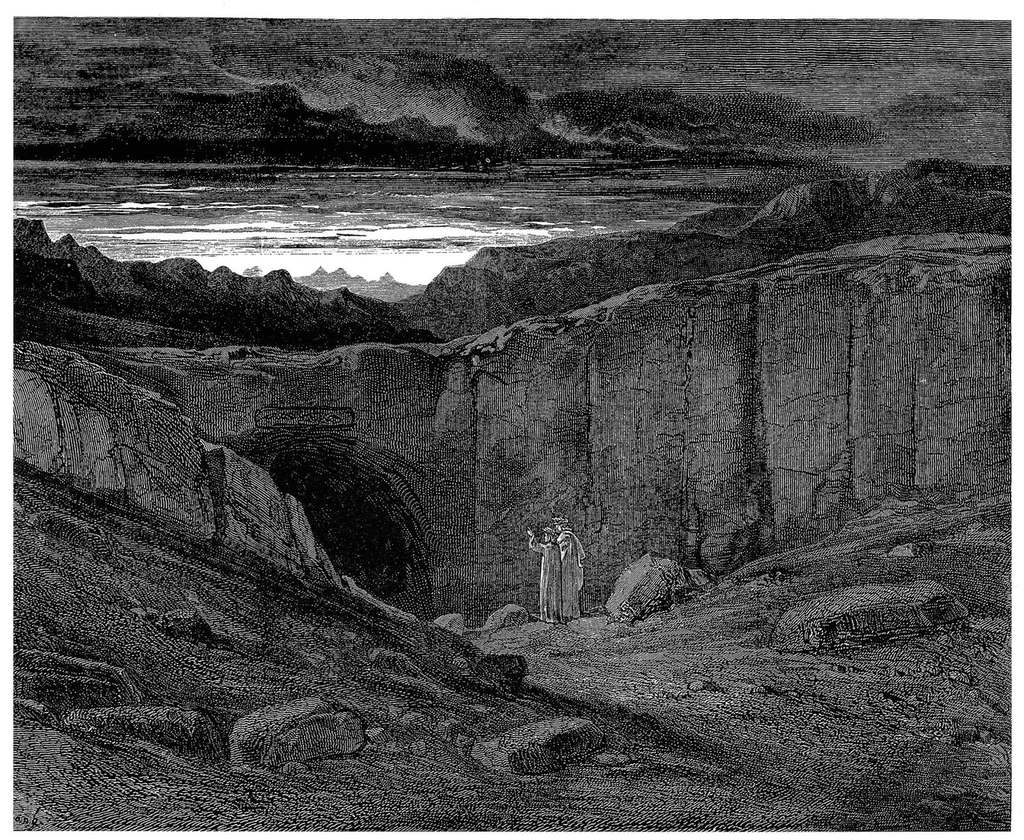
Over the gate of Hell stands a sentence: "Abandon all hope, ye who enter here." In Doré's engraving, Dante and Virgil are two tiny figures before the black arch. What disturbs most about Dante's Hell is not the fire and torture but its rationality: every punishment fits the sin exactly, the greedy shoving heavy weights against each other, traitors frozen in a lake of ice, simoniac popes planted head-down in burning pits. Between sin and punishment stands a mirror: you were, in life, what you are forever after death — only now there is no more chance to change.
That is why the most moving scenes in Hell are not the torments but the recognitions: Paolo and Francesca, dead for love, in the fifth canto; Count Ugolino, starved to death in a tower with his sons, in the 33rd. These people are not monsters. They have talent and passion; they simply chose wrongly. Hell is terrifying precisely because it is full of living human beings, not symbols.
Dante put popes in Hell too. Nicholas III, who sold church offices, hangs upside down in his pit with flames licking his feet; a place is already reserved for Boniface VIII, waiting for him to arrive after death.[2] To write such a poem in the early 14th century took more than courage: when the Church itself had become the center of corruption, where was faith to go? Dante's answer was to take the power of judgment away from human courts and hand it to a poem. A poem cannot burn anyone. But it can keep a name standing in the dock 700 years later.
Chapter ThreePurgatory: The Only Place with an Exit
If Hell is the architecture of despair, Purgatory is the architecture of hope. It is a mountain in the middle of the sea, and souls climb it ring by ring, washing away the 7 deadly sins. Each level is a labor and also a release. Time in Hell is frozen; time in Purgatory flows: the people of Hell will never change, the people of Purgatory change a little every day.
At the foot of the mountain stands Cato the Younger, a pagan, posted to guard the gate of salvation because he spent his life defending freedom. Freedom is not the property of any one doctrine; it is the precondition of all redemption. Without freedom, there is no repentance.
In Purgatory, Virgil still walks at Dante's side. The Roman poet is reason itself: he can lead you to recognize your errors and walk out of the dark, but he cannot lead you into Heaven. At the summit, Virgil hands Dante to Beatrice: from here on, you must judge for yourself. It is the tenderest and most ruthless moment in the whole poem — the teacher's work is done, the student's freedom begins.
Who was Beatrice? A girl Dante had seen in Florence when he was 9 years old, who married a banker and died at 24.[7] Dante wrote the Vita Nuova for her, and years after her death he was still thinking of her; in the end he made her the guide of Heaven. She is the part of Dante that exile never polluted — proof, held in memory, that a man who has lost everything once loved and once believed in something. The exit from Purgatory is not at the summit. It is inside a person willing to believe again.
Chapter FourHeaven and the Limits of Language
Heaven is the hardest part of the Comedy to write, and the easiest to misread. No torture, no plot; 33 cantos of almost nothing but light, music, and theological conversation. Dante knew the difficulty himself: in Heaven, language begins to fail. Again and again he tells the reader that what he saw exceeds what words can carry, that memory runs through his fingers like water.
Heaven has 9 spheres — Moon, Mercury, Venus, Sun, Mars, Jupiter, Saturn, the Fixed Stars, the Primum Mobile — and above them the Empyrean, where there is no space or time, only God himself.[2] Each sphere holds one kind of soul: the chaste, lovers, the wise, martyrs, just kings, contemplatives. In the sixth canto Dante meets the emperor Justinian, who tells him the history of the Roman Empire. This is Dante's political testament: emperor and pope should each keep to their own charge, one governing the order of this world, the other the salvation of souls; whoever oversteps, the world falls apart. No one adopted the idea at the time, yet it became the distant ancestor of the separation of church and state.
Beatrice leads Dante through the 9 heavens and, in the 31st canto, returns to her seat and hands him to Saint Bernard.[2] Her leaving has no farewell; she simply returns into the light. And what Dante sees in the final canto is not a face, not a throne, but a light, within which three rings dwell together in a single radiance. The poem's last line is: "the Love that moves the sun and the other stars." The poem ends here, because language has reached its end.
This is the most modern thing about the Comedy: it admits that reason and language have a boundary, and it makes the boundary itself the climax of the poem. Hell can be described, because sin has a shape; Heaven can only be pointed at, because love has none. That honesty is more persuasive than any theological argument — it still makes readers, 700 years later, believe that this man really saw something, even if he could not say it.
Chapter FiveHow a Dialect Became a Nation
The most far-reaching effect of the Comedy is not theological but linguistic. Dante wrote this long poem in the Tuscan vernacular, not in Latin. In the early 14th century, that was almost a provocation: Latin was the language of scholars, the Church, and the law; the vernacular was the language of the market, the kitchen, and the street. To write an epic in the vernacular was to declare that the language of the street could carry the most serious thought.
Dante did not decide this on impulse. Early in his exile he wrote the Latin treatise De vulgari eloquentia, completed around 1302–1305, arguing that the vernacular is nobler than Latin because it is learned naturally, while Latin must be painstakingly studied at school.[3] He counted at least 14 vernaculars across Italy, searching for an "illustrious vernacular," and judged Tuscan the most worthy.[3] He turned the theory into fact with the Comedy: a vernacular poem written with more power than any Latin work, and so the vernacular stopped being a dialect. It became Italian.
A peninsula with no political unity first gained a common literary language, and only centuries later a nation. Language walked ahead of politics; that is Dante's most solid legacy to Italy. The adjective "Divine" was never used by Dante himself: he called the poem simply the Comedy, because it begins in suffering and ends in happiness. The word "Divine" first appears in Boccaccio's life of Dante, written between 1351 and 1355, and was put on the title page by the Venetian edition of 1555.[2] Later generations crowned his poem, but the crown was one the poem earned itself.
Driven out of Florence, Dante lost a city and gained the whole freedom of a language. Exile did not make him smaller; it made him larger — large enough to hold Hell, Purgatory, and Heaven, and the future of a people not yet born.
EpilogueSeptember 1321, Ravenna
On September 13 or 14, 1321, Dante died in Ravenna, about 56 years old, only a short time after finishing the Comedy.[1] He died in another man's city. It was not until 2008 that the city council of Florence symbolically revoked his death sentence — 706 years late.[8]
That late rehabilitation says exactly why the Comedy is still alive: a city can sentence a man, time can overturn a city, and a poem can outlive them both. As Dante was writing Hell, Pope Clement V was moving the papal court to Avignon, where it would remain in the shadow of the French king for nearly 70 years;[4] as he was writing Heaven, Giotto had just finished the frescoes of the Scrovegni Chapel in Padua — and the father of the banker who paid for it was the usurer Dante had written into the 17th canto of Hell.[5] Power, art, and judgment were all crowded into a single age, and Dante gathered them all into one poem.
To read the Comedy today, you need not believe medieval theology. You need only recognize a situation: walking in a dark forest, the straightforward pathway lost. Dante offers no map, only a method — look downward until you see clearly, then climb, until language runs out and the light is still there. Books written by exiles are often more honest than books written by victors, because the exile has nothing left to lose except what he has to say: a person can lose home, standing, everything, and still not be truly lost, so long as he can still tell good from evil and still look up at the stars.