PrologueThe Woman in the Lead Box
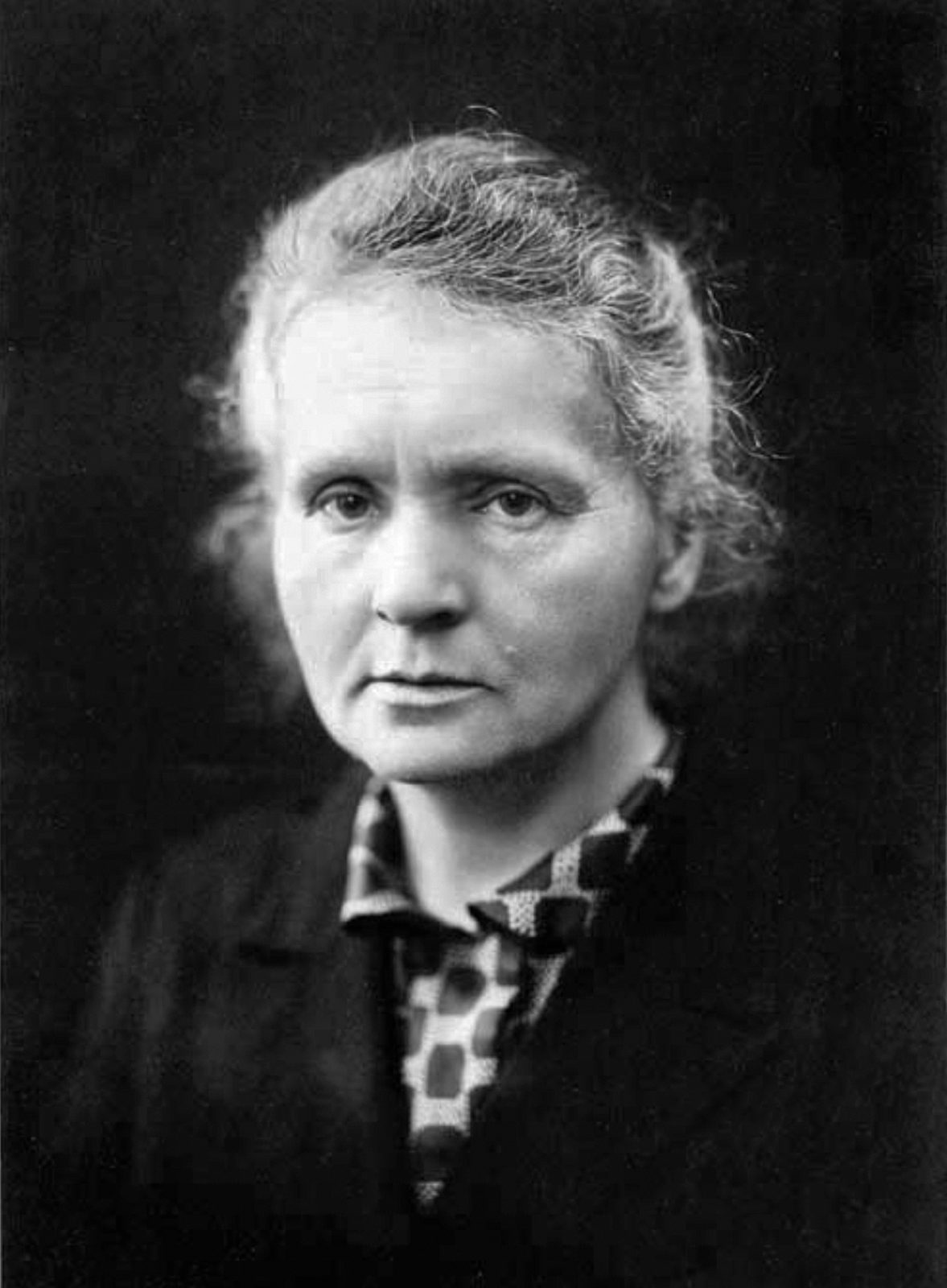
In April 1995, the doors of the Panthéon in Paris opened for a woman. Two coffins were carried into the temple of France's great men — one of them lined with lead. The woman inside had been dead for 61 years, and the radium in her body was still glowing. This is not a metaphor. It is physics.
Her name was Marie Curie. She was the first woman to win a Nobel Prize, and still the only person to win Nobel Prizes in two different sciences: Physics in 1903, Chemistry in 1911.[1][2] The element she discovered cured countless cancers — and killed her. Her laboratory notebooks are radioactive to this day, kept in lead-lined boxes at the Bibliothèque nationale in Paris; anyone who opens them must wear protective clothing and sign a waiver.[13]
This is not the story of a genius. It is the story of a stubborn person who measured something invisible until it gave up its secrets — and of a world that kept telling her she did not belong, while she kept staying.
This book does not set out to make a saint of her. She was stubborn, cold, indifferent to fame, and almost harsh in what she demanded of numbers. Her greatness was not that she had no weaknesses, but that she bet everything she had on a single thing.
Chapter 1The Underground Classroom in Warsaw
Maria Skłodowska was born in Warsaw on 7 November 1867, the youngest of five children, both her parents teachers.[11] Poland did not exist on the map then: Warsaw belonged to the Russian Empire, teaching in Polish was banned, and Polish women were barred from universities. A Polish girl who wanted to study had two options: accept it, or study in secret.
She chose the second. Warsaw had a university with no building and no timetable — the "Flying University," where teachers and students met in private apartments, ready to hide the books if the police knocked. Maria studied there for several years while working as a governess, first paying for her sister Bronisława's medical studies in Paris, then being paid for in turn when her sister graduated.[11]
Those years as a governess were not empty time. She taught in other people's houses, read her own books at night, and saved every coin — half sent to her sister, half kept for her own dream of Paris. The sisters' pact was simple: one goes first, the other follows; whoever stands firm first pulls the other up. Science has few contracts like that one. None of them were written on paper. This one was written between sisters.
In 1891, at 24, she boarded a train to Paris alone.[2] She carried little luggage and a large ambition: to win her place, by measurement, in a world that did not welcome her.
Chapter 2The Paris Garret
The Sorbonne admitted her. In 1893 she came first in her physics degree examinations; in 1894 she came second in mathematics.[3] By day she worked in the laboratory; by night she went home to an unheated garret, and survived the Paris winters on willpower.
She knew perfectly well how the world saw women. In the science of the late nineteenth century, a woman's place was in the audience, not at the lectern. Her answer was not protest but measurement: numbers have no sex, and a result does not change because its author is a woman. That was her method for life — and her lifelong gamble.
Choosing the topic was itself a gamble. Radioactivity had only appeared in 1896; nobody knew what it was, or whether it even counted as a field of study. She picked a territory with no map, for a simple reason: where nobody has gone, there is something to find.
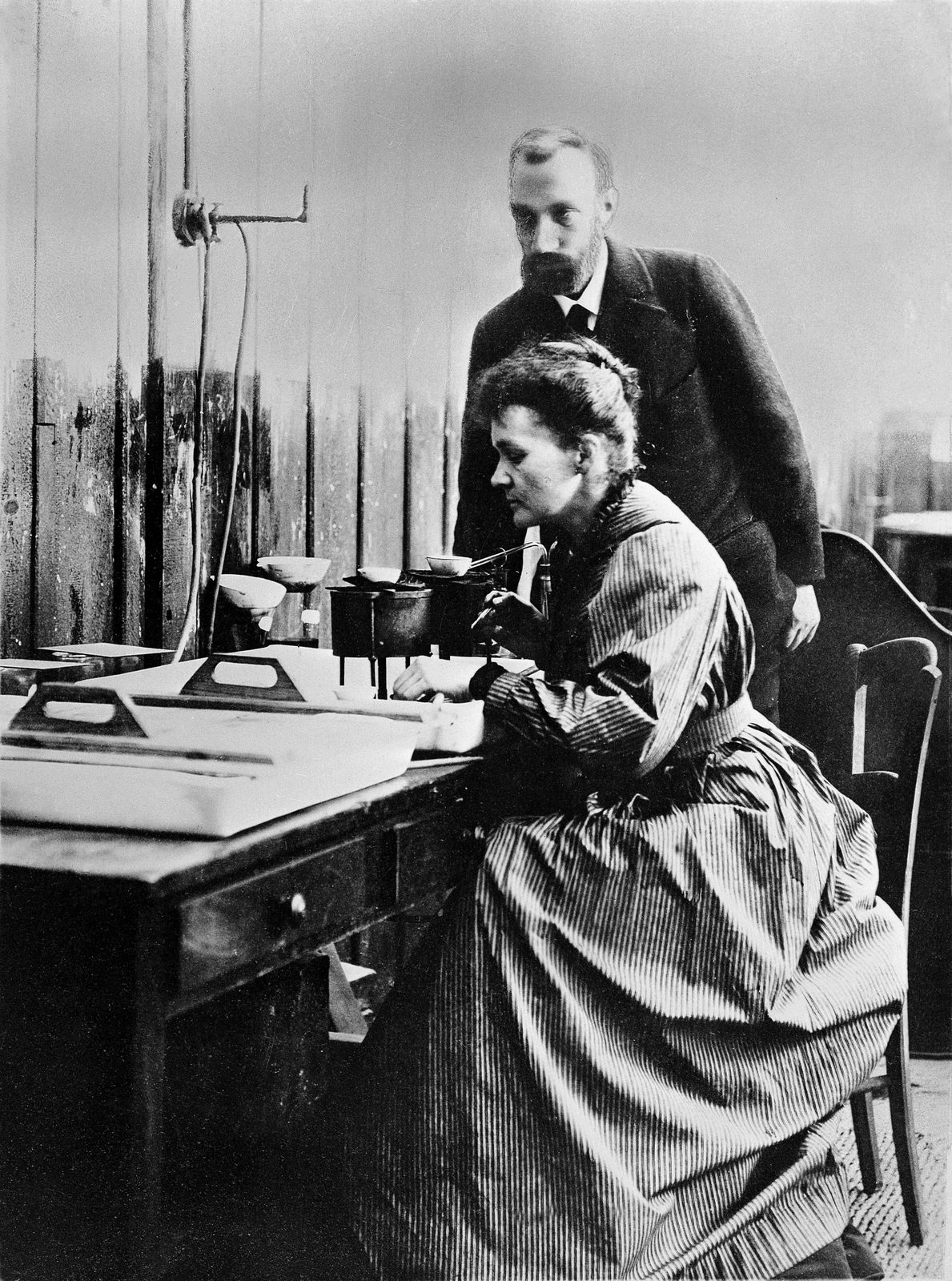
In the spring of 1894 she met Pierre Curie, a physicist, through a mutual acquaintance. He saw her worth before almost anyone else did, set aside his own work on crystals and magnetism, and joined her experiments. In July 1895 they married; their honeymoon was a bicycle trip.[3] The marriage had no dowry and no ceremony to speak of — only a laboratory, and two people who had decided to bet their lives on the same question.
Chapter 3Two New Elements in a Shed
In 1896 Henri Becquerel discovered that uranium gave off invisible rays all by itself.[2] Marie chose this phenomenon for her doctoral thesis, and coined a word for it: radioactivity.[11]
She measured everything she could find, discovered that thorium was radioactive too, and then fixed on a mineral: pitchblende. It was more radioactive than pure uranium — more radioactive than it had any right to be. Something unknown and fiercely active had to be hiding inside it.[3] On 14 April 1898, the Curies weighed out 100 grams of pitchblende and began to take it apart.[11]
Her weapon was an instrument Pierre and his brother Jacques had invented in 1880: the piezoelectric quartz electrometer. Radiation made air conduct electricity, and the size of the current was the size of the radioactivity. For the first time, the invisible had a scale. Without that instrument there would have been no discovery — a breakthrough in science is often not an answer found first, but a way to measure found first.[14]
In July 1898 they announced the first new element, which Marie named polonium, after her homeland — a country that had been carved up between Russia, Austria and Prussia and could not be found on any map.[11] On 26 December 1898 they announced a second: radium, from the Latin for "ray."[11]
Then came four years of hard labour in a run-down shed, stirring, filtering and crystallising by hand, until 8 tons of ore had yielded 1 gram of radium.[8] In 1910 Marie finally isolated radium as a pure metal, proving beyond doubt that the element was real.[1]
Chapter 4The First Trophy, the First Crack
In June 1903 Marie defended her doctoral thesis and took her doctorate.[2] That same year, the French Academy of Sciences nominated candidates for the Nobel Prize in Physics. The list held two names: Becquerel and Pierre. Not hers.[12]
A committee member, Gösta Mittag-Leffler, tipped Pierre off. Pierre wrote back in protest: a Nobel Prize for radioactivity without Marie made no sense. The committee relented. In December 1903 the prize was divided three ways — half to Becquerel, a quarter each to Pierre and Marie.[1] Marie Curie became the first woman to win a Nobel Prize.[3]
The couple did not attend the award ceremony in December 1903; health and work kept them in Paris, and Pierre did not deliver their Nobel lecture in Stockholm until June 1905.[12] The prize arrived; the prejudice did not leave. The world was willing to applaud her. It was not yet willing to admit she was the lead.
Glory came fast, and so did the crack. On 19 April 1906, on a rainy Paris street, Pierre slipped beneath a horse-drawn cart and was killed instantly.[11] Marie was left with two small daughters and a laboratory.
A month later, on 13 May 1906, she took over Pierre's chair at the Sorbonne, becoming the university's first woman professor.[3] She had no time to grieve — or rather, she folded her grief into her work. From then on, she was alone.
Chapter 5A Nobel Prize of Her Own
In 1911 the Nobel Prize in Chemistry went to her alone, for the discovery of polonium and radium, the isolation of radium, and the study of its nature and compounds.[1] She was the first person ever to win two Nobel Prizes, and she remains the only person to win them in two different sciences.[1]
But that year the Paris newspapers were judging her for something else: her affair with the physicist Paul Langevin had been made public, her private letters printed in the press. The same behaviour men called romance, women were called a scandal for. Svante Arrhenius of the Nobel committee wrote urging her not to come to Stockholm. She replied that there was no relation between her scientific work and the facts of her private life — and came anyway, receiving the prize on 10 December 1911 and lecturing the next day.[12]
She never patented any of her discoveries. The radium process could have made her enormously rich; she said radium was an element and belonged to all people.[6] That decision left her in an awkward position by 1921: the whole world was using radium to treat disease, and her own laboratory could not scrape together a single gram of it.
The American journalist Marie Meloney heard of it and launched a fundraising campaign; women across America gave 100,000 dollars to buy her a gram of radium. On 20 May 1921, at 54, Marie received the gift from President Harding at the White House — a golden key, because the little casket of radium itself was too dangerous to bring indoors.[6][9]
In 1914 the Radium Institute in Paris was founded, with her as its director; later she founded Curie Institutes in Paris and Warsaw.[2][11] She did not only discover elements. She left institutions behind — so that those who came after would not have to find their way between a garret and a shed the way she did.
Chapter 6The Little Curies Go to War
In 1914 the First World War broke out. She did not retreat into her laboratory. As director of the French Red Cross Radiology Service, she took X-rays to the battlefield.[7]
The X-ray machines of the day were huge and fragile, and wounded men had to endure long journeys to reach one. Marie's answer was to reverse the journey: put the machine on a car and drive it to the wounded. She collected automobiles from wealthy friends and rebuilt them as mobile radiology stations. In October 1914 the first vehicle rolled to the front, and the soldiers gave it a name: the petite Curie — the little Curie.[7]
By the end of the war she had assembled 20 little Curies, set up some 200 fixed radiological posts in field hospitals, and personally trained about 150 women to operate the equipment — among them her teenage daughter Irène.[7][10] An estimated one million Allied soldiers received X-ray examinations because of her, and for the first time surgeons could see a bullet or a piece of shrapnel before they cut.[10]
She watched with her own eyes how X-rays changed an operation: where surgeons had once searched for shrapnel by touch alone, they could now see it before they cut. Invisible rays had found a visible use. Science had walked out of the laboratory to the side of a stretcher — not elegant at all, and useful.
She learned to drive, and to repair a car that broke down in the mud, and drove to the front herself.[10] The war taught the world one thing: science does not belong only to the laboratory; it belongs to the dressing station too. The price she paid for it would only come due 20 years later.
EpilogueThe Two Faces of Radium
Early in 1934, her daughter Irène and son-in-law Frédéric discovered artificial radioactivity; the second generation of the Curie family had taken the same road.[4] A few months later, on 4 July 1934, Marie died of aplastic anaemia at the Sancellemoz sanatorium near Passy, aged 66. Her doctors believed the cause was a lifetime of radiation — the radium in her laboratory, and the years beside the X-ray cars at the front.[3][5]
The following year Irène and Frédéric won the Nobel Prize in Chemistry.[4] And her notebooks remain radioactive to this day, locked in lead-lined boxes at the Bibliothèque nationale.[13] In 1995 the remains of Marie and Pierre were moved to the Panthéon; she was the first woman to be honoured there on her own merits.[4][11]
Counting Pierre, Irène and Frédéric, the Curie family collected five Nobel Prizes between them.[11] No other family in the history of science looks like this — not because of genes, but because of the rule of that shed: measure to the end, take no shortcuts, never bend a number for fame or money. The rule lasted three generations.
The other face of radium is medicine. Radiotherapy as we know it began with radium: rays that can kill cells can also kill cancer cells.[6] What she discovered was both a murderer and a medicine. That was never hers to choose — scientists can only discover; the world decides how to use it.
What Marie Curie left behind was not an answer but an attitude: measure what you cannot see until it yields, and stay in a room that tells you that you do not belong. The glow of radium is faint — just enough, in the dark, to see the road ahead. She looked at it all her life. It is enough for us to look at for a long time yet.