PrologueA Letter, August 2, 1939
On August 2, 1939, Albert Einstein signed a letter on Long Island, addressed to President Franklin D. Roosevelt. The Hungarian physicist Leó Szilárd had drafted it, and it carried a single warning: uranium might become a new and important source of energy, a chain reaction might be set up within a few months, and this phenomenon "would also lead to the construction of bombs"; Germany had already stopped selling uranium from the Czech mines, and German scientists were repeating the American work.[7][2]
Roosevelt did not receive the letter until October 11. He acted at once, appointing the S-1 Uranium Committee, with a first appropriation of $6,000. In December 1942, Enrico Fermi achieved the first controlled chain reaction at the University of Chicago, proving that a bomb was physically possible.[7][2]
One letter, one $6,000 appropriation — and three years later, a project of 130,000 people. This essay is not about the physics. It is about the organization: how a nation locked its brightest minds in a desert to build something no one dared to name.
Chapter OneThree Cities That Did Not Exist
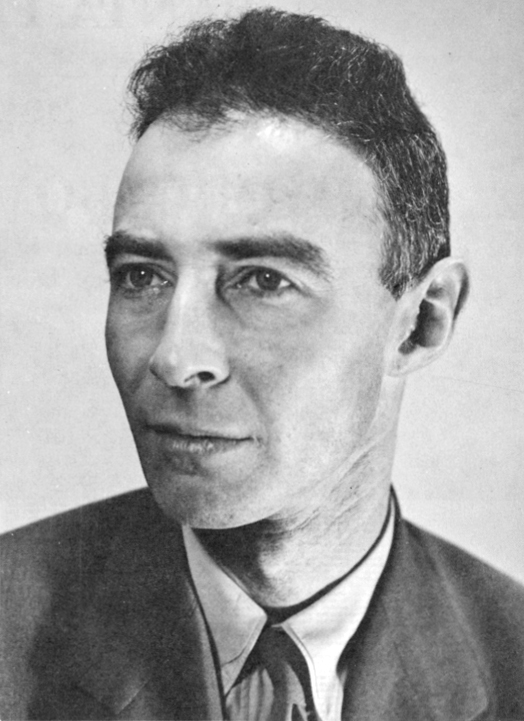
In the autumn of 1942, Major General Leslie Groves of the U.S. Army took charge of the project, codenamed the Manhattan Engineer District. He made a decision that surprised everyone: he put J. Robert Oppenheimer, a 38-year-old theoretical physicist, in charge of the Los Alamos Laboratory. Oppenheimer had no Nobel Prize, had never run a large laboratory, and nearly failed his security clearance. What Groves valued was his ability to make a room full of geniuses obey.[8][2]
At its peak the project employed nearly 130,000 people and cost nearly $2 billion in 1945 dollars — $1.89 billion through December 31, 1945. More than 90 percent of the money went to building factories and producing fissionable material; less than 10 percent went to developing and producing the weapons themselves.[2] In other words, this was first an industrial mobilization, and only second a scientific experiment.
The work was divided among three cities. Los Alamos, on a mesa in New Mexico, designed the weapons. Oak Ridge, in Tennessee, enriched uranium. Hanford, in Washington State, produced plutonium. By 1945 Oak Ridge had about 75,000 residents, yet appeared on no map; building Hanford forced the relocation of about 1,500 residents.[13][4]
Secrecy was enforced not by walls but by cutting knowledge into pieces. Under strict compartmentalization, each person knew only their own step of the process; the great majority of workers had no idea what they were building. Operators at Oak Ridge watched their gauges all day without knowing what lay at the other end of them; the theorists at Los Alamos did not know Hanford's progress. The people who knew the whole picture could be counted on one hand. It was the prototype of the modern large organization: a clear goal, secret methods, and individuals cut into parts.
Chapter TwoA Grapefruit, and a Gun
There were two weapons, because the physics forced two paths. Little Boy was a gun: two subcritical pieces of uranium-235 were fired together with explosives, like a bullet down a barrel — so simple it was used in war without ever being tested. Fat Man was an implosion device: a sphere of plutonium about the size of a grapefruit, some 6.2 kilograms, crushed from all sides at once by precisely shaped explosives — so complex it could not be used untested.[2]
Why two? Enriching uranium-235 was slow, while Hanford's plutonium came faster — but plutonium could not be used in a gun design, because it would detonate prematurely. So there were two production lines, two weapons, and two entirely different engineering problems. At Los Alamos the fight was over milliseconds and millimetres: if the explosive lenses of the implosion were asymmetric by a fraction, the squeeze would go crooked, and a test worth hundreds of millions of dollars would become a dud.
Here lies the first lesson of the whole affair: a technical choice is never only technical. It decides what the organization looks like, where the money flows, and who gets to decide.
Chapter ThreeJuly 16, 1945, 5:29 a.m.
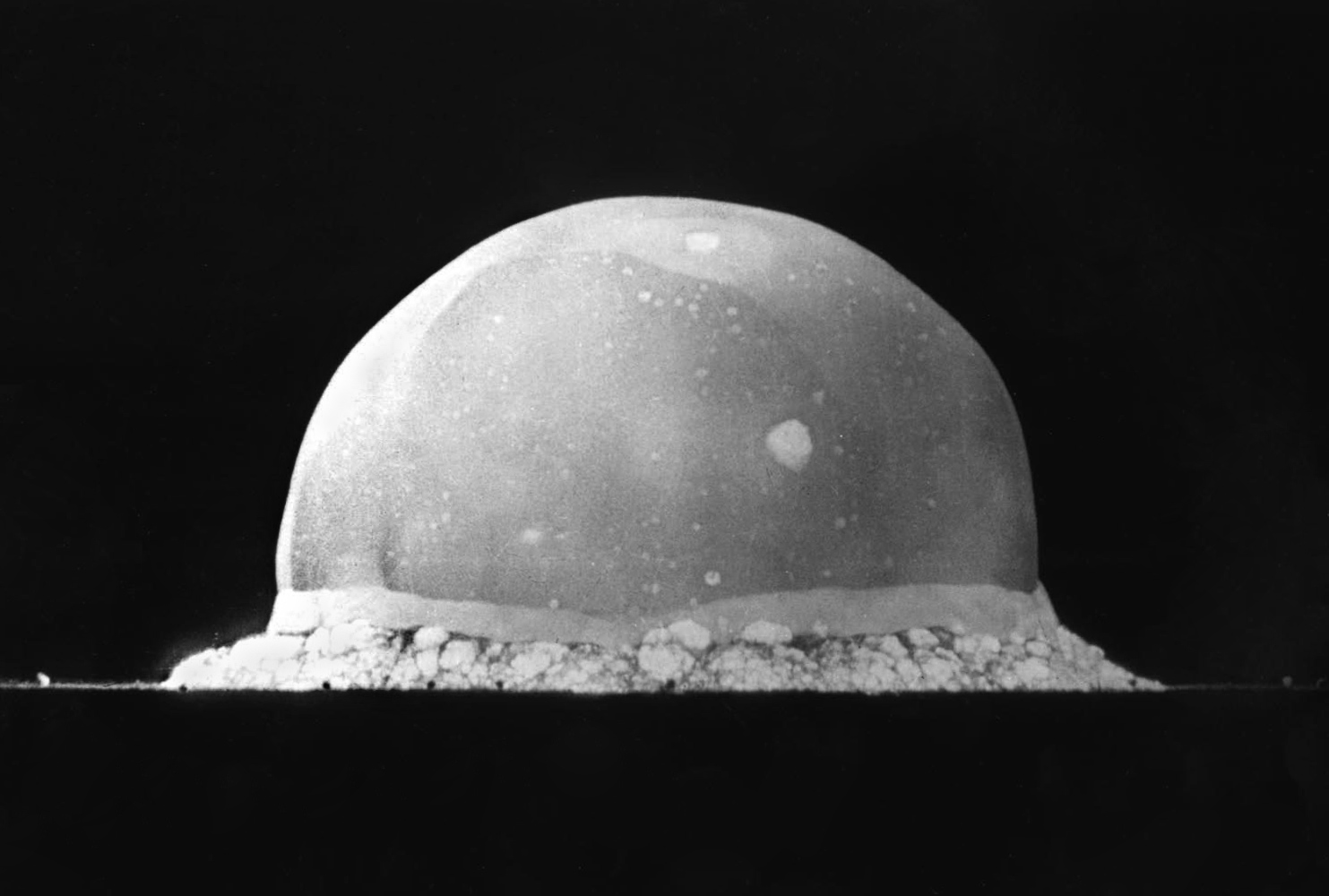
At 5:29 a.m. on July 16, 1945, in the Alamogordo desert of New Mexico, the device codenamed Trinity was detonated atop a 100-foot steel tower — the first nuclear explosion in human history. Its yield was about 21 kilotons, with later estimates ranging from 20 to 21 kilotons. The blast left a crater 250 feet (76 metres) wide, and the sand beneath it melted into green glass.[13][2][1]
Oppenheimer later recalled that a line from the Bhagavad Gita came to his mind: "Now I am become Death, the destroyer of worlds." He added: "We knew the world would not be the same. A few people laughed, a few people cried, most people were silent."[8]
We knew the world would not be the same.
A few people laughed, a few people cried, most people were silent.
At that moment, the project's goal was achieved. But its reason had vanished two months earlier: Germany had surrendered in May. The enemy the scientists had worked three years to beat was already gone.
Chapter FourThe Petition in the Drawer
After Germany's surrender, Japan had no nuclear programme worth the name. The project's scientists began to ask: must the bomb still be used? On June 11, 1945, the Franck group at Chicago's Metallurgical Laboratory sent up a report recommending that the bomb first be demonstrated in public — in a desert or on a barren island, before representatives of all nations, including Japan and the Soviet Union — and only then should its use on a city be decided. The report went into the machinery and did not come out.[5][6]
On July 17, 1945, the morning after the Trinity test, the final version of the Szilard petition was ready. Seventy scientists signed it, asking that the terms to be imposed on Japan first be made public and Japan given the chance to accept them, and that only if Japan refused should the President decide the question with the full weight of his office.[5][6]
The petition was stamped secret and filed. It was not declassified until 1958, and it never reached President Truman. A poll the Army itself conducted in July among 150 Chicago scientists found that only 15 percent favoured dropping the bomb on a city without warning.[5][6]
The point is not whether the scientists objected — they did: they wrote reports, signed petitions, filled in polls. The point is that an organization whose only goal is "finish the job" treats every warning as noise. The report went into the machine, and never came out.
Chapter FiveAugust 6, and August 9
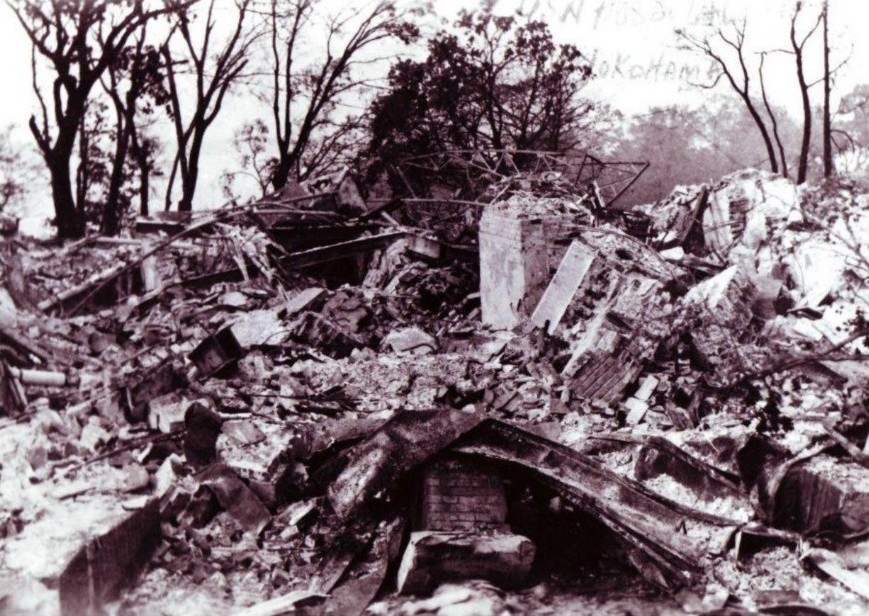
At 8:15 a.m. on August 6, 1945, the B-29 Enola Gay dropped Little Boy over Hiroshima: about 15 kilotons. Of the 64 kilograms of uranium-235 aboard, less than one kilogram actually fissioned — the rest was blown apart before the reaction could finish. Between 70,000 and 80,000 people died that day; by the end of 1945 the toll stood at about 140,000, by the city of Hiroshima's estimate; a firestorm consumed about 4.4 square miles of the city.[10]
At 11:01 a.m. on August 9, the Bockscar carried Fat Man aloft. Its original target, Kokura, was hidden by cloud, so the crew turned to Nagasaki. Fat Man yielded about 21 kilotons, roughly 40 percent more than Little Boy, but Nagasaki's hills confined the blast; about 40,000 people died that day, and about 74,000 by the end of 1945, by the city of Nagasaki's estimate.[10][12]
Japan announced its acceptance of the Potsdam Declaration on August 14, and formally signed the surrender on September 2. Whether the two bombs "ended the war" is still debated among historians — the Soviet declaration of war on August 8, the naval blockade and the conventional bombing each carry their own weight in the argument. This essay does not settle that debate; it leaves the numbers. The exact death tolls will never be known, because the cities' records burned with them. What is uncertain is the last digit, not the order of magnitude.[12][11]
EpilogueLess Than Nine Days of War
Finally, the accounts. Through October 1, 1945, the project had spent $1.845 billion — less than nine days of wartime spending. By the end of 1945 it had produced four weapons: the Trinity device, Little Boy, Fat Man, and one unused Fat Man — at an average of about $500 million each, in 1945 dollars.[2]
In October 1945, Oppenheimer met President Truman and told him he had blood on his hands. The remark changed no policy. After the war he publicly opposed the hydrogen bomb, and the scientists' political influence shrank as quickly as peace arrived.[8]
What the Manhattan Project left behind was more than two bombs. It left a template: the state pays, the scientists deliver, the military keeps the secrets, and the goal outranks everything. Forty years of Cold War nuclear rivalry — and, for that matter, today's large technology programmes — run on the same template: cut knowledge into pieces, put completion first, and leave the question of "whether" until afterwards.
The question was never "can it be built?" On July 17, 1945, seventy people tried to ask "should it be used?" No one heard them. The question has not expired.
Questions That Remain Open
In honesty, the following three things cannot currently be verified, and this essay does not pretend otherwise:
- If Szilard's petition had actually reached Truman's desk, would history have been different? The petition never arrived, so no controlled comparison is possible — the question has no answer.
- Whether "the bomb ended the war" is still without consensus among historians: how much weight belongs to the Soviet entry into the war, the blockade, and the conventional bombing remains under debate.
- Trinity's exact yield is still disputed: different institutions estimate between 20 and 21 kilotons, and the figures do not fully agree.