PrologueThe Night of August 31, 1854: Soho Dies in Ten Days
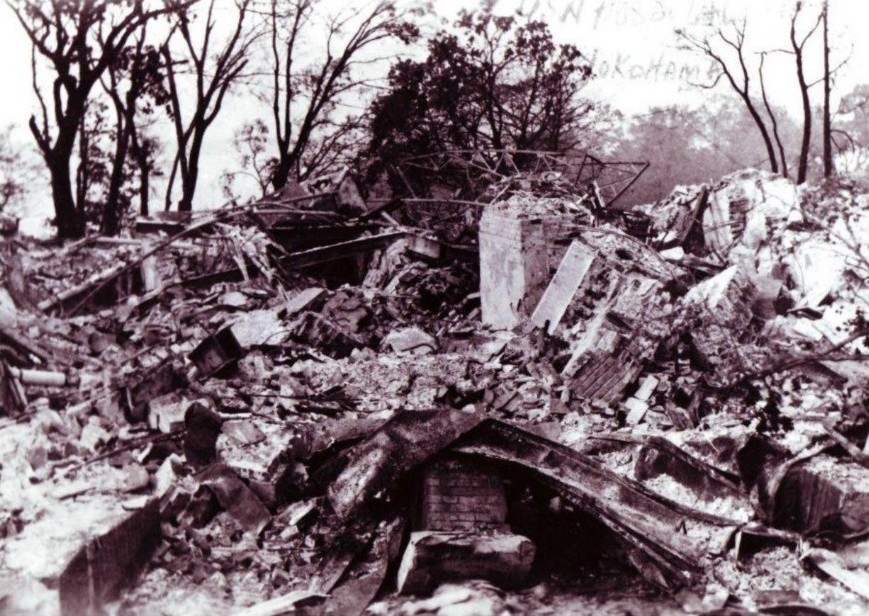
Late on the night of August 31, 1854, residents around Golden Square in London's Soho began to collapse, one after another. Vomiting, diarrhoea, dehydration: within hours, a healthy person became a corpse. On September 1 alone, 143 new fatal cases began, according to the table John Snow later compiled[1]; within ten days, more than 500 fatal cases were concentrated within 250 yards of a single water pump on Broad Street[8]; by September 30, the outbreak had claimed 616 lives by his count[1]. This was a city of 2.5 million people, a city that stank — and everyone believed the killer was the air.
This is not the story of a genius struck by a flash of insight. It is the story of how a society learned to doubt what it was most certain of. A map, a pump handle, a nappy, a brewery — every object this epidemic left behind answers the same question: when everyone is looking in the same direction, what gives one person the right to look elsewhere?
Chapter OneThe Air Stood Accused
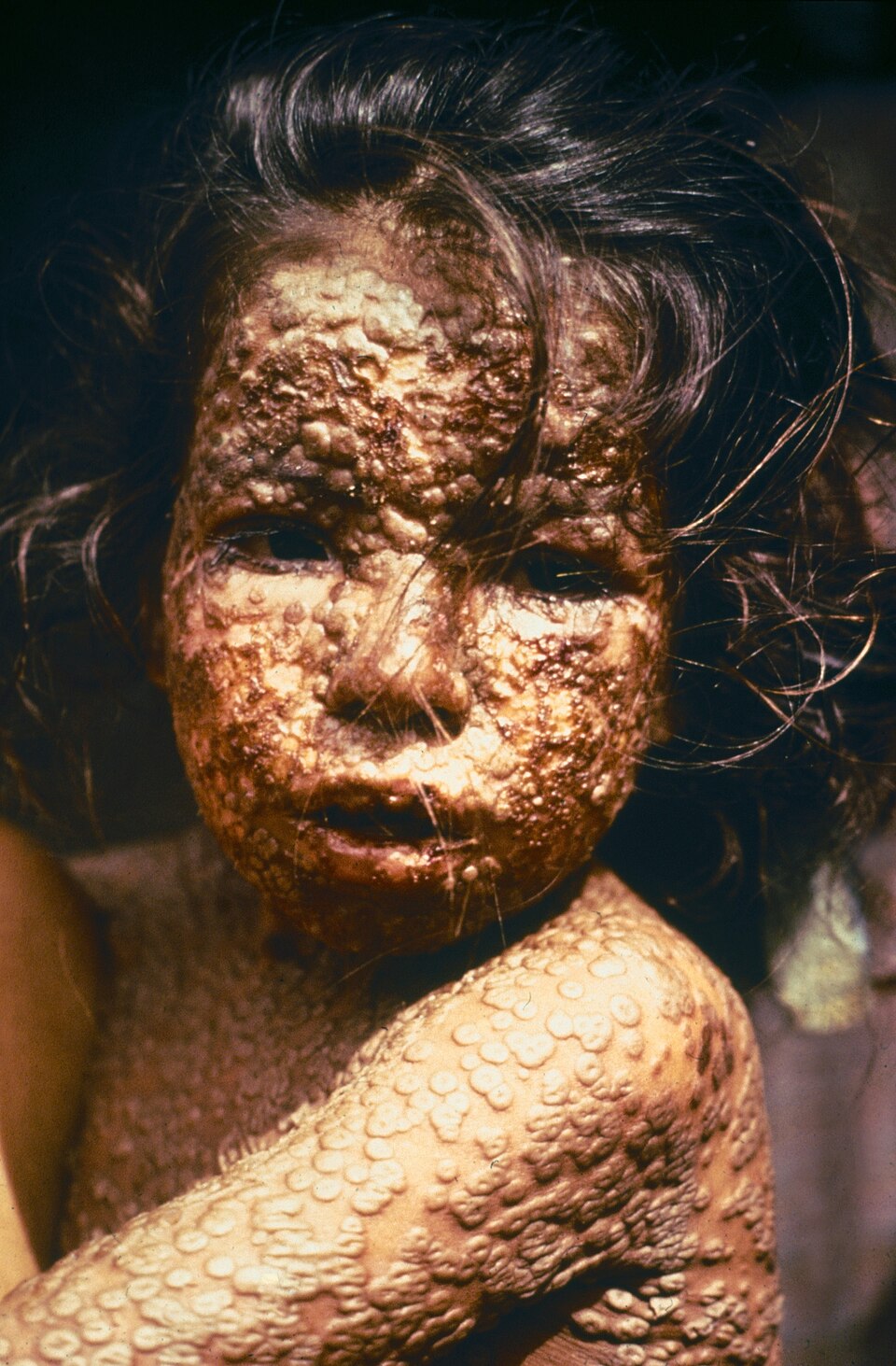
Cholera first reached England in June 1831[6]. The epidemic of 1831–32 killed 32,000 people in England; the epidemic of 1848–49 killed 52,000[6]; in 1853–54, London alone lost 10,739 people, and Great Britain as a whole lost 23,000[9]. It was the worst year of the third cholera pandemic (1846–1860)[9].
Almost every doctor and official believed the same explanation: miasma. Disease was foul air rising from rotting matter, breathed into the lungs. The stench of the Thames, the stench of the sewers, the stench of the slums — the whole city smelled like a cause of disease. The remedies followed logically: ventilate, disinfect, flee the worst-smelling places. Nobody saw anything wrong with this, because everyone could smell the same smell.
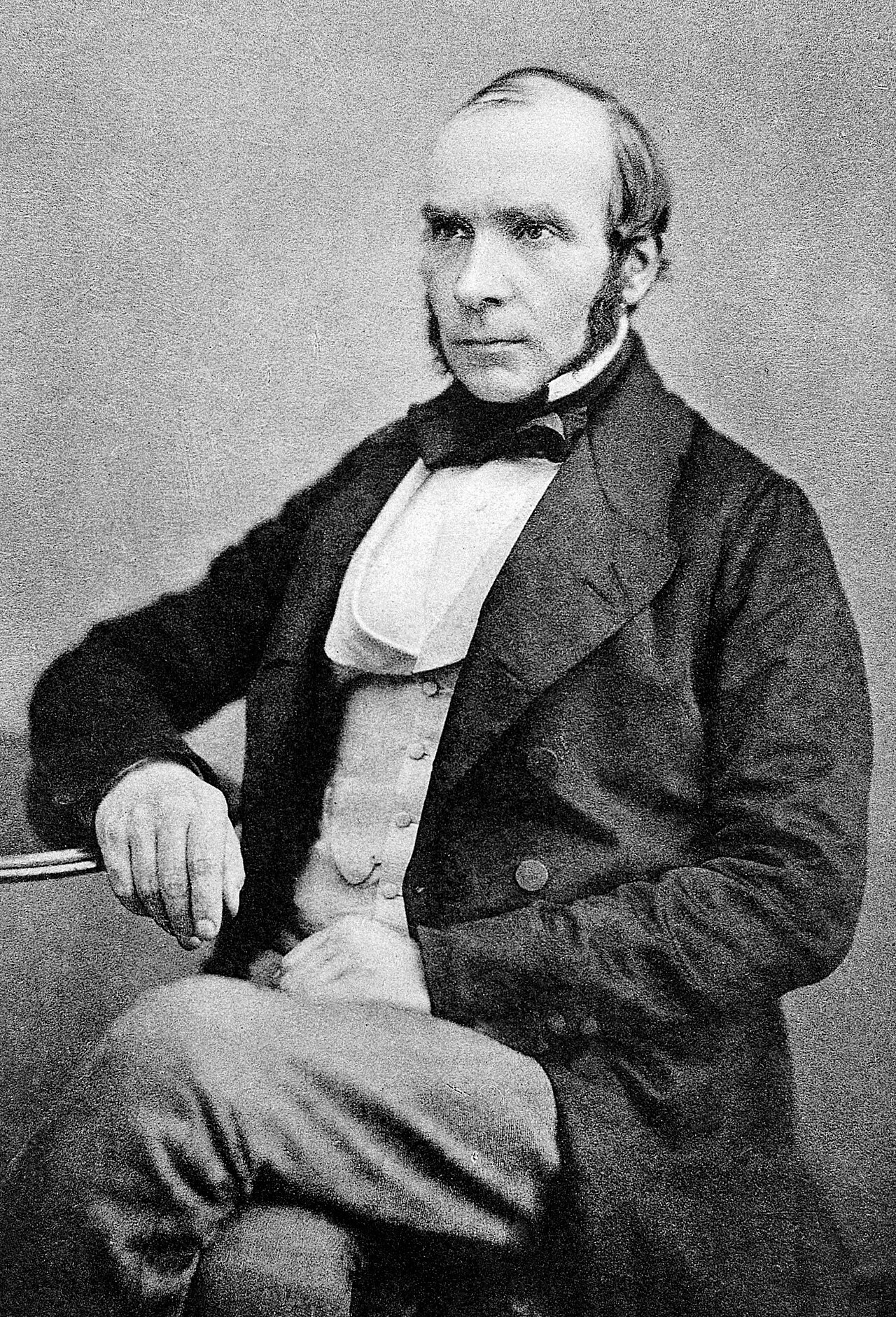
John Snow first met cholera at nineteen, as an apprentice in a mining village near Newcastle[7]. In 1849 he published a pamphlet, On the Mode of Communication of Cholera, arguing that cholera came not from the air but from water — something in the evacuations of the sick contaminated the water, and those who drank it fell ill[7]. The pamphlet drew almost no attention. A claim that argues with the nose of an entire age is destined to wait a long time.
Chapter TwoThe Natural Experiment of Two Water Companies
In the summer of 1854, before the epidemic reached Soho, Snow was already running a larger experiment. South of the Thames lived two populations drinking water from two companies: the Southwark and Vauxhall Company drew its water downstream, where the river had already received the city's sewage; the Lambeth Company had moved its intake upstream a few years earlier. The same river, the same city — only the intake differed. In the first seven weeks, the 40,046 houses supplied by Southwark and Vauxhall suffered 1,263 deaths, 315 per 10,000 houses; the 26,107 houses supplied by Lambeth suffered only 98 deaths, 37 per 10,000[6]. The death rate differed by more than eightfold. Snow called it the "grand experiment" — a natural comparison nobody had designed, yet cleaner than any experiment could be.
But numbers were not enough. Numbers can convince statisticians; they cannot convince a city. Snow needed a killer he could point at, a place specific enough to name. On the night of August 31, 1854, Soho gave him that place.
Chapter ThreeThe Man Who Knocked on Doors
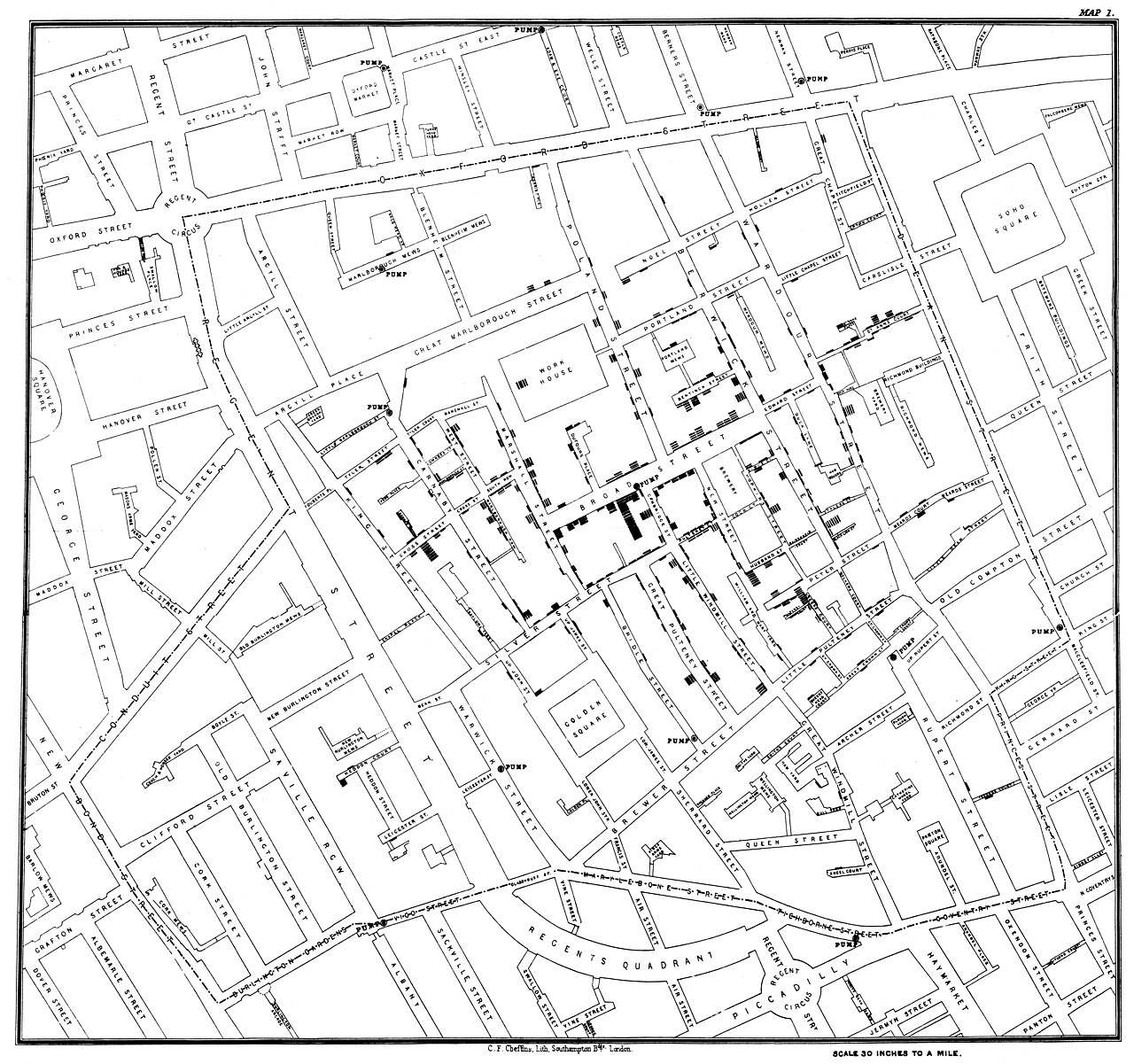
Snow lived near Soho, his practice not far from Broad Street. Once the epidemic erupted, he went door to door, asking every household which well it drank from, then checking the addresses against the death registers[7]. Bar by bar, the black marks piled up, all pointing at the same well: the public pump at the corner of Broad Street and Cambridge Street.
What made the case was the people who did not fall ill. The Poland Street workhouse housed 535 inmates and recorded only five deaths — it had its own well and never drank Broad Street water; the Lion Brewery on Broad Street, with about 70 workers, recorded no deaths at all — the men drank beer and had a deep well of their own; a factory employing 200 people, by contrast, lost 18 — they drank the well water every day[2]. On the same street, what you drank decided whether you lived. Even the exceptions stood on the same side: a few deaths occurred in houses closer to other pumps, but inquiry showed that the dead had preferred Broad Street water, some walking past nearer pumps to fetch it[2].
On the evening of September 7, Snow took his findings to the Board of Guardians of St James's parish. The guardians were sceptical — miasma was still orthodoxy, and Snow's theory sounded strange — but the death toll was catastrophic, and they agreed to act as a precaution. On September 8, the handle was removed from the pump[8].
But honest history must add a sentence: the epidemic was already ebbing before the handle came off. New fatal attacks numbered 143 on September 1, 116 on the 2nd, 54 on the 3rd, and only 12 on the 8th[1]; many residents had fled the neighbourhood, and the outbreak faded with them. Snow himself admitted in his book that the epidemic had declined so far that it was impossible to decide whether the well still contained the cholera poison in an active state[1]. The handle was no magic wand, and removing it did not "end" the epidemic. The real achievement lay not in that piece of iron, but in the method: knocking on doors, comparing groups, chasing down exceptions.
"The epidemic had declined so far that it is impossible to decide whether the well still contained the cholera poison in an active state."
— John Snow, On the Mode of Communication of Cholera, 1855[1]
Chapter FourA Nappy and a Well
How did the contamination get into the well? The answer came from the man who had most opposed Snow: the parish clergyman Henry Whitehead. He had set out to prove Snow wrong, to show the disaster was an act of God; his house-by-house reinvestigation turned him into Snow's ally[4]. He traced one of the earliest cases: five-month-old Frances Lewis, who lived at 40 Broad Street, opposite the pump. Water used to wash her soiled nappies had been thrown into a cesspool, and the cesspool stood beside the well; sewage seeped into it[4]. One well, one cesspool, one nappy — the origin of the epidemic was almost unbelievably small, yet the chain was complete and impossible to refute.
In 1855, the parish Cholera Inquiry Committee wrote this route into the official record[2]. But in the same year, the General Board of Health's Committee for Scientific Inquiries reached the opposite conclusion: "After careful inquiry, we see no reason to adopt this belief."[3] The evidence was on the table, and the establishment refused it anyway. The most stubborn thing in the history of science is rarely ignorance. It is a consensus already formed.
Chapter FiveThe Map Was Not the Evidence; the Method Was
The famous map — every death drawn as a black bar, stacked at the address where the person had lived — was actually drawn after the epidemic ended, and published in the second edition of 1855, whose preface is dated December 11, 1854[5]. The map did not give rise to the insight; the insight came before the map. What the map did was something else: it made the insight visible, so that a city could no longer pretend not to see it[5]. That is why it remains the most cited image in the history of data visualisation.
Snow's map hid an even more precise layer of reasoning. He marked every public pump in Soho, then drew the area each pump was "nearest" to — in theory, people drank from whichever pump was closest to home. The result was stark: the zone nearest the Broad Street pump had the highest mortality, and deaths stopped almost exactly at its boundary[8]. Today this way of drawing is called a Voronoi diagram; in 1854 it had no name — only a doctor drawing a boundary between life and death across a city.
Nor was Snow fighting alone. After the cholera outbreak of 1849, London founded the Epidemiological Society, and Snow was one of its founding members[9]. His method — treating disease as something that can be traced through a population, rather than as doom in the air — gained, from then on, a society, a language, and colleagues. The Broad Street pump was simply the first time a city saw the method at work.
Snow did not live to see his vindication. He died in 1858, aged 45[6]; germ theory was only slowly accepted after his death, until 1883, when the German physician Robert Koch isolated Vibrio cholerae in Egypt, proving there really was something in the water[6]. Broad Street was later renamed Broadwick Street, and a replica pump with no handle now stands near the original site, beside a pub named for Snow[10].
EpilogueWe Are Still Removing Pump Handles
The Broad Street pump has since entered every epidemiology textbook, but what it truly left behind comes in three parts. The first is method: comparison groups, geographic distribution, chasing down exceptions — the same moves used to track every epidemic today. The second is visualisation: a single picture can make an invisible chain of cause and effect impossible to deny. The third is the easiest to forget: how a society treats a claim that cannot yet be fully proven, but is probably right.
Removing a pump handle cost almost nothing; being wrong would have cost almost nothing either. Waiting for complete proof would have cost lives. On September 8, 1854, the parish guardians were not convinced — they simply thought there was no harm in doing something first. It was that humility — admitting they might be wrong, admitting prevention is cheaper than proof — that saved lives.
With every epidemic since, we have replayed September 1854. Some smell the air; some see the water. The only difference is whether, this time, we recognise that we are smelling the air.
Questions That Remain Open
Snow's method could find a well, but it could not answer a harder question: when the next invisible threat appears and the evidence is still incomplete, how long should a city wait before acting? In 1854 the answer was eight days — from the outbreak to the removal of the handle. Applied to today, is that too fast, or too slow?