PrologueThe Weight of Five Thousand Words
There is a book whose entire text runs about 5,000 words — barely longer than a newspaper column.[2] It has no author, or at least none that can be pinned down. It offers no argument, no story, no command. In just 81 short chapters it says one thing that everyone thinks they understand and almost no one actually does: step back. More than two thousand years later, it is among the most translated books in the world, second only to the Bible and the Bhagavad Gita.[7]
This is the Tao Te Ching, also known as the Laozi. Its first sentence pushes the reader away: "The Tao that can be told is not the eternal Tao." A book that refuses to be understood in its very first line — how has it survived for more than two millennia? The answer may lie in that refusal. It does not offer knowledge; it offers a position — a place to stand a little farther back, where things come into focus.
This essay will not explain it line by line. Explaining a book that refuses explanation, line by line, would itself be a misreading. Instead, we ask different questions: how did a book with no author come to be written? Why is "not doing" harder than doing? And why is a short book from more than two thousand years ago quoted more often today — in an age that wants everything more, faster, and bigger?
Chapter OneAn Author Without an Author
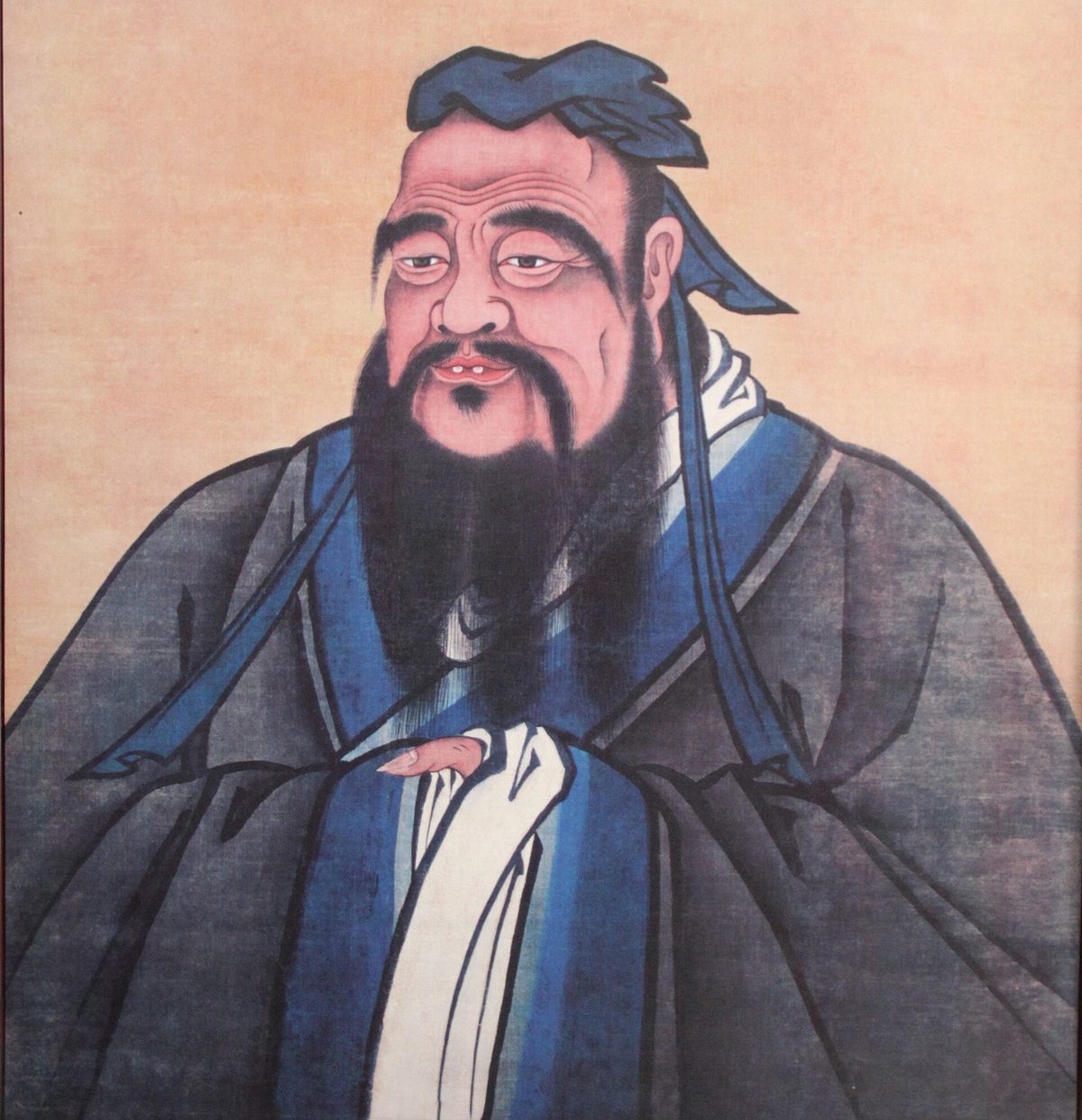
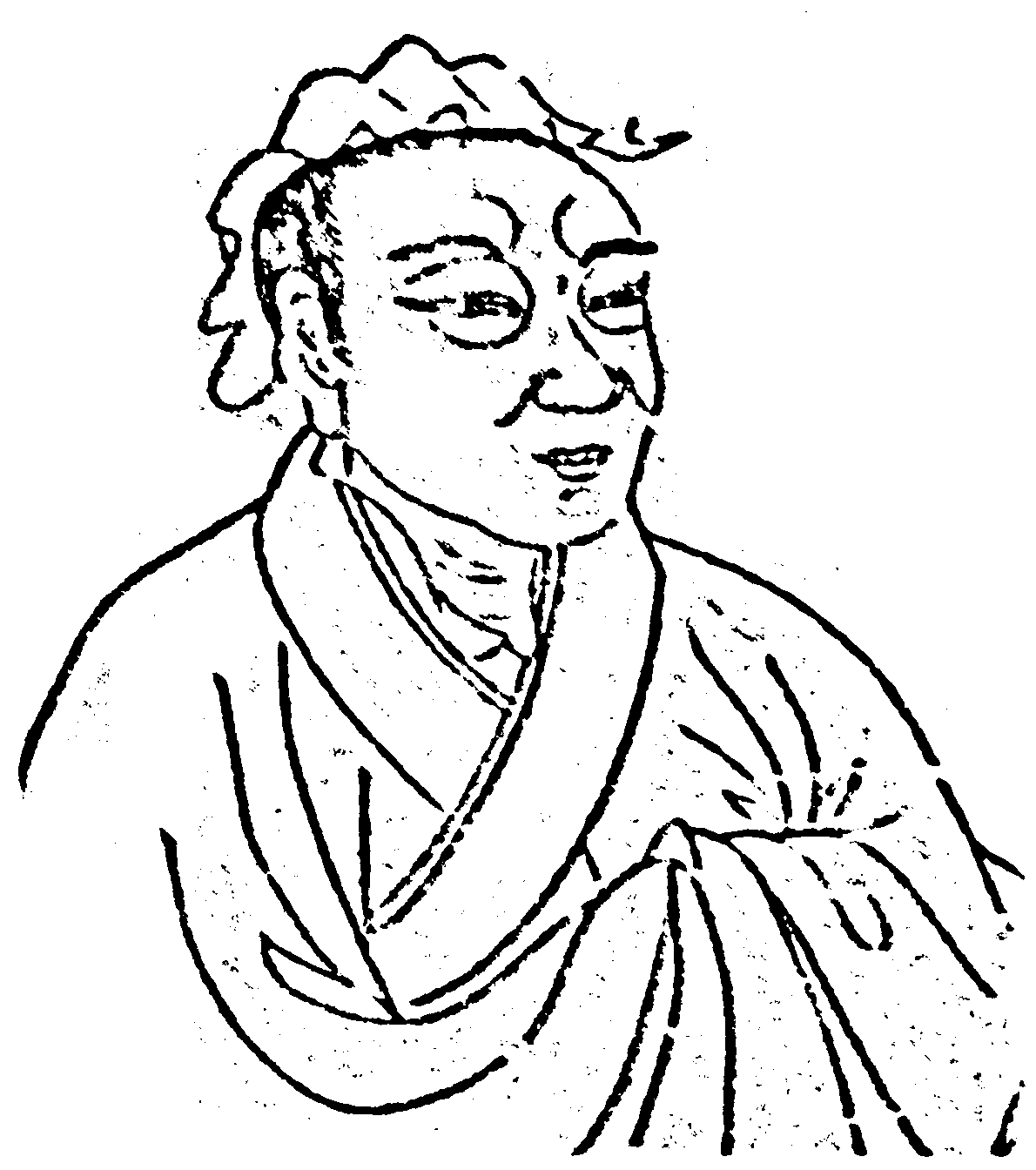
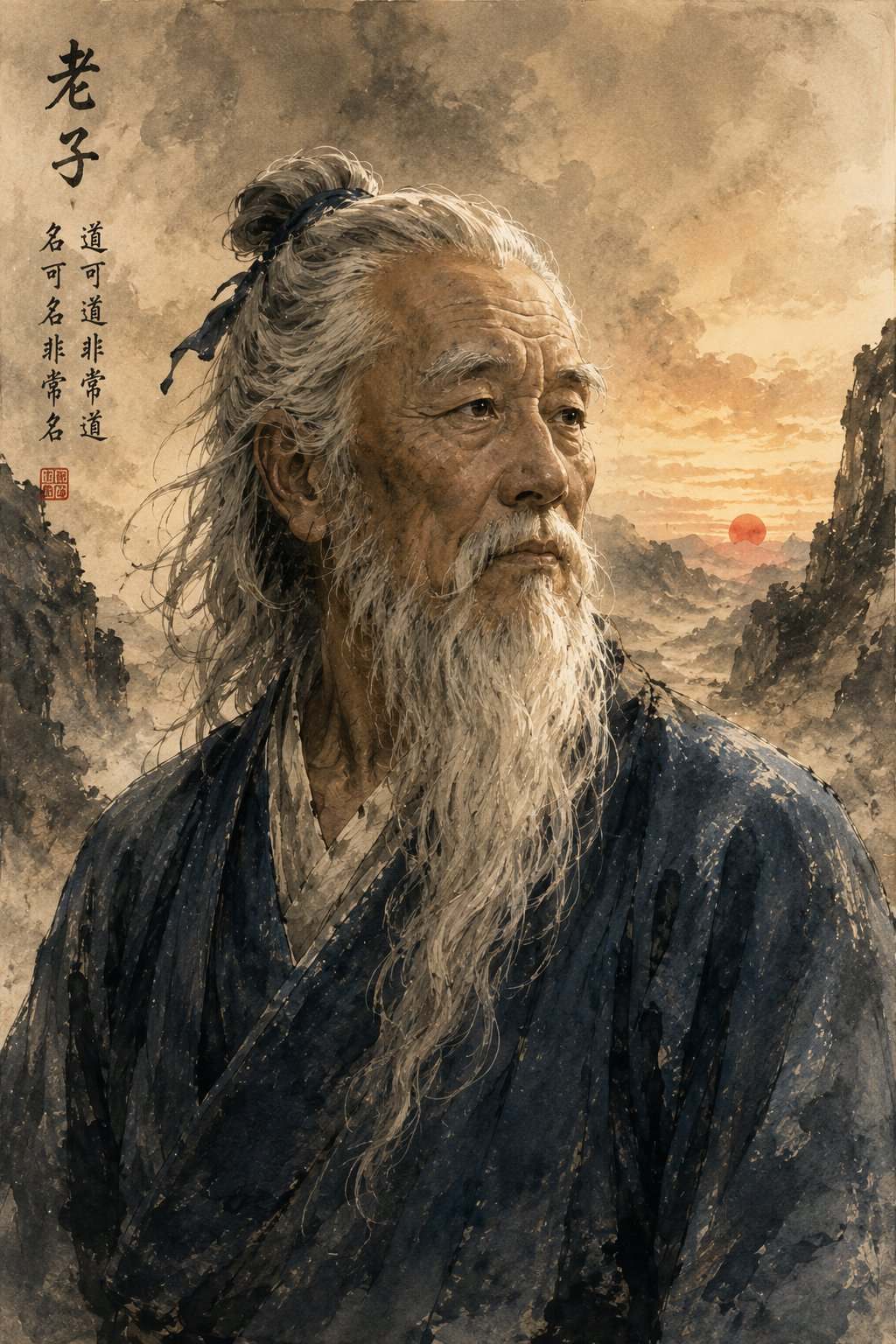
The traditional story goes like this. Laozi — surnamed Li, named Er — was a man of Chu in the late Spring and Autumn period who served as an archivist in the royal court of Zhou. Confucius once travelled to consult him on ritual, and returned telling his disciples that Laozi was like a dragon, riding the wind and clouds up into the sky, beyond all reckoning.[1] Later, Laozi rode west through the Hangu Pass; the gatekeeper Yin Xi asked him to leave something in writing, so he wrote two sections, about five thousand words, and vanished from history.[1]
It is a good story — too good to doubt, which is exactly why historians have doubted it for a long time. When Sima Qian wrote the Records of the Grand Historian, more than four hundred years had passed since the supposed Laozi; in his biography of Laozi he lists three different accounts at once: Laozi may have been the archivist Li Er of Zhou, or another man called Lao Laizi, or someone who lived as late as the Warring States period.[1] An author whose very identity cannot be settled, writing a book whose date cannot be settled — the scholarly view is that the oldest parts of the text can be traced to the late fourth century BCE,[9] and the book as a whole may have taken shape later still. In other words, it may never have been written by one person on one night at all, but ground out slowly, over a century or more, by many hands.
This is not a flaw. It is the point. A book written by a genius lets us read the genius; a book assembled by an age lets us read the age. In the late Spring and Autumn period, ritual had collapsed, the feudal order was breaking apart, and rival states were at each other's throats. Confucius answered with repair: ritual, humaneness, the gentleman. Laozi answered with the opposite: order breaks precisely because everyone is straining to hold it together. The straining itself is the problem.
Two men stood in the same chaos and offered two roads running in opposite directions. For the next two thousand years, Chinese thought has mostly been walking back and forth between them.
Chapter TwoLike Water
Chapter 8 of the Tao Te Ching is a single sentence that almost everyone can recite: "The highest good is like water. Water benefits all things and does not compete; it dwells where everyone dislikes to be, and so it is close to the Tao."[2]
Water is a strange role model. We praise mountains because they are tall; we praise fire because it is fierce. No one praises water, because water is too ordinary. But that is exactly what the Tao Te Ching sees: water never competes for height, yet nothing is harder to defeat. Chapter 78 says: "Nothing in the world is softer and weaker than water, yet nothing is better at attacking the hard and the strong."[2]
This is not poetic metaphor. It is an observation about power. Hard things look unbreakable, and precisely because they are hard, they are brittle: they cannot bend, cannot retreat, cannot change, and when pressure arrives there is only one outcome — they snap. Soft things look like they have nothing, and precisely because they are nothing, they are everywhere: strike them and they part; surround them and they flow around you; you think you have beaten them, and they have simply taken another road and kept going.
Crowd psychology works the same way. The more loudly a leader displays his strength, the more his followers wait to see when he will fall. The more a system insists it cannot be questioned, the more the cracks begin at the very place it is most confident. The iron-fisted rulers of history almost without exception died of the rigidity they themselves created. Water never declares that it has won — and that is exactly why it never loses.
Chapter ThreeWu Wei Is Not Doing Nothing
"Wu wei" is the most misunderstood phrase in the Tao Te Ching. It does not mean lying flat, giving up, or doing nothing at all. Chapter 37 says: "The Tao never acts, yet nothing is left undone."[2] Chapter 48 puts it more directly: "In the pursuit of learning, one gains every day; in the pursuit of the Tao, one loses every day. Lose and lose again, until you arrive at doing nothing."[2] Study adds; the Way subtracts — subtract until nothing deliberate remains.
What wu wei truly opposes is deliberate action for its own sake — action performed to prove that something is being done. A ruler issues ten decrees, holds ten meetings, creates ten agencies: it looks diligent and caring, but every new order is another burden for ordinary people to carry, and every new agency is another mouth to feed. Chapter 57 delivers the warning with almost cruel bluntness: "The more laws and decrees, the more thieves and robbers."[2] The tighter the control, the faster the disorder.
This is not an anti-government slogan. It is an insight into human nature. Once an institution begins serving itself, it keeps manufacturing problems that "need managing," so that it has a reason to exist. A department solves one problem and must find the next; a policy fails, and the answer is always "we did not control enough," never "we controlled too much." Wu wei is not the absence of government; it is a reminder to those who govern that the best government is the one people barely notice.
Carry this into the present and it reads as if it were written for the modern organisation. The more meetings, the slower the decisions; the stricter the process, the more scattered the responsibility; the more performance metrics, the more refined the gaming of them. Every manager believes that one more control will fix the problem, and the Tao Te Ching said more than two thousand years ago that the control is often the problem. Chapter 60 says: "Governing a great state is like frying a small fish."[2] Turn it too often and the fish falls apart.
Chapter FourBamboo, Silk, and Two Thousand Years
The Tao Te Ching we read today is not the book as it was two thousand years ago. It was rewritten, rearranged, added to, and cut down as it passed from hand to hand, in more versions than anyone can count. What lets modern scholars touch its early form is two archaeological discoveries.
The first came in 1993, when a batch of bamboo slips was excavated from Guodian Tomb No. 1 in Jingmen, Hubei. Three bundles of slips — labelled A, B, and C — all contain Laozi material, copied around 300 BCE.[3][5] Together the three bundles hold fewer than 2,000 characters, about a third of the received text,[5] and they are not divided into 81 chapters, nor into the sections on the Way and on Virtue. They read less like a finished book than a manuscript still growing.
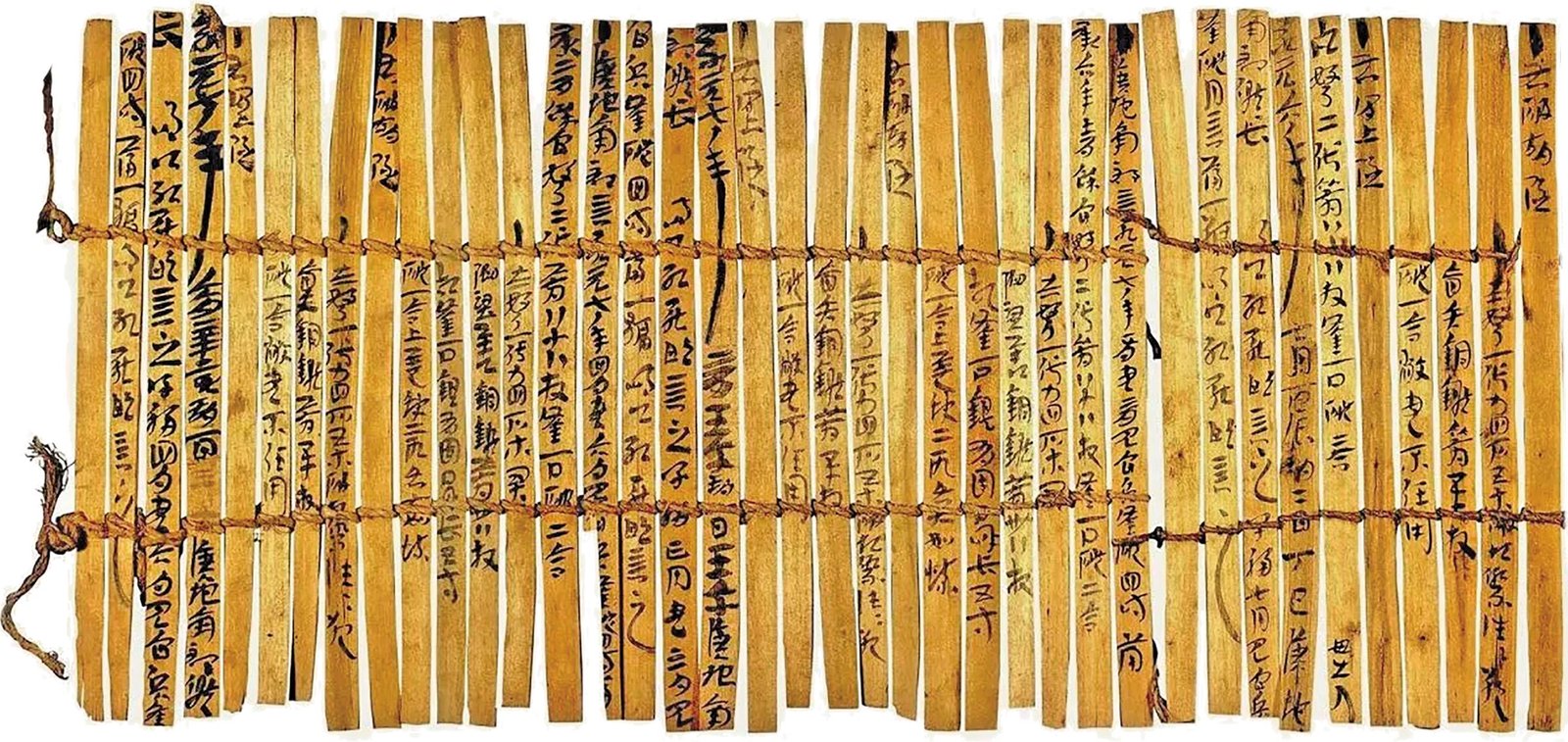
The second came in 1973, when two silk manuscripts of the Laozi — known as versions A and B — were unearthed from Mawangdui Tomb No. 3 in Changsha, Hunan, dating to around the end of the Qin dynasty and the start of the Han.[6] Curiously, the silk manuscripts put the section on Virtue before the section on the Way — the reverse of the order we know today. The "Way first, Virtue second" arrangement we take for granted may simply have been an editor's later choice, not the original shape.
Taken together, the two finds tell a simple fact: this book never had a fixed text. It is like a river — every age it flows through carries away a little silt and deposits something new. Even the opening line, "The Tao that can be told is not the eternal Tao," does not appear in the Guodian slips; the place it occupies at the very beginning was probably only fixed when the text was compiled later.[5] The first sentence of the book may itself have been added by later hands. There is something deeply Laozi about that: a book with no author whose opening was not even original.
And that is precisely why it survived. A finished classic is left behind by its age; an unfinished text can be reinterpreted again and again. In the third century CE, Wang Bi wrote his commentary on it and established the basis of the received text;[9] every dynasty since has produced its own commentaries, and every age has read into it what it wanted to find. It is not a book. It is a container.
Chapter FiveThe Wisdom of Doing Less
If the Tao Te Ching could be reduced to one sentence for the modern reader, it would be this. Chapter 9 says: "When the work is done, step back — that is the way of heaven."[2]
What makes this so hard? The moment of success is exactly the moment when no one wants to step back. An entrepreneur who has just taken his company public is at his most convinced that he can do no wrong; an investor who has made money for three years running is at her most certain that she has the market figured out; a team that has just won a hard battle is at its most eager to press the advantage. Success manufactures an illusion: since it worked this time, it will work next time; since this method is effective, use it forever.
The Tao Te Ching sees straight through that illusion. Chapter 33 says: "To know others is cleverness; to know oneself is wisdom."[2] Knowing others is smart; knowing yourself is wise. And the hardest self-knowledge of all is knowing when to stop. The most devastating losses in the market almost never happen when a judgement is wrong — they happen after a judgement is right: money is made, the bet is doubled, and then everything goes to zero in one move. The worst infighting in an organisation does not happen in failure either, but after success — credit must be divided, positions must be fought over, and people who fought side by side yesterday begin watching each other today.
"When the work is done, step back" does not mean giving up. It means telling the difference between what was your doing and what was the doing of the times. Chapter 2 says: "It gives birth to all things but does not possess them; it acts but does not claim credit; when the work is done, it does not linger. It is precisely because it does not linger that it is never lost."[2] Give life without owning it, do the work without clinging to it, finish and walk away — and because you do not cling, nothing is taken from you. Set down in today's workplace, in today's market, in any place where fame and fortune are counted, that sentence lands like a slap: the tighter you grip the credit, the faster it leaves you; let go, and the reputation stays.
Doing less does not mean doing little; it means doing precisely. Not competing does not mean losing; it means choosing a different contest. Stepping back is not running away; it is leaving yourself room to see the whole board. In an age when everyone is doubling down, the refusal to double down is itself a rare ability.
EpilogueThe Word That Cannot Be Spoken
The easiest mistake after reading the Tao Te Ching is to think you have learned a method: yield in conflict, refuse to compete, walk away from opportunity. But Laozi says the opposite: the Tao is not a method. Methods can be copied; the Tao cannot. Chapter 47 says: "Without going out of doors, one can know the whole world; without looking through the window, one can see the way of heaven."[2] This is not advice to stay indoors. It is a claim that the things that matter most were never out there waiting to be seized.
The most honest thing about this book is that it admits its own incapacity from the start. "The Tao that can be told is not the eternal Tao" — whatever I am about to say, the moment it is said, it is no longer the thing itself. This is not mystification. It is the deepest suspicion of language ever written. Language can name, classify, and define, but what it names is always the shadow of the thing. The Tao is what moves behind the shadow: you can feel it, but you cannot hold it.
So Laozi wrote a book destined to fail: words, used to hold something words cannot hold. And it fails so gracefully that more than two thousand years later, the whole world is still repeating that failure, translation after translation — well over a hundred versions in English alone, and more than 250 in Western languages altogether.[7][10] Every translation is a new misreading; every misreading keeps the book alive a little longer.
Perhaps that is its real wisdom: to accept failure, to accept that some things cannot be said clearly, to accept that some tasks can only be half done. A person who can admit "I do not know" travels farther than one who is certain he knows. A book that can admit "I cannot say this clearly" outlives books that claim to have it all worked out.
More than two thousand years ago, someone — or some people — wrote about 5,000 words on bamboo slips and then disappeared from history. They left no name, no portrait, no solid evidence of any kind. They left a single sentence at the head of the book, like a door with no gate: "The Tao that can be told is not the eternal Tao."[2] You cannot push it open. You can only stand outside and listen to what moves within. And standing outside, listening — that is, in the end, everything this book has to teach.