PrologueThe Noise in the Sky
In the spring of 1965, on a hill in Holmdel, New Jersey, two Bell Laboratories researchers were losing a fight with a 6-metre horn antenna. Arno Penzias and Robert Wilson had pointed it in every direction, and no matter where they looked, a faint signal refused to go away — an excess noise of about 3 K that no calibration could explain.[5] They cleaned out the pigeon droppings, replaced parts, and checked everything twice. The noise stayed. Only later did anyone understand: they were not listening to a broken instrument. They were listening to the leftover warmth of the birth of the universe.
This is the story of how that noise stopped being an engineering nuisance and became evidence for the origin of the cosmos — and of how, 38 years earlier, a Belgian priest had already written down, in a French paper almost nobody read, that the universe had a beginning.
Chapter OneThe Priest's Equation
In 1927, Georges Lemaître published a paper in the Annales de la Société Scientifique de Bruxelles under the French title "Un Univers homogène de masse constante et de rayon croissant rendant compte de la vitesse radiale des nébuleuses extragalactiques".[2] Lemaître was a Belgian Catholic priest who was also a fully trained physicist and astronomer. Its conclusion bordered on heresy: the universe is not a fixed stage; it is expanding, and galaxies recede from one another at speeds proportional to their distances.
Physicists at the time believed in an eternal, static universe. In 1917 Einstein had even added the cosmological constant to his equations for the sole purpose of holding the universe still. Lemaître's paper was written in French and printed in a Belgian provincial journal; almost nobody noticed it.[2] Two years later Hubble published a similar conclusion, and the fame went to Hubble.
Lemaître did not stop at expansion. He ran the film backwards: if the universe is expanding today, it must have been smaller, hotter and denser in the past. In 1931 he published a note of just 457 words in Nature, proposing that the universe began as a "primeval atom" — all matter and energy once packed into a single tiny quantum, which then burst apart.[1] He called it the primeval atom hypothesis; others later called it the Cosmic Egg.
It is worth pausing here. A priest talking about the beginning of the universe sounds like theology. But Lemaître drew the line more sharply than anyone: he insisted that a physical beginning is not the same as a theological creation. Science answers how, not why. He refused to let his theory be used as evidence for faith, and refused to let faith interfere with his calculations. That restraint is part of why his theory could eventually be accepted as science.
Yet in the 1930s almost nobody took the primeval atom seriously. A universe with a beginning meant time itself had a beginning — not just a physics problem, but a psychological one, for a profession accustomed to an eternal cosmos.
Chapter TwoThe Galaxies Are Fleeing
In 1929 the American astronomer Edwin Hubble published a paper in the Proceedings of the National Academy of Sciences. Studying 46 galaxies, he found that the speed at which a galaxy recedes from Earth is proportional to its distance: the farther away, the faster it flees.[3] His value for the constant of proportionality — about 500 km/s per megaparsec — was, by modern standards, wildly wrong, because his galaxy distances were on average 7 times too small.[3] But the proportionality itself was right.
The plot became known as the Hubble diagram, the first observational evidence for an expanding universe. In 1931 Einstein abandoned the static universe.
But Hubble himself never accepted the inference that the universe had a beginning. He measured the expansion and refused to discuss the starting point. The history of science is full of such divisions of labour: the person who makes the decisive measurement is not always the one willing to push the conclusion to the end, and the one willing to push it often has no measurement to stand on. Lemaître had the theory without the data; Hubble had the data without the theory. Between them lay the hardest step in the formation of scientific consensus: stitching mathematics, observation and imagination into a single story.
In 2018 the International Astronomical Union formally renamed "Hubble's law" the "Hubble–Lemaître law" — a correction 91 years late.[10]
Chapter ThreeThe Forgotten Prediction
In 1948, Ralph Alpher, a student of George Gamow, calculated in his doctoral dissertation that if the universe had once been hot and dense, the leftover heat of the Big Bang should still be around today, bathing the whole sky in microwaves at a temperature of about 5 K.[4] Alpher and Robert Herman published the prediction in Nature. Later textbooks often credited it to Gamow, but the detailed calculation was Alpher and Herman's.[4]
The prediction was published — and nobody went looking for it. Seventeen years passed, and physics had all but forgotten it.
Meanwhile the opposition offered a more comfortable alternative. In 1948, Hoyle, Bondi and Gold proposed the steady-state theory: the universe has no beginning and no end; as space expands, new matter is continuously created, so that on the largest scales the universe always looks the same. The theory was elegant and symmetrical, and it required no unimaginable starting point. On 28 March 1949, Hoyle, trying to distinguish the two theories on a BBC radio broadcast, casually used the phrase "big bang" — and the name stuck to the very theory he was arguing against.[9]
Whether a theory survives is never only a question of whether it is right; it is also a question of whether it is comfortable. The steady-state theory was comfortable: with no beginning, there is no awkward question about what came before the beginning. The Big Bang was uncomfortable: it asked you to accept that time, space, matter and energy all had a starting point. In the 1950s most astronomers preferred the comfortable side.
Chapter FourPigeon Droppings and 3 K
Back to Holmdel in 1965. The noise Penzias and Wilson measured was equally strong in every direction, unchanged by the seasons, indifferent to where the antenna pointed.[6] They even climbed inside the antenna and cleaned out the droppings left by a pair of pigeons — jokingly called "white dielectric material" — and the noise remained.
Earlier that year, Robert Dicke, Jim Peebles, Peter Roll and David Wilkinson at Princeton had been building an antenna specifically to search for this radiation. When they heard about the strange noise at Bell Labs, they understood at once: this was the relic radiation Alpher and Herman had predicted in 1948. In July 1965, two papers appeared side by side in the Astrophysical Journal — one reporting the measurement, one explaining it.[5]
The measured temperature, about 3 K, was in the same ballpark as the predicted 5 K. From that day on, the steady-state theory had nowhere left to stand: an eternal, unchanging universe leaves no uniform afterglow spread across the whole sky. Penzias and Wilson received the Nobel Prize in Physics in 1978.[5] Alpher and Herman did not; Alpher's prediction had to wait until 2005, when he received the US National Medal of Science, for belated recognition.
Scientific consensus rarely turns because one side wins a debate. It turns because of a measurement. The steady-state theory was not argued down; it was eliminated by a noise that nobody could clean away.
Chapter FiveA Photograph of the Infant Universe
If the cosmic microwave background really is the afterglow of the Big Bang, it should not be perfectly uniform: the tiny initial ripples are the seeds from which galaxies and clusters later grew. On 23 April 1992, the team behind NASA's COBE satellite announced that they had measured temperature fluctuations in the background, just one part in 100,000 of the total.[7] The announcement turned the Big Bang theory from the most promising hypothesis into the standard model.
COBE also pinned the average temperature of the background at 2.726 K and confirmed that its spectrum is an almost perfect blackbody.[7] John Mather and George Smoot shared the 2006 Nobel Prize in Physics for the work.[7]
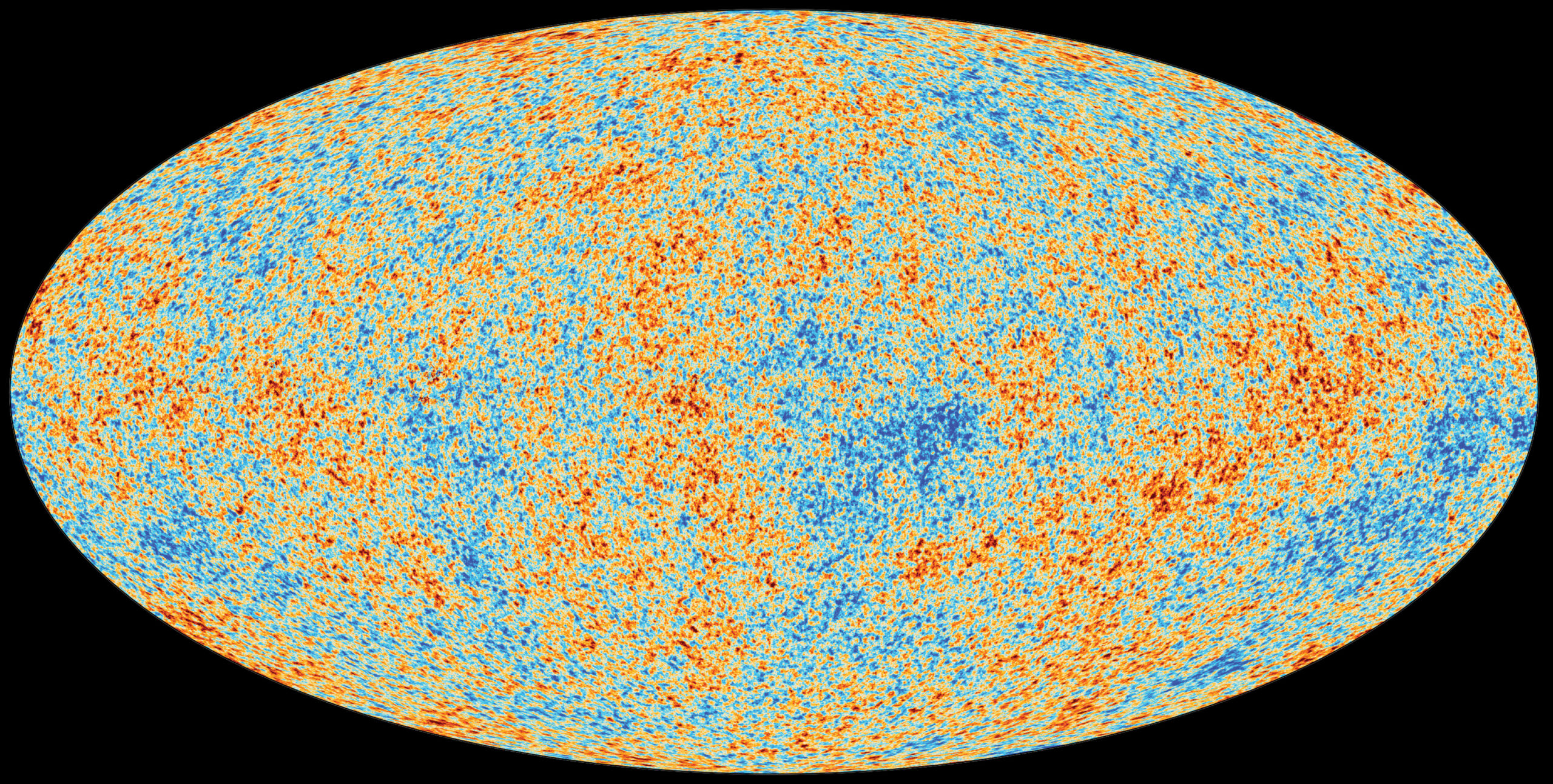
Over the following decades, WMAP and the Planck satellite photographed the infant universe in ever sharper detail. Planck's 2018 data put the age of the universe at 13.787 billion years, with an uncertainty of only 20 million years; the expansion rate — the Hubble constant — at about 67.4 km/s per megaparsec; and the temperature of the background at 2.725 K.[8] The numbers fit together into a single self-consistent picture: a universe that began 13.787 billion years ago in a hot, dense state and is still expanding.
The background light was released about 380,000 years after the beginning, when the universe had cooled enough for atoms to form and light could finally travel freely. Every microwave we measure today has been travelling for more than 13.7 billion years before reaching our instruments.
EpilogueHow We Know
The triumph of the Big Bang was not a single flash of insight but a relay race that ran for 91 years. In 1927 a priest wrote down the equations of expansion; in 1929 an astronomer measured the expansion; in 1948 two young men predicted the leftover heat; in 1965 two engineers stumbled on it while cleaning pigeon droppings; in 1992 a satellite photographed the infant universe; in 2018 another satellite dated the universe to two decimal places.
What is most worth remembering may not be the numbers but how the institution treated dissent. Lemaître was ignored not because his mathematics was wrong but because his conclusion was unsettling; Alpher was forgotten not because his calculation was wrong but because his name was not famous enough; Penzias and Wilson won the prize not because they were the cleverest but because they refused to let go of a noise that would not go away. Scientific consensus never forms because truth wins automatically; it forms because a chain of uncompromising measurements slowly squeezes comfortable errors out.
The universe still holds unanswered questions. In the late 1990s astronomers discovered that the expansion of the universe is accelerating, driven by something still unknown; dark matter and dark energy, which make up most of the cosmos, have names but no known faces. The Big Bang theory does not answer everything — it pushes the questions deeper, and that is precisely why it deserves trust. An honest theory knows where its boundaries lie.
13.787 billion years ago, the universe began from a single tiny point. 13.787 billion years later, creatures on an ordinary planet built instruments and measured their own birthday. Knowing where we come from does not make us small. On the contrary, it makes every glance upward feel like reading a letter addressed to us, 13.787 billion years late.