PrologueThe Last Postcard
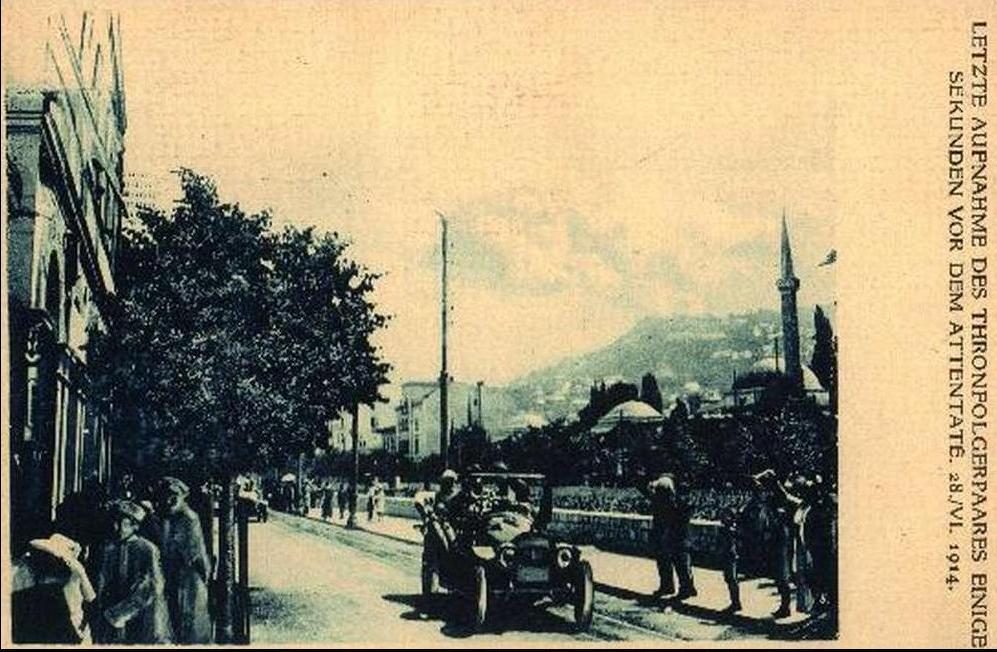
On the morning of Sunday, 28 June 1914, the sun shone kindly on Sarajevo. An open car rolled along the riverfront avenue carrying the heir to the Austro-Hungarian throne and his wife. Minutes later, two shots rang out, and the old world began its countdown.
The photograph survives: Archduke Franz Ferdinand in a white uniform, Sophie in a wide-brimmed hat, sitting side by side in the back seat, smiling at the camera. They did not know it was their last photograph. They did not know that minutes after it was taken, a 19-year-old would step out from a street corner and aim a pistol at them.[2] History is like that sometimes: it does not knock, it does not warn. It simply pushes a door open on a sunny Sunday morning.
We like to explain the war as a chain of inevitabilities — the alliance system, the arms race, nationalism, imperial greed. None of that is wrong, but none of it is complete. Europe in the summer of 1914 was not a machine running out of control; it was living people — afraid, proud, misjudging, cheered on by crowds — walking themselves, step by step, into the abyss. This book is about those steps.
Chapter 1Two Shots
28 June was St. Vitus's Day, the day Serbs commemorated the Battle of Kosovo. That the Archduke and his wife chose this day to inspect military manoeuvres in Sarajevo was itself a provocation — or an oblivious kind of arrogance. Six young assassins waited along the motorcade route. They belonged to Young Bosnia, backed by the Serbian secret society known as the Black Hand, and their aim was to tear Bosnia away from Austria-Hungary.[2]
Bosnia had been Ottoman land until Austria-Hungary formally annexed it in 1908. Young Serbs in the province never accepted that: in Belgrade they read banned books, practised with pistols, and dreamed of a single South Slav state. Princip was one of them — 19 years old, quiet, convinced that an assassination could wake a nation.[2]
At 10:10 in the morning, the first bomb was thrown at the motorcade. It bounced off the folded roof of the Archduke's car and exploded beneath the following vehicle, wounding 20 people. The Archduke and his wife were unhurt, and they carried on to the town hall as planned. After the ceremony, the motorcade changed course to visit the wounded in hospital — but the driver took a wrong turn and reversed the car near the Latin Bridge, stopping directly in front of Gavrilo Princip. Princip drew his pistol and fired twice at close range: the Archduke was hit in the neck, Sophie in the abdomen. Sophie died in the car; the Archduke died shortly afterwards at the governor's residence.[2]
Two shots, two lives. Princip was 19, too young under Austro-Hungarian law to be executed, and was sentenced to 20 years in prison. He probably believed he was firing for the freedom of a nation. He had no idea that within six weeks his two shots would drag the whole of Europe into war. Assassins often believe they are rewriting history; history never follows an assassin's script.
The death of an imperial heir on a public street could have remained a murder, a trial, a diplomatic incident. What turned it into a world war was not the two bullets, but every decision made in every capital over the five weeks that followed.
Chapter 2July: A Month's Walk into the Abyss
Austria-Hungary had long wanted to teach Serbia a lesson, and the assassination handed it the excuse. On 5 July, Kaiser Wilhelm II promised Vienna that Germany would support whatever Austria-Hungary did — the famous "blank cheque." With that cheque in hand, Vienna no longer needed restraint; it needed only an ultimatum Serbia could not accept.[3]
On 23 July the ultimatum reached Belgrade: 10 demands, 48 hours to answer. Serbia accepted 9 of them, holding out only on the demand that Austro-Hungarian officials be allowed to investigate inside Serbia — because accepting that would have meant giving up sovereignty. Vienna was waiting for exactly that "no." On 28 July, precisely one month after the assassination, Austria-Hungary declared war on Serbia.[3][8]
Then the dominoes fell — but dominoes do not fall by themselves; people push them, one by one. On 30 July, Russia ordered general mobilisation to protect Serbia; on 1 August, Germany declared war on Russia; on 3 August, Germany declared war on France and invaded neutral Belgium; on 4 August, Britain declared war on Germany over Belgium. From two shots to a war engulfing all of Europe: 37 days.[3][8]
It is worth noting that the war was not pushed forward by generals and diplomats alone, but by newspapers and crowds. The European press of 1914 competed to inflame patriotic feeling, portraying compromise as cowardice and restraint as betrayal, while crowds in the streets treated war as a festival. In such an atmosphere, any leader who wanted to apply the brakes first had to defy his own people. That is the most dangerous thing about crowd psychology: it lets everyone believe they are merely following public opinion.
The most sobering question is not who fired first, but why nobody applied the brakes. Every capital believed it was merely "responding"; nobody believed it was "starting" a war. Germany's war plan demanded France be beaten before Russia, and once mobilisation timetables began, they could not be stopped; diplomats were still talking while trains were already carrying soldiers to the frontiers. When the gears of a system begin to turn, human will becomes a supporting actor.
Chapter 3Home by Christmas
In August 1914, the capitals of Europe fell into a strange euphoria. In London, Paris, Berlin, Vienna and St. Petersburg, crowds poured into the streets to cheer, young men rushed to enlist, as if war were a long-awaited festival. Newspapers said they would be home by Christmas; generals promised a "short and glorious war." Nobody imagined what was waiting for them was four years of mud.
The scale of the war machine is visible in the mobilisation figures alone: Russia called up 12 million men, Germany 11 million, France 8.4 million, the British Empire 8.9 million. These were not abstractions — they were 65 million sons, husbands and fathers, uniformed, numbered and put on trains within weeks.[1]
German armies swept through Belgium under the Schlieffen Plan, driving towards Paris — until the British and French halted them at the Marne in early September, and the dream of a quick victory shattered. Both sides raced north to outflank each other, and in the end they dug a line of trenches running hundreds of kilometres from the Swiss border to the North Sea. From then on, the war stopped moving. All that remained was stand-off, shelling and attrition.
At Christmas 1914, on parts of the Western Front, British and German soldiers stopped firing on their own initiative, climbed out of their trenches, exchanged cigarettes and food, and even played football in no man's land. It was the gentlest moment of the whole war — and the cruellest. It proved that the men in the trenches had no wish to kill each other; but once war had been handed to the machinery of the state, individual goodwill could no longer steer its course. When the truce ended, the guns resumed — and they did not fall silent for four years.
Chapter 4Four Years in the Mud
Trench warfare turned war into an industrial slaughterhouse. 1916 was the peak of attrition: at Verdun, from February to December, the two sides suffered some 976,000 casualties over a fortress of almost no strategic value; at the Somme, from July to November, casualties reached about 1.22 million — and on the first day alone, 1 July, the British Army suffered 57,470 casualties, the bloodiest day in its history.[4][1]
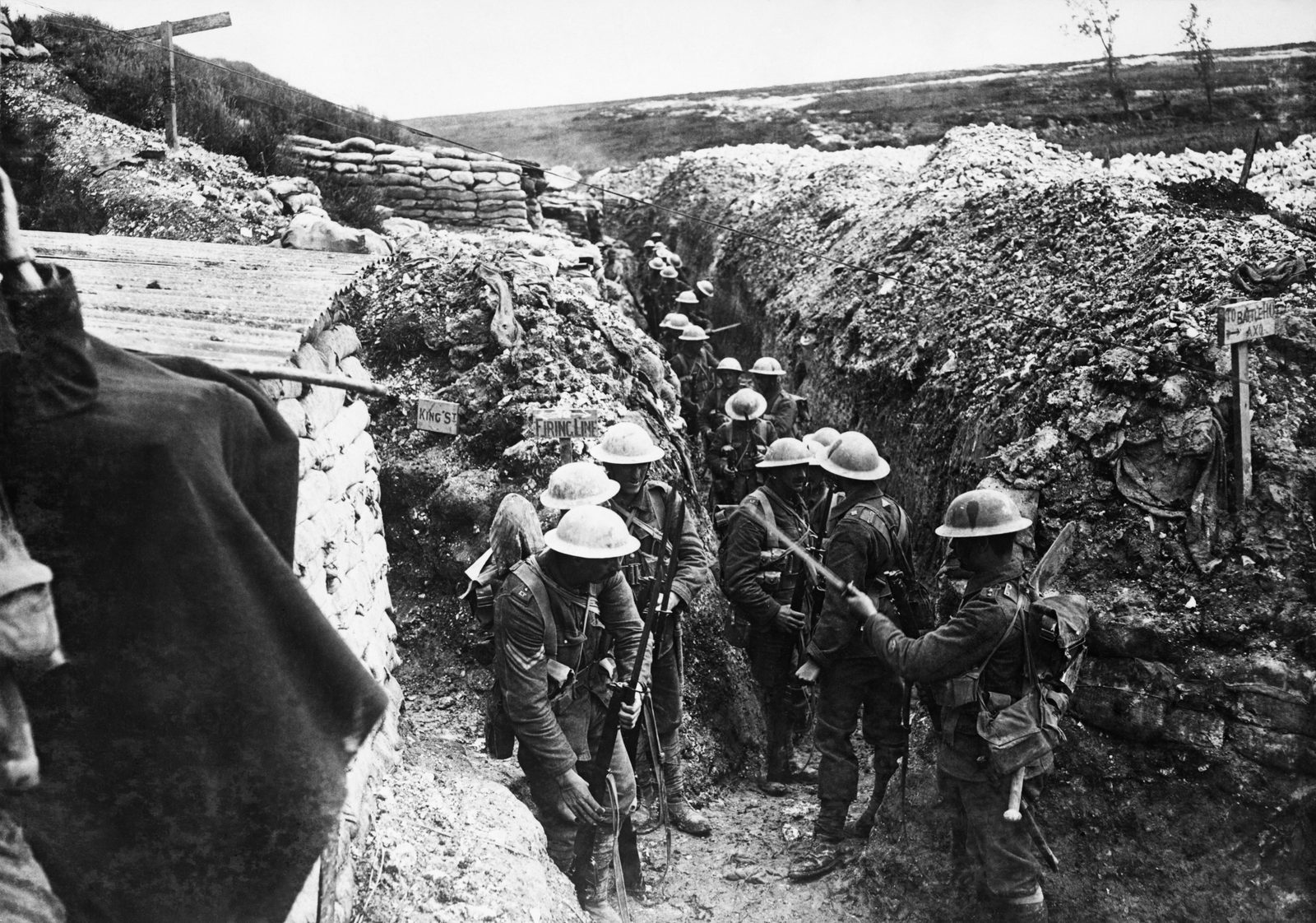
Poison gas, machine guns, tanks, heavy artillery — new weapons made killing efficient, and made the war long. Each side believed that one more push, more men, more shells would break through; each time it proved wrong, and each time someone was willing to try again. That is the most terrible thing about a war of attrition: it does not end in victory, but when one side has bled dry first.
Behind the numbers were people. The war mobilised some 65 million men; about 9 million soldiers died, and with roughly 7 million civilians killed by fighting, famine and disease, the total dead reached about 16 million. Another 21 million were wounded, and countless families were left with an empty chair.[1][4]
What deserves remembering is that these numbers were not a natural disaster; they were man-made. Every body at Verdun and the Somme corresponds to a decision held firm in some headquarters, a misjudgement made in some meeting. The cruellest truth of war is not found on the battlefield, but in the conference room.
Chapter 5The Twilight of Empires
In 1917, the war began to come apart, first in the east. Revolution broke out in Russia, the Tsar abdicated, and the new government made a separate peace with Germany and left the war. In the same year, Germany's unrestricted submarine warfare dragged the United States in: on 6 April 1917, America declared war on Germany, and fresh troops and supplies began pouring into Europe.[5]
In the spring of 1918, Germany launched its last great offensive; it gained ground at first, then ran out of strength. From August, the Allies' Hundred Days Offensive pushed the German line back until it collapsed altogether. Bulgaria signed an armistice on 29 September, the Ottoman Empire on 30 October, Austria-Hungary on 3 November. On 9 November, Kaiser Wilhelm II abdicated; at 11 a.m. on 11 November, the armistice took effect in a railway carriage in the Forest of Compiègne.[6][5]
The irony is that 2,738 men still died on that final day — killed in a war that was already over, simply because the order said the guns would stop at 11 o'clock.[6]
The price was not paid only at the front. The blockade left German civilians hungry; the fighting turned villages in Belgium and Serbia to ash; and in 1918 an influenza pandemic travelled the world aboard troopships, taking countless more lives beyond the battlefield. The line between soldier and civilian blurred for the first time — and that was the beginning of modern war.[1][5]
When four years of fire ended, four empires were gone: the German, Austro-Hungarian, Russian and Ottoman empires had all collapsed. The map was redrawn and new states appeared one after another: Poland, Finland, Czechoslovakia, Yugoslavia. The old world was not defeated; it was hollowed out.[5][7]
EpilogueThe Old World Had No Funeral
On 28 June 1919, the Treaty of Versailles was signed in the Hall of Mirrors — exactly five years after the shots in Sarajevo. Germany lost about 13 percent of its territory and all of its overseas colonies, its army was slashed, and it was saddled with heavy reparations; Article 231 declared Germany wholly responsible for the war. Peace had come, but inside the peace were buried the seeds of the next war.[7]
The League of Nations was founded — humanity's first attempt to replace the arms race with collective security. But the League had no army, and no United States: the American Senate refused to join an organisation its own president had proposed. The ideal was sound; the execution was not. Twenty years later, a greater war proved it.
Looking back at 1914, the most unsettling thing is not the two shots, but every "rational" decision that followed them. Every decision-maker had reasons: honour, alliance obligations, national security, domestic pressure. Each reason, taken alone, seemed perfectly reasonable; together, they added up to catastrophe. That is the deepest lesson of the First World War: disaster rarely comes from madmen. More often it comes from ordinary people who, pushed along by institutions and emotion, walk step by step towards an ending none of them wanted.
Two shots killed two people; four years of war killed about 16 million. That photograph from a Sarajevo street still reminds us: history's turning points are never abstract. They always happen on some sunny morning, on some ordinary street, at a moment when everyone believes tomorrow will be just like today.[1]