PrologueA Saturday in November
On Saturday, November 14, 2026, Bitcoin fell below $62,000 at one point — the first time since mid-July.[3] For the month it was already down 17%, with six straight weekly losses; U.S. spot Bitcoin ETFs had logged seven consecutive sessions of net outflows totaling about $1.91 billion, and roughly $2 billion of leveraged positions were liquidated in a single day.[3][4] From its high of nearly $126,000 in October 2025, it had lost about half its value.[4]
If you only look at that Saturday, Bitcoin looks finished. On social media, some were calling the bottom and others were calling it zero, both sides shouting. But step back a little, and the scene looks familiar — not once, but five times. Over the past 15 years, Bitcoin has died every few years; each time someone wrote its obituary, and each time it survived. This book tells the story of those five winters: how they began, how they ended, and why each one looked like the last.
Chapter OneThe First Winter
The story begins with a financial crisis. On October 31, 2008, six weeks after Lehman Brothers collapsed, a person calling themselves Satoshi Nakamoto published a nine-page white paper on a cryptography mailing list: Bitcoin: A Peer-to-Peer Electronic Cash System.[1][2] A little over two months later, on January 3, 2009, the first block was mined, carrying that day's headline from The Times: "Chancellor on brink of second bailout for banks."[2] It was a timestamp and a manifesto at once: Bitcoin was born out of distrust of the banking system.
For its first two years, Bitcoin barely had a price. In the summer of 2011 it climbed to $32 for the first time — then fell to $2 within five months, a drop of 94%.[6] The trigger was a hack of Mt. Gox, then the largest exchange: account data leaked, trading was suspended. A market that had just learned to walk fell flat on its face. The same scene played out again in April 2013: Bitcoin topped $229 for the first time, then fell back to $66 within three months, a drop of 71%.[8]
That winter was short, and total. Nearly 20 months later, in February 2013, Bitcoin reclaimed its old high.[6] The first believers learned their first lesson: this thing falls without a floor, but if you do not sell at the bottom, it seems to come back. That lesson would be taught many times over.
Chapter TwoThe Mt. Gox Winter
On November 30, 2013, Bitcoin hit $1,163. Less than three months later, on February 7, 2014, Mt. Gox suddenly halted all Bitcoin withdrawals; weeks later it filed for bankruptcy, saying about 850,000 bitcoins had vanished.[6][7] Around the same time, the People's Bank of China ordered financial institutions to stay away from Bitcoin. The price slid all the way down, reaching $152 on January 14, 2015 — about 87% below the peak.[6]
This winter lasted much longer. The exchange was gone, the regulators had arrived, the press declared Bitcoin dead. It took nearly three years to reclaim the old high.[6] But in that same winter, Bitcoin got its first real infrastructure: wallets got better, exchanges learned cold storage, and the shape of regulation began to appear. What the winter froze to death were the people who kept their customers' money in the same pocket as their own.
Chapter ThreeThe Shape of a Bubble
2017 was the year Bitcoin became a household topic for the first time. It started the year below $1,000 and hit $19,783 on December 17.[6] ICOs — initial coin offerings — let anyone issue their own currency overnight; thousands of projects flooded in, most of them with nothing but a white paper and a pile of promises.
Then the bubble burst. In early 2018, the Japanese exchange Coincheck lost about $530 million in cryptocurrency to hackers; even the Bitconnect Ponzi scheme collapsed that same year; ICOs dried up, and regulators around the world tightened the screws.[6] By December 15, 2018, Bitcoin had fallen to $3,122, down 84% from the peak.[6] The phrase "crypto winter" entered the language that year.
Reclaiming the old high took nearly three more years.[6] But the mania of 2017 left one thing behind: the whole world now knew the name Bitcoin. A winter can beat a price back to where it started; it cannot take away a name.
Chapter FourHalf Gone in Two Days
In March 2020, COVID-19 swept the globe and every asset fell together. Bitcoin lost about half its value in two days, bottoming at $3,782 on March 13.[6] In that moment it looked less like a safe haven and more like the most dangerous asset of all.
But this winter lasted only nine months. Central banks opened the taps as never before, and Bitcoin set a new high in December 2020.[6] In the spring of 2021 it broke above $60,000; after China announced a mining ban, it fell from $63,564 to $29,787 — a 53% drop in three months.[8] The market thought winter had come again; instead, on November 10, 2021, Bitcoin hit $69,044, another all-time high.[6]
Those two years, 2020 and 2021, played the previous decade's script on fast-forward: panic, money printing, mania, a regulatory crackdown, a new high. The only difference was that this time, the institutions started to arrive.
Chapter FiveThe Year the Dominoes Fell
Between May 7 and 13, 2022, the algorithmic stablecoin UST lost its peg to the dollar, and its sister token LUNA saw its supply explode from 350 million to more than 6 trillion in 72 hours. Both went to zero, and investors lost more than $40 billion.[10] That was the first domino.
Over the next six months, the dominoes fell one after another: the hedge fund Three Arrows Capital entered liquidation on June 27; the lending platform Celsius paused withdrawals on June 12 and filed for bankruptcy on July 13; and on November 11, FTX, the world's second-largest exchange, filed for bankruptcy, its founder having diverted more than $8 billion of customer funds.[10][11] Bitcoin bottomed at $15,476 on November 21, down 77.6% from its 2021 high.[6] In seven months, the entire crypto market lost $2.1 trillion in value.[10]
But this time the recovery came faster. About 16 months later, in March 2024, Bitcoin was back above its old high.[6] The lesson of 2022 was specific: it was never the Bitcoin protocol that failed, but the leverage, the lending and the exchanges built around it. Not a single entry in the on-chain ledger was wrong; the people off the chain were.
Chapter SixWall Street Walks In
On January 10, 2024, the U.S. Securities and Exchange Commission approved 11 spot Bitcoin ETFs; trading began the next day.[9] Something dismissed as a Ponzi scheme 15 years earlier had become an asset you could hold in a retirement account. In their first quarter, the spot ETFs took in about $60 billion — more buying than the new coins being mined.[14] On April 19–20 of the same year, Bitcoin went through its fourth halving: the block reward fell from 6.25 to 3.125 bitcoins, cutting the pace of new issuance in half again.[9]
By the end of 2024, Bitcoin had broken $100,000 for the first time; on October 6, 2025, it reached about $126,000, a new all-time high.[6] From worthless in 2009 to $126,000 a coin in 2025, Bitcoin had walked the whole road from fringe experiment to Wall Street asset.
Then, in the autumn of 2026, the wind changed. Worries about borrowing costs grew, tech stocks began to slide, and on November 12, Nvidia founder Jensen Huang resigned as president, chief executive and director, shaking confidence in the AI trade.[13] Bitcoin fell with the rest — no longer a solo performance, but one instrument in the whole risk-asset market.
Chapter SevenWhat Is Different About This Winter
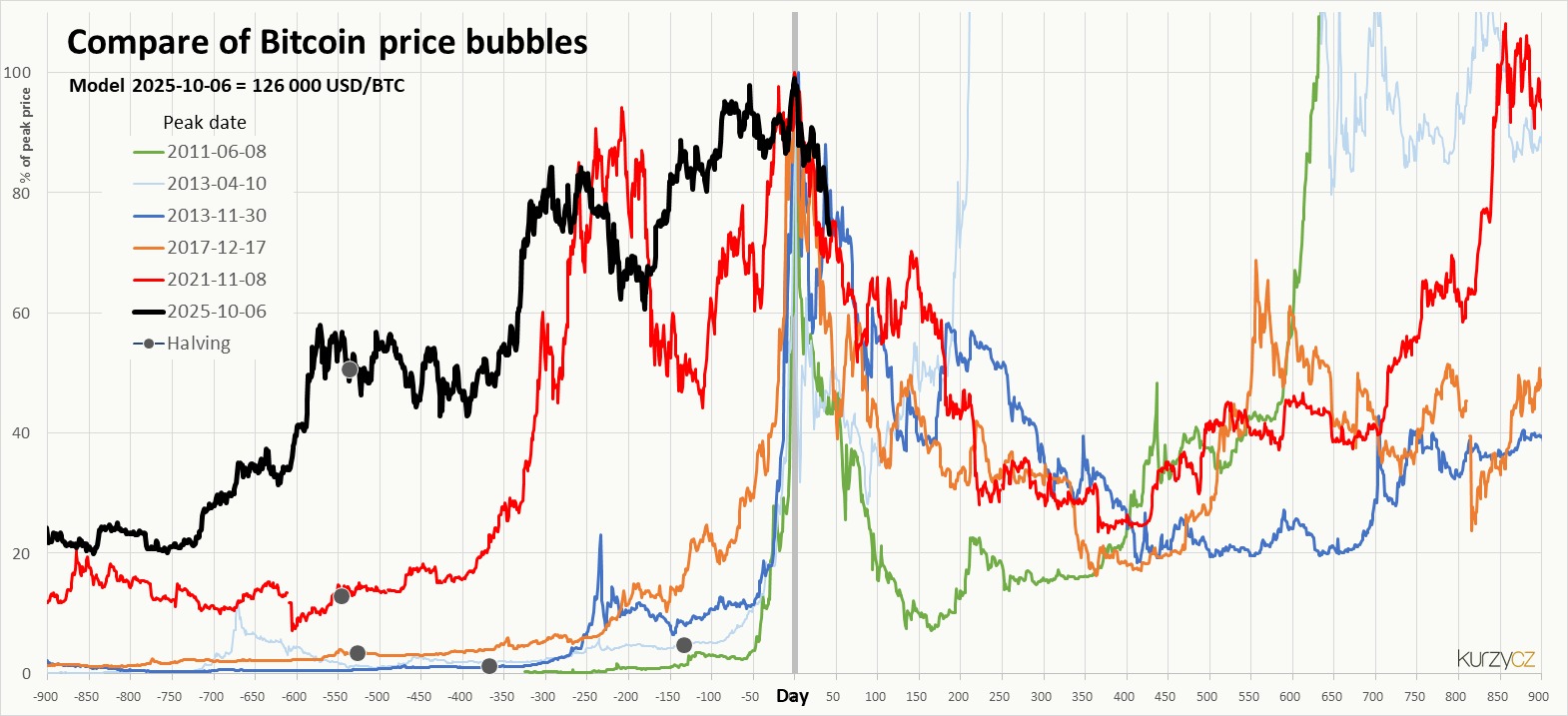
The short answer: by the numbers, the winter of 2026 is not yet the coldest kind. Roughly half off the high is far less than the 77% to 94% of the four great bear markets of 2011, 2013, 2017 and 2022.[4][6] Six straight weekly losses have happened only five times in Bitcoin's history — including this one.[4] In early November, Bitcoin was still above $78,000; for the year to date it is down about 28%.[5] In other words, the size of the fall has not yet caught up with the record books, but the rhythm of it has.
Two things are different. First, selling now has a formal exit: ETFs let institutions sell Bitcoin the way they sell stocks, and $1.91 billion of outflows in seven days is the size of that exit.[3] Second, Bitcoin is no longer alone: this time it is not only the coins falling — tech stocks and metals are falling with them.[3] It is no longer a chip in a fringe casino, but a member of the risk-asset market — falling together when it falls, and perhaps rising together when it rises.
One thing has not changed: in every winter, the market asks the same question — is this time different? And every time, the answer only arrives after the winter is over.
EpilogueWinter Is Bitcoin's Season
Lay the five winters on top of one another and they look astonishingly alike: euphoria pushes the price into the sky, leverage magnifies the rise, something breaks, panic takes over, and then a long silence. The six curves on the chart — 2011, April 2013, November 2013, 2017, 2021, 2025 — trace almost the same shape.[12]
But two things must be said plainly. First, the sample is five — far too small for any claim that "it always happens this way" to be more than an observation, not a guarantee. Second, the cause was different every time: a hack, a collapsed exchange, an ICO bubble, a pandemic, a chain of leveraged failures. The script is the same; the culprit changes.
Bitcoin is 17 years old this year. It has lived through five winters; each time someone said it was dead, and each time it returned to higher ground within a few years. Perhaps winter is not Bitcoin's accident but its season — like the tide: when it comes in, everyone is there; when it goes out, you can see who truly believed and who was only following the crowd. And what the believers have done has not changed since 2011: wait.
Waiting is not doing nothing. Waiting is admitting you do not know how long the winter will last, while believing spring is not a myth. Those who waited in 2011 were rewarded in 2013; those who waited in 2014, in 2017; those who waited in 2018, in 2021; those who waited in 2022, in 2024. Every time, the price of waiting was different, but the direction was the same.