PrologueA Question in November
On Friday, November 13, 2026, Nvidia closed at $162.85. Its closing high of $239.24 on October 6 was less than six weeks earlier; from that high, the stock had fallen about 32 percent. In just five trading days, $573 billion of market value had evaporated, and the company fell below a $4 trillion valuation — the first time since July 2025. Six straight weekly declines, the longest losing streak since 2012.[8]
The same company, five weeks earlier, was the most valuable company on earth, a giant worth about 8 percent of the S&P 500. Five weeks later, the market was asking a different question: is the artificial intelligence boom real, or is it another bubble?
This is not the first time the question has been asked. London asked it in 1720. London asked it again in 1845. The whole world asked it in March 2000. And every time, somebody answered with the same sentence: this time is different.
This book will not answer the question for you directly. A bubble is never a true-or-false question. It is an arithmetic problem: where the money comes from, where it flows, and what happens when it stops. Let us do the arithmetic first, and then decide whether to believe that sentence.
Chapter OneThe Money Loop
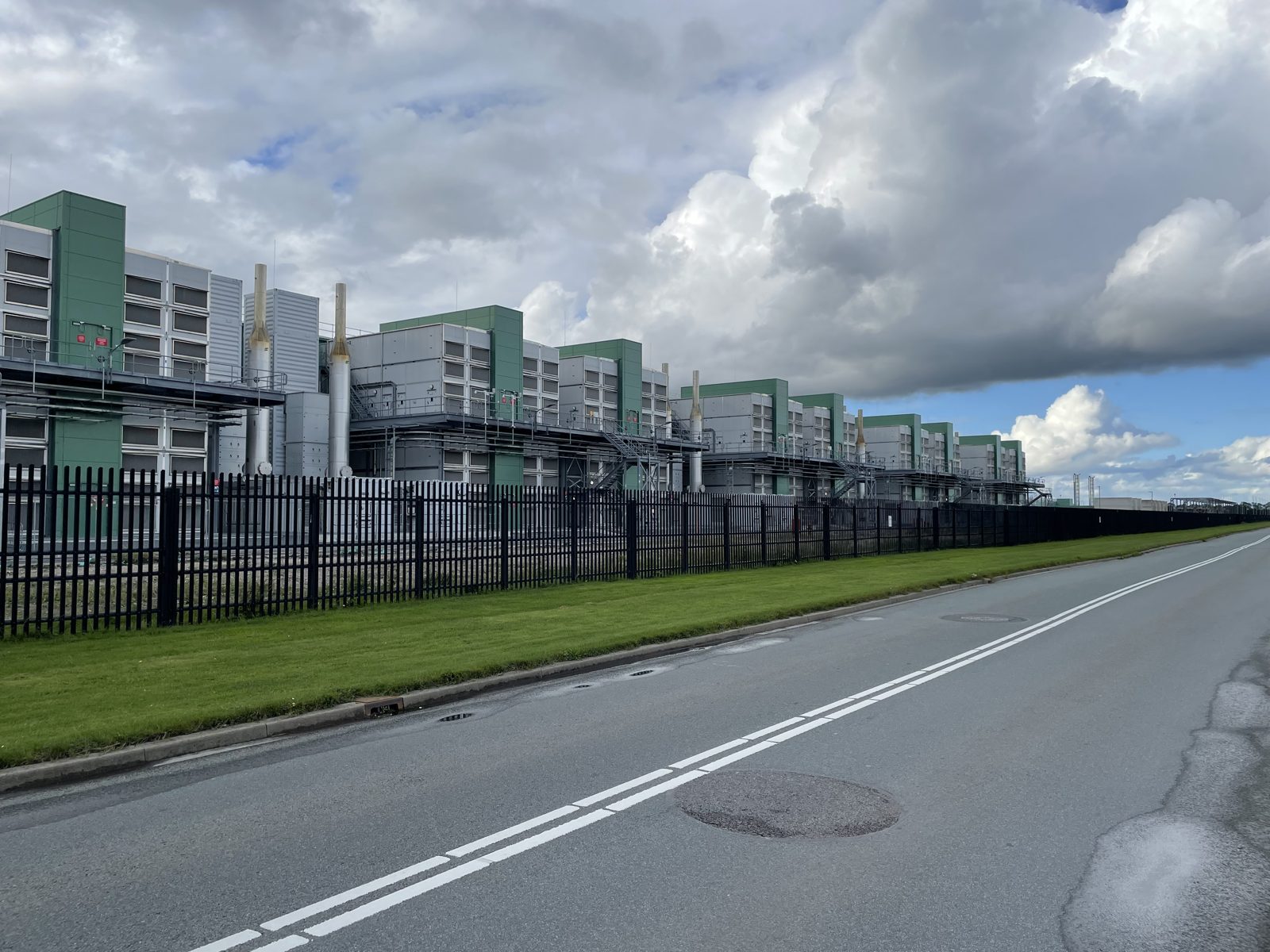
In September 2025, Nvidia announced it would invest up to $100 billion in OpenAI, in exchange for roughly 10 gigawatts of new data-center capacity — filled entirely with Nvidia chips.[1] In February 2026, it put another $30 billion into OpenAI's funding round.[3] In August 2026, it went further, guaranteeing up to $105 billion of financing for OpenAI's campus in Ohio: 4.25 gigawatts to start, 8 gigawatts eventually, a 20-year lease, Nvidia hardware only.[1]
It is not only OpenAI. Nvidia owns about a tenth of CoreWeave, and has agreed to buy up to $6.3 billion of computing capacity CoreWeave cannot sell, through April 2032.[2][3] Broadcom, meanwhile, is lending Anthropic up to $42 billion so it can lease Broadcom chips.[4]
This is what Wall Street calls "circular financing": the people selling the equipment fund the people buying it, and the buyers spend the money back with the sellers. The revenue on the books is real. The demand is real. The money really does go around — it is just that the same dollar shows up in the accounts more than once.
The International Monetary Fund counted the deals in its October 2026 Global Financial Stability Report: at least 14 such transactions since 2023, about $300 billion of equity and $650 billion of debt, tied to $1.4 trillion of future revenue commitments.[4][5] The Bank for International Settlements found something more striking: between 2021 and 2025, 55.2 percent of the money flowing into AI companies came from other AI companies, and in nearly half of the deals, the investor was also a supplier or a customer.[4][6]
Jensen Huang calls this framing "ridiculous."[1] Michael Burry, the protagonist of The Big Short, says the risk of an AI infrastructure bubble is real.[1] The same set of deals, two different movies. The difference is only whether you believe the money loop is an industry's normal blood supply — or a bubble feeding on itself.
Chapter TwoA $730 Billion Bet
Beyond the loop, there is a bigger bill. In 2026, Amazon, Microsoft, Alphabet and Meta — the four big cloud companies — will spend about $730 billion in capital expenditure between them: Amazon about $220 billion, Microsoft about $170 billion, Alphabet $195–205 billion, Meta $135–145 billion.[7] In 2025 the four spent about $410 billion combined — a rise of nearly 80 percent in a single year. Goldman Sachs puts their five-year bill, from 2025 to 2030, at $5.3 trillion.[7]
Where does the money come from? Some of it from profits, some of it from borrowing. Amazon's free cash flow in the first quarter of 2026 was just $1.2 billion, down 95 percent from a year earlier.[7] When a company has to spend $220 billion a year building data centers, cash drains away far faster than the earnings on the income statement.
And the demand side? OpenAI has signed about $730 billion of computing contracts, against an annual revenue run-rate of about $50 billion — the contracts are more than 14 times the revenue.[2] The Bank of Korea's estimate is blunter still: circular deals make up 47 percent of Oracle's cloud backlog and 41 percent of Microsoft's.[4]
The problem is not that the numbers are large. The railways, the internet — the numbers were large every time. The problem is how much of these promises rests on future revenue, rather than on the next round of financing. If the answer is the latter, then every contract signed is waiting for the next person to take the baton.
Chapter ThreeThe South Sea Bubble
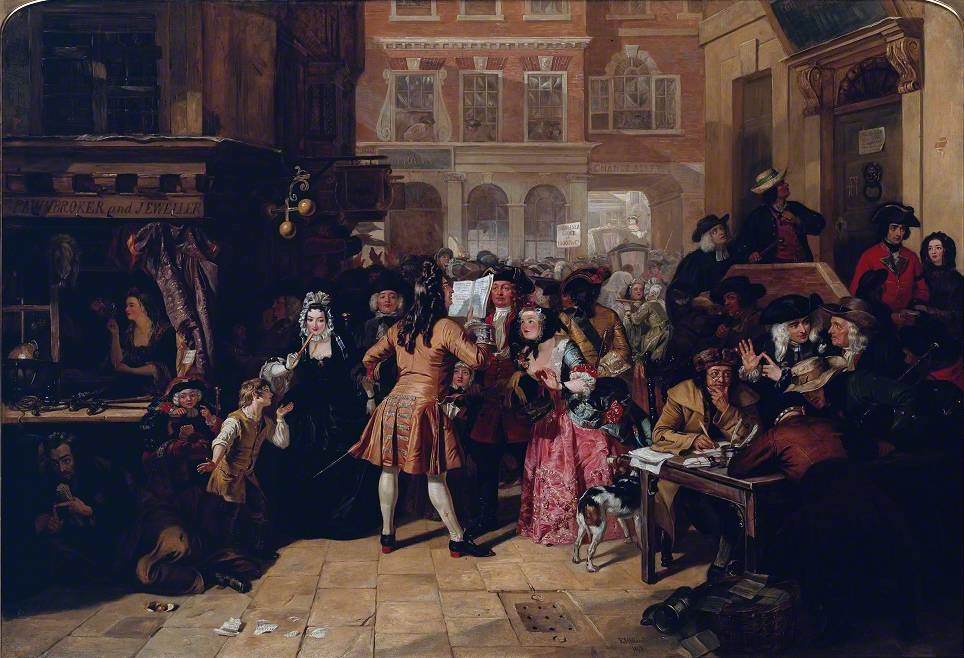
In January 1720, shares in the South Sea Company stood at £128. By early August they had reached £1,000; by the end of September they were back at £150. In less than eight months, the price rose nearly eightfold, then fell 85 percent.[14][15]
The company's official business was a monopoly on British trade with South America. But Britain and Spain were at war for much of the time, and the trade barely existed. Its real business was taking over British government debt, converting it into stock, and then lending shareholders the money to buy more of its own stock — the fuel for the rising price was the company's own lending.[14]
Isaac Newton lost money in it too. He sold early, doubling his money; watched the price keep doubling; bought back in near the top, and ended up losing about £20,000 — roughly £3 million in today's money.[14] A man who could calculate the motion of the heavens could not calculate the madness of crowds.
The lesson of 1720 is simple: a bubble needs no fraudsters. It needs a good story, a company willing to lend, and a crowd afraid of missing out. Whether the story is true does not matter. What matters is whether the money is lending to itself.
Chapter FourRailway Mania
In August 1845, an index of British railway shares peaked at 1,984; by April 1850 it had fallen to 673, a loss of about two-thirds.[12] In 1846 alone, Parliament passed 263 railway acts, and between 1845 and 1847 it authorized some 8,590 miles of new track, against an existing national network of only about 2,000 miles in 1842.[12]
Cheap money lit the fuse. The Bank of England had cut its discount rate to 2.5 percent, the lowest in its 150-year history.[12] Partly-paid shares let middle-class savers subscribe to large holdings for a small deposit — leverage on the way up, and a demand for further payments on the way down. Those who could not pay were forced to sell at a loss.
In October 1845, the Bank raised rates, and Great Western shares fell 40 percent from their August peak within a month.[13] In October 1847, a full commercial crisis broke out, and the government had to suspend the Bank Charter Act of 1844 to let the Bank lend freely.[12] In 1849, George Hudson, the "Railway King," was exposed for paying dividends out of capital and falsifying his accounts.[12]
But the railways themselves survived. The duplicated routes and over-optimistic branch lines that speculators laughed at are, most of them, still running today. The bubble destroyed share prices, not tracks. The technology was real; the price was not. That sentence was true in 1845, true in 2000, and true in 2026.
Chapter FiveThe Dot-Com Bubble
On August 9, 1995, Netscape went public, igniting the dot-com bubble.[10] The Nasdaq Composite rose about 600 percent between 1995 and March 2000, closing at 5,048.62 on March 10, 2000.[10][11] Then it fell for two and a half years, closing at 1,114.11 on October 9, 2002 — down 78 percent, with about $5 trillion of market value erased. It took 15 years, until April 2015, to reclaim the old peak.[10]
At the peak, Cisco, a genuinely profitable company, traded at about 130 times earnings — and its shares still fell 90 percent.[10] Pets.com raised $82.5 million in its February 2000 IPO and was liquidated by November of the same year.[10] Investors who read the trend correctly but bought at the wrong price lost money all the same — and waited 15 years to get it back.
The dot-com bubble was the same play as the railway mania: the technology really did change the world, and the growth rate priced into the shares really was false. After the bubble burst, the internet stayed, the railways stayed, and the only people ruined were the ones who bought at the top. The lesson of 2000 is not "do not believe in the internet." It is "do not pay today's price for profits 15 years away."
Chapter SixWhat Is Different This Time
First, what is genuinely different. In the second quarter of fiscal 2027, Nvidia reported $96.2 billion of revenue in a single quarter, up 105.8 percent year on year, with its data-center business at $89 billion, up 117 percent.[8] Its fiscal 2026 free cash flow was $96.7 billion.[4] This is not the Pets.com of 2000, nor the South Sea Company of 1720 — the chips really are sold, the money really does come in, and customers queue up for hardware, not for the next funding round.
Now, what is the same. A single company, Nvidia, is about 8 percent of the S&P 500[3] — everyone who owns an index fund has made the same bet. More than half of the money in AI companies comes from other AI companies.[6] The biggest customers are simultaneously the biggest shareholders, the biggest creditors, and the biggest landlords. Correlation is the systemic risk of 2026.
A bubble is never about whether the thing is fake. It is about whether the price assumes the future will keep growing at today's speed forever. Nvidia's shares falling 32 percent does not mean AI is fake; Nvidia's revenue doubling does not mean the share price is always reasonable. Both statements can be true at once — and what markets are worst at is believing two contradictory truths at the same time.
Chapter SevenHow to Read a Bubble
Rather than guessing whether a bubble will burst, ask three questions. First, where does the money come from — profits, or borrowing and new share issues? Second, without the financing, would the demand still be there? Third, if growth slows by 20 percent, who runs out of money first?
In 2000, the answers were: the money came from IPOs and debt, the demand came from companies that had not yet made a profit, and when growth slowed, the whole chain snapped. The answers for 2026 are not yet written — but the questions are already on the table: OpenAI's $730 billion of contracts must be paid for out of $50 billion of annual revenue; Nvidia's $105 billion guarantee depends on OpenAI not defaulting for 20 years; four cloud companies spending $730 billion a year must keep their cash flow alive.
Carmen Reinhart and Kenneth Rogoff surveyed financial crises across 66 countries and eight centuries in This Time Is Different, and reached a single conclusion: before every crash, the most expensive sentence in the world is "this time is different."[16]
EpilogueThe Bubble Is Not the Problem. The Price Is.
After 1720, Britain still became a sea power. After 1845, the railway network still covered the country. After 2000, the internet still remade the world. After every bubble burst, the technology stayed. The only people ruined were the ones who bought at the top.
So the question was never "is AI real?" AI is real. The chips are real. The data centers are real. The question is: how many "forevers" are baked into the price you paid?
If the arithmetic of AI ever stops adding up, it will not be AI that falls. It will be the people who paid for ten years of growth all at once. Understanding where the money flows matters more than understanding the technology — because technology decides what the world becomes, and price decides whether you are a winner or a loser in that change.
Questions Without Answers Yet
For honesty, the following have no reliable answers yet, and this book will not pretend otherwise:
- The full terms and triggers of Nvidia's guarantees to OpenAI have not been made public; quarterly filings disclose only part of them.
- Of the $730 billion of computing contracts OpenAI has signed, how much has a fixed payment schedule is not visible from outside.
- Nvidia's earnings on November 17, 2026, have not been reported yet; the numbers may change the judgment in this book.